A New Era: President Anne D’Alleva delivers 2026 State of the University address
Binghamton president shares what’s in store for Binghamton this year and beyond
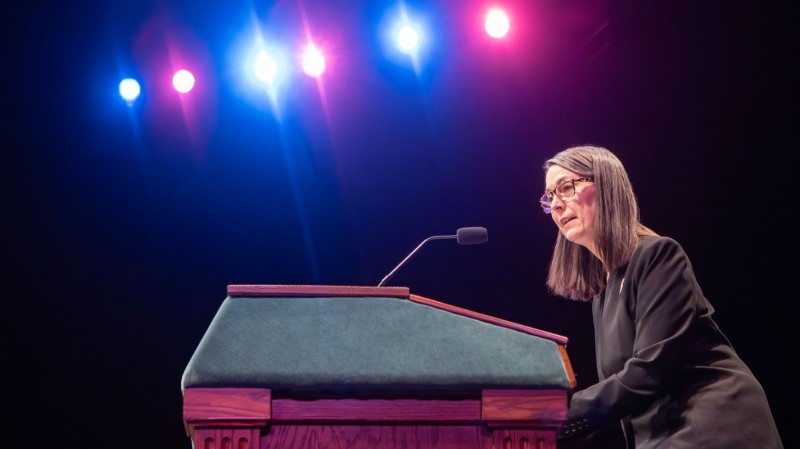
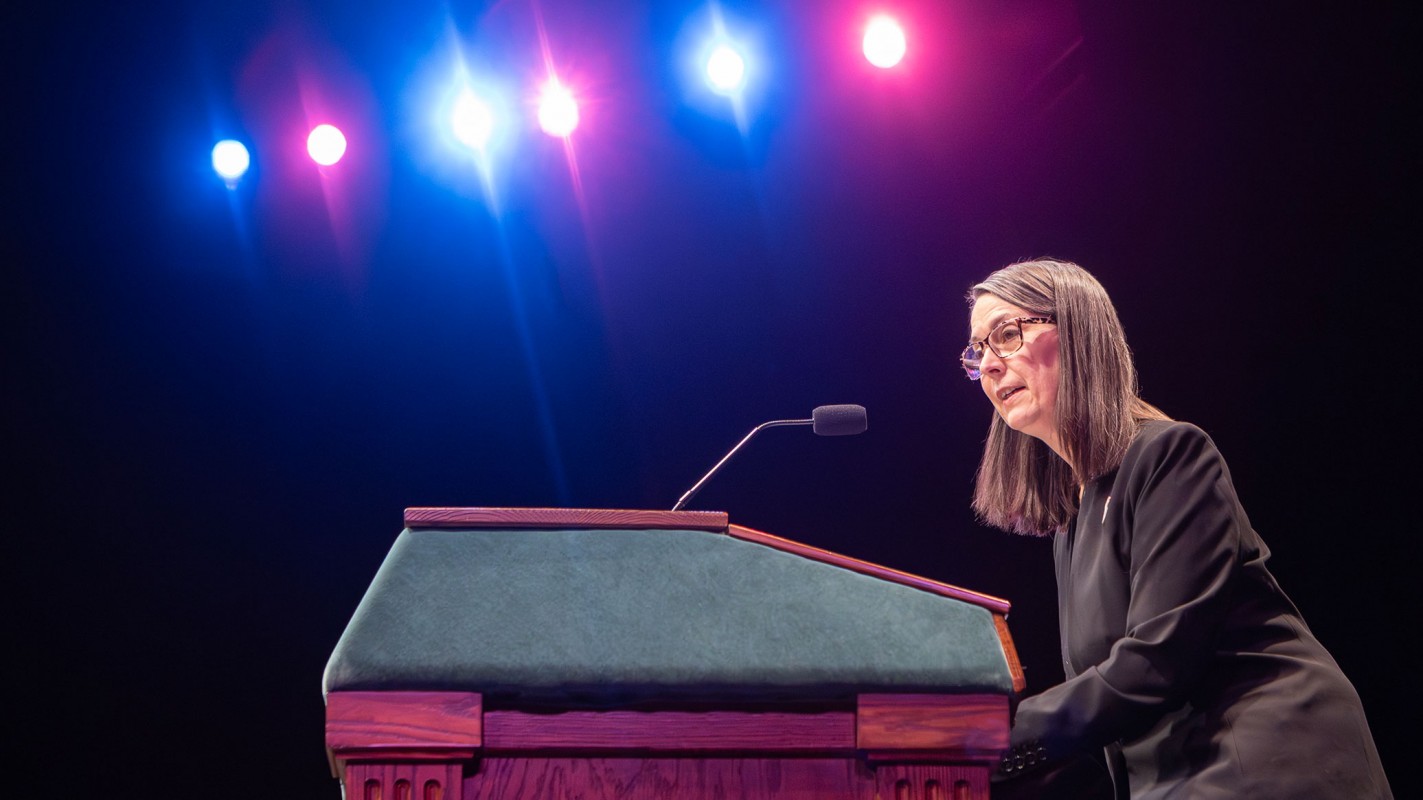
In her first State of the University address, Binghamton University President Anne D’Alleva focused not only on the school’s success over the last year, but also on the future and the potential it brings.
On Friday, Jan. 23, in Watters Theater on the University’s Vestal campus, D’Alleva touched on her Listening to Lead Tour; the strategic planning process; Binghamton’s mission, vision and value statements; and the Binghamton Bond.
“You know what the Binghamton Bond is, even if you can’t quite define it,” D’Alleva said. “It is the spirit that unites all of us — the big, broad Binghamton community — in the work we do to advance learning, teaching, research, service and the commitment to making our world a better place. I have certainly felt what makes Binghamton University so special since I’ve arrived.”
Celebrating 80 years
On Sept. 30, 1946, the first classes were held at Triple Cities College, the predecessor of Harpur College and what is now known as Binghamton University. D’Alleva shared that the University will be celebrating 80 years of history throughout 2026, especially as we get closer to the anniversary date in the fall.
“When I think of Binghamton University, it fits in the great tradition of public higher education in this country, alongside institutions like the University of Virginia, the University of Michigan and UC Berkeley,” she said. “The difference is our 80 years of history, compared to the hundred-plus years of tradition some of our peers have.”
D’Alleva also shared how Binghamton’s history and traditions are significant. Triple Cities College was founded in large part to educate the greatest generation as they returned home from World War II. Leadership, service and providing young people with the opportunity to go out and make a meaningful difference in the world are all in the school’s DNA.
“Despite how Binghamton has grown, it hasn’t deviated from its original mission,” she said. “For 80 years, this place has been driven by giving talented young people the opportunities and resources they need to make our world a better place.”
AI and Binghamton
This January, Binghamton received the largest academic gift in University history, $30 million, to create the New York Center for AI Responsibility and Research.
“It is a first-of-its-kind, independent AI research center at a public university that will focus on responsible AI and advancing it for the public good,” D’Alleva said. “Binghamton has already done tremendous work in AI thanks to our faculty in the Watson College of Engineering and Applied Science. I am extremely proud that this University will lead the nation and the world in ensuring that AI serves for the benefit of all.”
The $30 million gift from Tom Secunda ’76, MA ’79, the co-founder and vice chairman of Bloomberg L.P., is paired with a $25 million capital investment from Gov. Kathy Hochul and the New York State Legislature.
“Tom Secunda is giving back to Binghamton because he has a deep love and appreciation for this place and the role it played in his education and subsequent career,” D’Alleva said. “I thank Tom for this generous gift and I thank New York state and SUNY for investing in Binghamton as a national leader in responsible AI.”
Engaging with the community
Earlier this month, Binghamton University learned it has received a Carnegie classification for community engagement.
Similar to how Carnegie classifies universities for research, and how being an R1 research institution signifies we are among the best in the nation, Binghamton has been recognized nationally for its work in partnering with the community in the mutual exchange of knowledge and resources.
“It is the faculty and students in the College of Community and Public Affairs, Decker College of Nursing and Health Sciences and the School of Pharmacy and Pharmaceutical Sciences providing essential healthcare and services to our neighbors,” D’Alleva said. “It is teaming up with community partners to talk about how climate change will affect Broome County. It is student volunteers working with GiGi’s Playhouse, providing educational and therapeutic programs to individuals with Down syndrome. It is students from the Watson Institute for Systems Excellence helping Kennedy Valve, a fire hydrant manufacturer in Elmira, develop a better powder-coating process. And it is embedding this work and this style of thinking in the curriculum so that all students are experienced in thinking about what they can do to solve problems and serve others.”
Listening to Lead Tour
One of the first things D’Alleva did at Binghamton was her Listening to Lead Tour. Throughout November and December, she met with Binghamton students, faculty, staff, alumni, partners and friends from all across the University as a way to learn about Binghamton and what makes it special.
The Listening Tour blog captured feedback and ideas from the groups that met with the new president. She will continue writing about her experiences on a new blog, From Anne’s Desk, with new entries going up each Monday.
D’Alleva added that several themes emerged from her listening tour.
“These themes showcase what Binghamton does well, where it can improve, and how connected we are across the schools, colleges, divisions, offices and departments that make up this University.” she said.
During the listening tour, D’Alleva asked the audience for one word that describes Binghamton University. Some of the words that came up most frequently were:
- Collaborative
- Community
- Innovative
- Excellence
- Caring
- Supportive
- Opportunity
- Growing
- Welcoming
- Home
“That’s what Binghamton University is,” D’Alleva said. “This is how this community sees itself. So many positive words and so many words that talk about things outside of teaching, learning and research. This is a community of people who truly, genuinely care about one another and are proud of the environment they’ve cultivated.”
She met many different people on her listening tour, many of whom shared stories and experiences at Binghamton that resonated with her: “A staff member in the Division of Research offered a sentiment shared by many, saying, ‘People here are outstanding in how they support each other and deliver for each other.’ This is just one example but you see just how important and established the culture of caring is here.”
D’Alleva also shared a quote from a faculty member in the School of Management: “We have amazing undergraduate students. They are smart, aspiring students, and in combination with our alumni network, they’re doing great things. I think it’s our obligation to make sure they have an amazing campus experience and anything to enhance and improve their experience would be a great investment.”
She said she’ll know she has succeeded five years from now when Binghamton continues to come up on the list of the great public universities.
“Binghamton deserves to be on that list because of the great people in this community,” she said. “The listening tour was an excellent opportunity for me to reaffirm my belief that this is possible, and that we have the people and the resources in place to make it happen.”
Strategic planning
Next, D’Alleva touched on the strong culture of strategic planning at Binghamton, something that has amazed her.
“It’s rare to have that level of passion for strategic planning spread throughout a university,” she said. “That speaks to President [Harvey] Stenger and the success of the Road Map in engaging everyone in the process of planning for Binghamton’s future. It is time for a new strategic plan, and work started on it during the fall semester.”
She then offered some details about the vision for the next strategic plan: “It is going to be focused on Binghamton’s mission and values and it’s going to put students first. The process for the strategic plan will be inclusive, both in its development and its implementation.”
That means, she added, inviting many people to the table from all corners of campus to serve on subcommittees and to participate through surveys and open meetings.
Over the next few years, the University will also be building up toward the Middle States Commission on Higher Education’s accreditation visit during the 2028-29 academic year.
“The strategic plan is going to align with the goals we’ll outline in our self-study,” D’Alleva said. “The Road Map is a tremendous template for us to build on. We are going to spend the spring semester deliberating on what goes into the strategic plan. What you can expect is a further commitment to the things we do well. Teaching. Research. Scholarship. Student success.”
When it comes to developing the strategic plan, D’Alleva doesn’t believe it needs an extended timeframe.
“Through March, the committee is going to engage broadly with the campus community,” she said. “We are going to gather information and feedback from students, faculty, staff and other constituents to fully examine the scope of Binghamton’s strategic priorities. In March and April, we will refine those and start to clarify key five-year actions and the metrics we’ll use to measure those. By May, the plan will be further refined and finalized.”
She added that they’ll start communicating and implementing the strategic plan throughout the summer and the start of the fall 2026 semester. Follow this link for the latest on the strategic plan.
Mission, vision and values
As part of strategic planning and Middle States accreditation, the University is refreshing and updating its mission, vision and values statements. Members of the Strategic Planning Committee; the Middle States Steering Committee; and the Mission, Vision and Values Committee are working on the changes and hope to share them with the University community shortly.
D’Alleva spoke broadly about the University’s priorities, reiterating the commitment to high-impact research, high-touch teaching and learning, and providing New Yorkers with opportunity and access to education.
“Binghamton’s mission, vision and values aren’t changing,” she said. “We are refining the language to help us meet the moment and take this next great leap into the future.”
The Binghamton Bond
To conclude her first State of the University address, D’Alleva discussed the concept of the Binghamton Bond, something that stretches back 80 years to the founding of this institution.
“Our GIs came home from World War II looking to satiate their intellectual curiosity, prepare themselves for the workforce and create friendships that would last a lifetime,” she said. “It’s the same today. Binghamton provides students with a transformative education. Our faculty conduct pathbreaking research. We collaborate with peer institutions, industry partners and our neighbors here in Broome County. Binghamton creates leaders.”
D’Alleva added that what holds all of that together is the Binghamton Bond: the core sense of community, and the ties that join students, faculty, staff, alumni and the people in this region.
“As a newcomer to this community, I’ve felt the Binghamton Bond,” she said. “I heard about it throughout the listening tour. How much everyone in this community cares about one another. How collaborative we are in our work, and how Binghamton and its people make a difference.”
The Binghamton Bond, she said, is in our DNA: “It is the magic element that has guided this university through 80 years of progress and success. Thank you for being part of it. Thank you for adding to it, and thank you for what you’re going to do for Binghamton in the years ahead.”
Watch the entire State of the University address here.