New leadership at Watson College diversity office sets a course for 2026 and beyond
Director, assistant director discuss what issues students are facing and priorities for the coming year
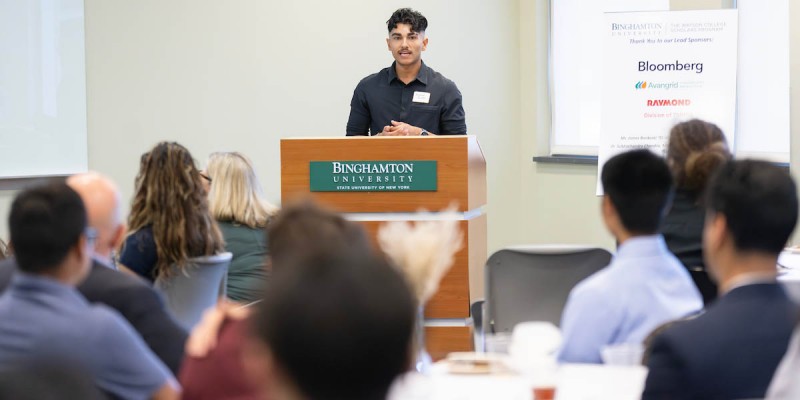
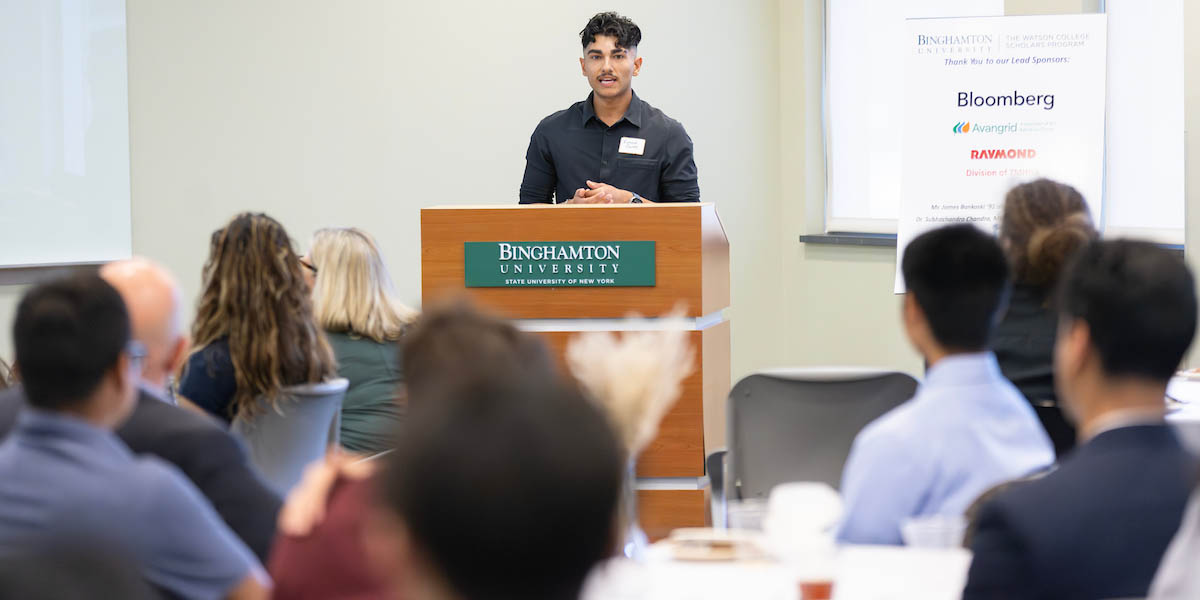
For the 2025-26 academic year, new leadership is steering the future of the Thomas J. Watson College of Engineering and Applied Science’s Office for Excellence in Diversity, Equity and Inclusion. Neither of them, though, are new to Binghamton University.
Before moving to Watson, Christina Toulon, WEDEI’s incoming director, served as the associate director of recruitment for the University’s Division of Diversity, Equity and Inclusion. Richard Quiles ’24, MS ’25, previously a coordinator for diversity education at DEI, is now WEDEI’s assistant director and oversees the Watson College Scholars Program.
We recently caught up with the WEDEI team about what issues students are facing, how to try to overcome them and what Watson College’s DEI priorities are for the coming year.
How do you see your office supporting Watson students as part of their educational journey?
TOULON: I see our office as a line of support for Watson students holistically across their academic, professional and personal development. That means meeting students where they are and helping them navigate the institution, not just survive it. We focus on access, belonging and opportunity by connecting students to resources, mentoring, experiential learning and leadership development that complement their technical education.
We work closely with faculty and campus partners to shape policies, practices, and programs that reflect students’ lived experiences and intentionally foster a sense of belonging, particularly for those who have been historically unseen or marginalized within STEM spaces.
What are some of the struggles you see students having, and how do you help them overcome those issues?
TOULON: I often see students struggle with isolation, imposter syndrome, financial stress and uncertainty about career pathways, particularly in rigorous STEM environments. These challenges are compounded when decision-making processes are unclear or inaccessible, leaving students feeling as though they are grappling in the dark about expectations, opportunities and the systems that shape their experiences. Many are also balancing academic demands with work, family responsibilities, or limited social capital.
We respond by building intentional support structures such as cohort-based programs, mentoring, wellness-focused micro-supports and more transparent pathways to internships, research and graduate school. Just as important, we work to normalize help-seeking and foster environments where students feel seen, supported and empowered to ask questions, make sense of institutional systems and advocate for themselves.
QUILES: One of the most significant challenges that Watson students face is burnout. Students often balance demanding academic workloads alongside employment, internships, future career planning, family responsibilities and their social lives. The cumulative pressure of managing these commitments can be overwhelming.
While we encourage Scholars to remain actively engaged in the program, we are also mindful that they are navigating many competing priorities. The Scholars Program is intentionally designed to support students holistically, not add to their stress. Programming that may initially appear “extra” is structured to address these challenges directly. For example, workshops led by the University Counseling Center on managing burnout or sessions focused on navigating bias and microaggressions are designed to equip Scholars with practical tools that support their well-being and resilience.
Now that the Watson College Scholars Program is in its fifth year, how do you sustain the momentum?
QUILES: There is still much to be done. The fall semester was largely focused on gaining a deeper understanding of the program’s structure and how it has evolved over the past five years. That time allowed me to lay important groundwork, and I am excited to see how those efforts take shape during the spring semester.
While the program already offers strong programming and meaningful opportunities, this period is also about refinement — identifying areas for improvement, addressing gaps and ensuring the program continues to meet Scholars’ needs. Scholar feedback is central to this work, as the program exists to support their success. If our Scholars are not thriving, then we have more work to do.
Looking ahead to 2026, we are excited to continue longstanding initiatives such as the Global Immersion experience, including this year’s program in Galway, Ireland. We are also proud to celebrate the upcoming graduation of Cohort 2, marking the program’s second graduating class.
Both of you had experience elsewhere on campus before coming to Watson. What opportunities or services have you seen that you will encourage Watson students to take advantage of?
TOULON: From the moment I first stepped onto campus, back then to now, the breadth and quality of student services and opportunities have expanded significantly.
Having previously worked as the associate director of recruitment in the Division of Diversity, Equity and Inclusion, I have seen firsthand the value of cross-functional engagement. As an office, we encourage Watson students to take advantage of undergraduate research opportunities, career development services, leadership programs, wellness resources and interdisciplinary initiatives that extend beyond the college. Many of these opportunities remain underutilized by students, often because they are not always visible or embedded within their academic experience. Part of our role is to help students connect the dots and fully leverage the broader university ecosystem in ways that support both their success and their sense of belonging.
Two practices that had a significant impact on me later in my undergraduate journey were frequent visits with my EOP [Educational Opportunity Program] advisor, Wes Van Dunk, and consistently meeting with my professors, even when I was doing well in my coursework. These relationships shaped not only my academic performance but also how I came to define success. That approach has stayed with me. As a doctoral student at Lehman College, I regularly attend office hours and continue to build working relationships with faculty. This practice has been deeply beneficial, providing greater insight into how I question, approach and engage with my work, both academically and professionally.
QUILES: Having earned both my bachelor’s and master’s degrees from Binghamton, and having held multiple roles across campus, I’ve had the opportunity to learn about many services that support student success. Three resources that stand out are the University Counseling Center, Campus Recreation and the Speaking Center.
I strongly believe that both mind and body are essential components of overall health. Campus Recreation not only provides facilities to stay active but also offers internships and student employment opportunities that foster engagement and physical well-being. The University Counseling Center is an invaluable resource, offering students a space to speak with professionals who understand both Binghamton’s culture and the student experience. Finally, the Speaking Center plays a critical role in helping students develop soft skills such as public speaking, interview communication and professional connection-building — skills that are sometimes overlooked but are essential for long-term success.
Any big plans for 2026?
TOULON: 2026 will center on intentional growth, sustainability and alignment. Our priorities include strengthening partnerships with industry and alumni, expanding wellness and basic-needs support, and embedding equity and belonging more deeply across the Watson experience for students, faculty and staff. In parallel, we are refining programs to be scalable and semi-self-sustaining, ensuring we can extend impact responsibly while remaining attentive to capacity and long-term viability.
We are also elevating faculty and staff engagement through a dedicated speaker series designed to foster dialogue, reflection and shared learning. To anchor this work, we are implementing transparent, structured methods to capture, synthesize and disseminate insights across the college. These practices will directly inform hiring, professional development and institutional decision-making, while reinforcing a culture of belonging and accountability within Watson.
For students, while Richard will lead the Scholars Program, I will continue to support undergraduate and graduate students through the Office for Excellence in Diversity, Equity and Inclusion by strengthening existing offerings and launching new initiatives. This work is intentionally designed to complement academic pathways while addressing students’ holistic, personal and professional development.
As President D’Alleva begins shaping the University’s next chapter, we are energized by the vision she brings and committed to aligning our strategic planning with Binghamton’s future direction. Our goal is to advance a Watson culture where excellence and inclusion are not parallel ambitions, but integrated drivers of student success, institutional strength and lasting impact.