Home on the range: Environmental science major interns as a cowboy
What cattle-rustling taught Ian Skinner about agricultural sustainability, maturity and grit
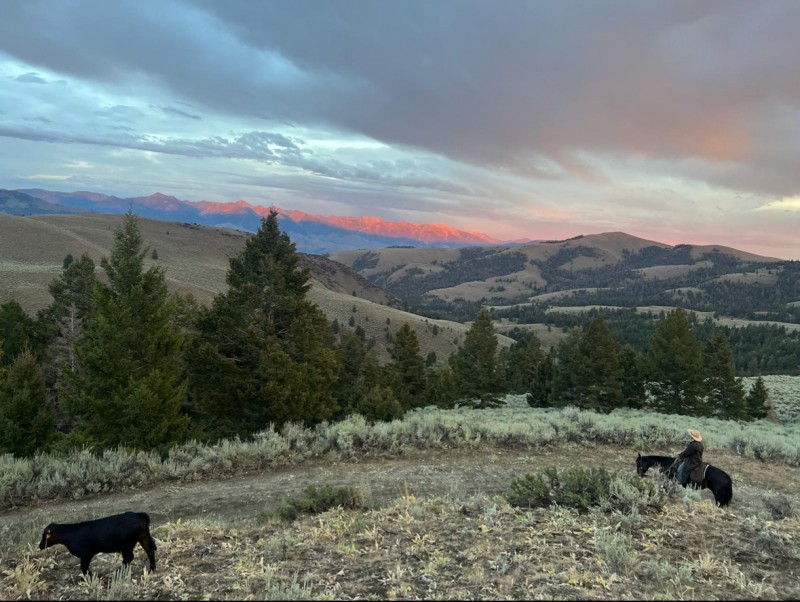
Ian Skinner always wanted to be a cowboy.
His hometown of Madison, N.J., is hardly cowpoke country, situated squarely in suburbia. But he grew up watching Westerns with his Vestal-born dad, nourished on family tales of his great-grandfather, who rustled cattle in Wyoming before retiring to upstate New York.
In the summer of 2025, he had a chance to live his dream, drawing on experiences he received at Binghamton University. From late June to late August, the senior did a summer internship at Alderspring Ranch in Idaho, focused on cattle management and horsemanship. Unlike a typical ranch, Alderspring is focused on sustainability and regenerative grazing — in which pasture not only sustains cattle, but cattle improve the condition of the land.
Competition for the internship was considerable; his background at Binghamton helped him stand out from a pool of more than 500 applicants. That included Skinner’s experience with sustainable agriculture, acquired via an independent study with Assistant Professor of Ecosystem Science Amy Churchill.
The prior summer, he took part in a summer program in New Hampshire’s White Mountains in partnership with the World Trails Network, which promotes international cooperation between trail organizations to protect and maintain hiking trails. While there is a learning component, participants basically live outdoors for an extended period of time — exactly what Skinner needed to qualify for Alderspring.
“I don’t think I would have been selected without those two, and both of those happened because I go to Binghamton,” he said.
There was just one problem: He needed to know how to ride a horse, and horses are in short supply on campus.
Already accepted, he assured the ranch that he would get the requisite experience. Before heading out west, he volunteered at a local barn, cleaning stalls in exchange for free horseback riding lessons.
Was that enough experience?
“It allowed me not to die, and there were definitely some points where I could have,” Skinner said. “I could do everything I needed to do without supervision.”
Life on a sustainable ranch
Sustainable grazing operations are labor-intensive, moving cattle from spot to spot while safeguarding streams and other vulnerable ecological areas. Traditional farming operations are also involved; the ranch grows and harvests hay to feed the cattle during the winter, when grass doesn’t grow.
Fun fact: Cows don’t chew grass with their teeth; instead, they wrap their tongue around the grass stalk and pull. As a result, they only eat the top 60% of the grass, leaving 40% behind to regrow. In turn, the shorn grass — which evolved with herbivores — dumps nutrients into the soil to aid regeneration.
“That also means that regenerative grazing operations sequester more carbon into the soil than what they output; instead of carbon neutral, they’re net negative,” Skinner said.
In other words, the amount of carbon stored in the regenerating grassland exceeds emissions from the cows, horses, chainsaws and ranch trucks, he explained.
The ranch proper is cradled in a desert valley, where interns spend half their time doing farming tasks such as fixing irrigation lines, bottle-feeding calves or giving shots to sick animals. They spend the rest of the time in the surrounding Sawtooth Range, where the cattle graze, taking turns working morning and afternoon shifts during eight-day stints.
The morning crew wakes up at 4 a.m. to grab coffee and tack up their horses before heading out to the holding area, where the cows were penned overnight. To keep the operation sustainable, the cows are moved in a wheel-and-spoke pattern an acre at a time, returning to a designated spot to sleep.
“You ride out, you get the cows from the night pen, and you move them out, which is like trying to herd cats; it’s so difficult,” Skinner recounted. “They go out and eat, then lie down in the middle of the day to chew their cud.”
Cow naptime is typically around 2 p.m. — a thirsty time for both cows and cowboys in an environment with little precipitation. That’s when the afternoon crew arrives to move the cows to the next spoke; the morning crew then heads back to camp for food and a nap, preparing their horses and tack for the next day. The afternoon crew heads back once the cows are in the night pen, eating dinner around 11 p.m.
And cowboy hats? They’re a must to keep off the sun, which can be punishing.
“I do still have the hat and, yes, I wear it sometimes,” Skinner said.
What a bad day can teach you
Keeping cows out of streambeds is critical for safeguarding the fragile environment. But in the hot desert sun, thirsty cows will make a beeline for the creek. The cowboys typically persuade them to return to the central pen, where they can have a drink of water before settling down for a rest.
Cue the hottest day of the summer, when temperatures hit 90 degrees by 10 a.m. Skinner was on the morning crew with three other riders, bumping the cows back into their designated area. As the others rode the perimeter, Skinner headed to his station by the creek bed.
Hot and thirsty, the cows were headed to the forbidden stream by the hundreds. As Skinner and his tiring horse pushed them back again and again for three hours, he came to a sick realization: his radio was dead, and he had no way to call his fellow cowboys for aid.
Quickly, he galloped to find the next rider, who used his own radio to call the rest of the team. Wearily, they pushed the cows to safer ground. It was close to 2 p.m., the time when the cows typically headed back to the pen for a break.
And then Skinner heard a thunderous moooo — from another 60 cows headed downhill into the streamside trees. Unable to reach them on his horse, Skinner dismounted and shooed the cows out of the woods.
“It was like something out of a movie; I was roping cows with a lasso,” he recalled. “I felt like I was literally in a Western because they didn’t have radios either.”
Once he emerged, his horse was gone.
Horseless, his radio long-dead, he slogged four hours back to camp on foot under the hot summer sun. The horse, it turns out, went back to camp for a drink and a break.
Skinner laughs about it now, but that tough day taught him the importance of grit, he said.
Just like the Western skies, Skinner’s horizons are open past Commencement, although he can’t imagine being happy in a cubicle job. He’s weighing his options: Playing hockey in Germany for a time. Law school, a career he hasn’t imagined yet — or even another stint on the range.
“It forced me to develop an insane level of maturity and grit and independence,” he said of his time at Alderspring. “I realized that I had no idea how comfortable someone could be by themselves until I did this internship — and the maturity of rolling with the punches.”