Special edition of Undergraduate Research Journal to focus on Human Rights
The peer-reviewed research papers were produced by Professor Alexandra Moore’s Source Project stream
In English Professor Alexandra Moore’s Source Project stream in human rights, students take an interdisciplinary deep-dive into topics such as incarceration, Indigenous rights, terrorism, women’s rights, and more. Along the way, they learn the ins and outs of research, forging an identity as emerging scholars.
Their work is now showcased in a special edition of the Binghamton University Undergraduate Journal (BUUJ), which demonstrates the broad spectrum and quality of student research, scholarly investigation, and creative work at Binghamton University. The annual journal, initially published as Alpenglow from April 2015 to 2023, is reviewed by an editorial board and members of the University community. It accepts submissions from all fields and disciplines, although submissions must be sponsored by a faculty member for consideration.
“The idea has been to introduce students to a wide range of disciplinary approaches to human rights and human rights research,” explained Moore, who is also the co-director of the University’s Human Rights Institute (HRI). “One of my goals as the instructor of the course, taking students on this journey to become first-order researchers, is to make sure they’re published.”
Nine students chose to submit their work. Topics are both national and global in scope, and range from the correctional system to food insecurity.
Prior to this year, students’ work was published in the Binghamton Law Quarterly. While peer-reviewed, the Quarterly’s process required students to take a portion of their research that specifically addresses the law and turn it into a stand-alone essay. The pieces in BUUJ, on the other hand, are longer and more varied in scope, and authors worked with BUUJ managing editor Carissa Bayack on revisions.
“The process so far has been incredibly valuable, as it has given me direct experience with writing, editing, and publishing for an undergraduate journal,” said Ianna Choi, a sophomore political science major.
Choi’s project focused on monitoring technologies in the U.S. prison system and how they violate the right to privacy under Article 17 of the International Covenant on Civil and Political Rights. Her research consisted primarily of analyzing legal instruments, cases, and existing scholarship, she said.
She decided to submit her work for a few reasons: to make it more accessible to the Binghamton community, and also to gain firsthand experience with the peer-review and publication process.
“I’ve long been interested in the intersection of technology and human rights,” she explained. “I previously studied the use of surveillance in China to monitor and restrict the movement of Uyghurs, and I wanted to expand on this area for the Source Project class.”
Hatim Husainy, a sophomore political science major, looked at the impact of a parent’s incarceration on their children. He read around two dozen papers during the course of his research and hopes to contribute to a broader conversation on the issue, he said.
Husainy, who plans to go to law school, is no stranger to writing. He’s had his work published in Happy Medium, a campus political science-themed publication, and is always on the lookout for more publishing opportunities, he said.
“Professor Moore was really good at teaching the underlying philosophy of international human rights legislation,” he said of the Source Project stream. “This was a really great opportunity to take those ideas and see how they look in practice.”
Outside the classroom
In addition to their research, Moore’s Source Project stream gives students the opportunity to explore human rights issues outside the classroom.
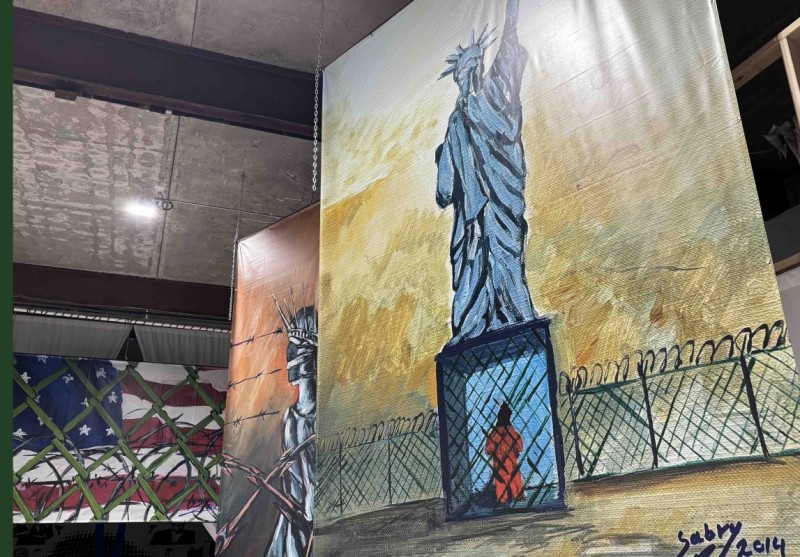
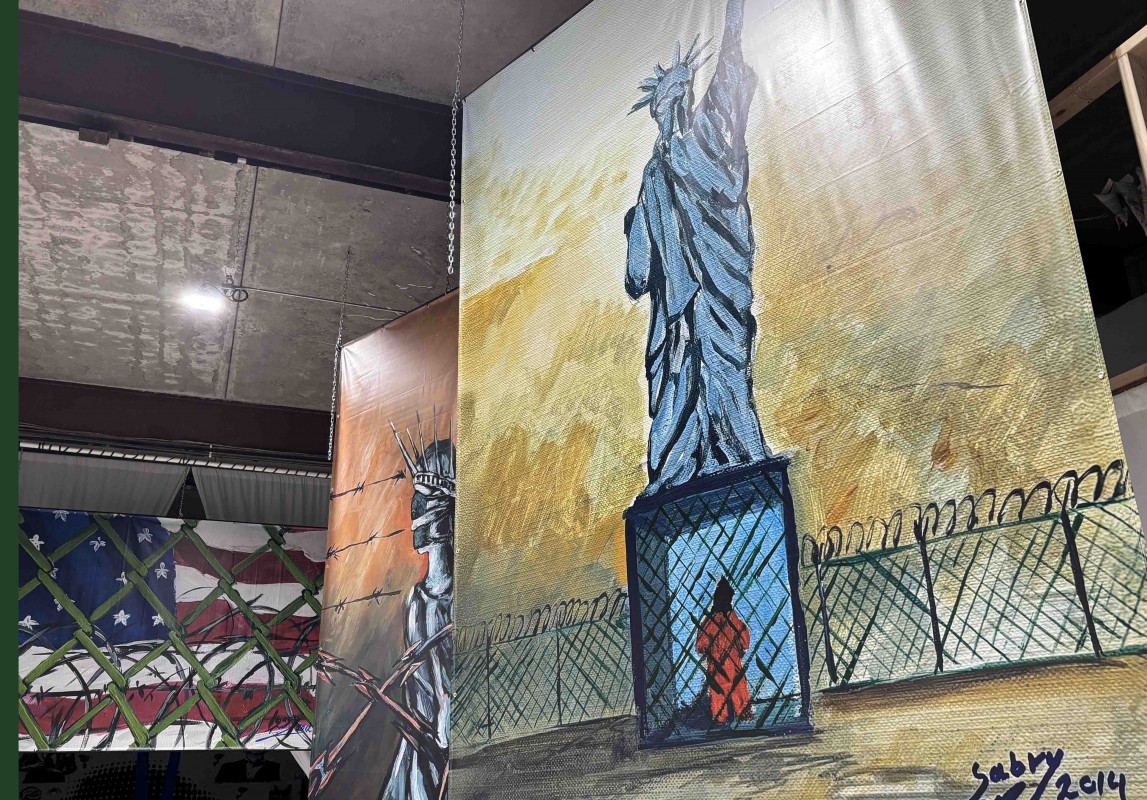
Last semester’s stream culminated with a downtown Binghamton art installation centered on international human rights. It featured the work of an artist who began painting while imprisoned in Guantánamo, as well as a live conversation with three former Guantánamo detainees.
Both Choi and Alayna Bhatti, a sophomore majoring in philosophy, politics and law, participated in weekly informal conversations with incarcerated individuals at the Broome County Jail, which broadened their understanding of carceral conditions.
Like Choi, Bhatti wrote her research paper on carceral issues — in her case, the lack of treatment for mental illness in prison, and how that contributes to recidivism. During her project, she analyzed empirical studies on inmates with mental illness and their outcomes, which she compared with both U.S. and international human rights laws.
She continues to visit the jail, even now that the course has wrapped up.
“It’s very grounding; you don’t realize how prevalent these issues are,” Bhatti said. “I realized that everything I was researching, I was hearing about when I talked to inmates in jail.”
You can learn more about the Source Project stream and read the students’ peer-reviewed papers in the special edition of the Binghamton University Undergraduate Research Journal, available here.
“These are very substantive papers. They’re far beyond a final paper in a typical undergraduate class,” Moore said.