Art of Transformation: American Riad weaves connections between neighbors and cultures
School of the Arts director Christopher Robbins completes MacDowell fellowship to plan the next phase
Life in American cities can be shrouded in loneliness. Rather than neighbors, Americans all too often encounter a sea of strangers, wordlessly passing by as they slip into separate homes.
For answers to this quintessential “first-world” problem, Christopher Robbins — a public artist and co-founder of the Ghana ThinkTank — turned to a focus group in Morocco. Their solution: A riad, a traditional garden courtyard that functions as a common area and links the surrounding domiciles.
“The principle is that shared space and a shared entrance ensure that people know each other and bump into each other,” said Robbins, the founding director of Binghamton University’s School of the Arts.
That suggestion led to the American Riad, a collaborative art and housing justice project in Detroit. In December, Robbins completed a prestigious two-week fellowship at the MacDowell artist colony in New Hampshire to plan its next phase.
Global lessons
The project’s roots go back to 2006, when Robbins created the public art project Ghana ThinkTank with Rhode Island School of Design classmates John Ewing and Matey Odonkor; Ewing is from Ithaca, NY, and Odonkor from Ghana. All three had worked overseas and worked on the fringes of international development.
This international art group collects problems from the “developed” world and distributes them to “developing” countries or marginalized groups to solve. It’s not just limited to Ghana; participants have included focus groups in Cuba and El Salvador, as well as juvenile detention facilities in Boston and the Bronx, and, in collaboration with Binghamton University’s own Human Rights Institute, individuals released from the federal detention facility in Guantanamo Bay.
“This is a way to flip the idea that the West is best, and that the U.S. knows better than everyone else,” Robbins explained. “I wanted my own culture to experience what it’s like for someone from another culture to tell you what’s good for you.”
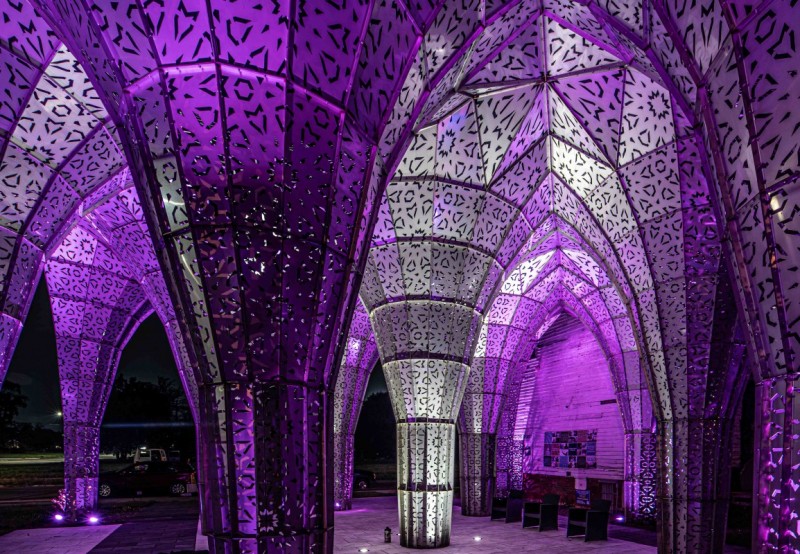
Around 2016, the project acquired a block of abandoned buildings in the North End neighborhood of Detroit, in collaboration with Purchase College, SUNY New Paltz, the University at Buffalo, and Detroit nonprofits Oakland Avenue Artist Coalition, Central Detroit Christian Community Development Corporation, the Detroit Justice Center, and the Detroit Collaborative Design Center. The goal: to link the buildings with an architectural sculpture over a courtyard space and then rehabilitate the buildings into affordable residences and businesses.
By partnering with local nonprofits and forming a community land trust, the project seeks to avoid gentrification, which would price out and ultimately displace area residents. It also provided the opportunity for cross-cultural exchange, in partnership with think tank groups in Morocco and Indonesia.
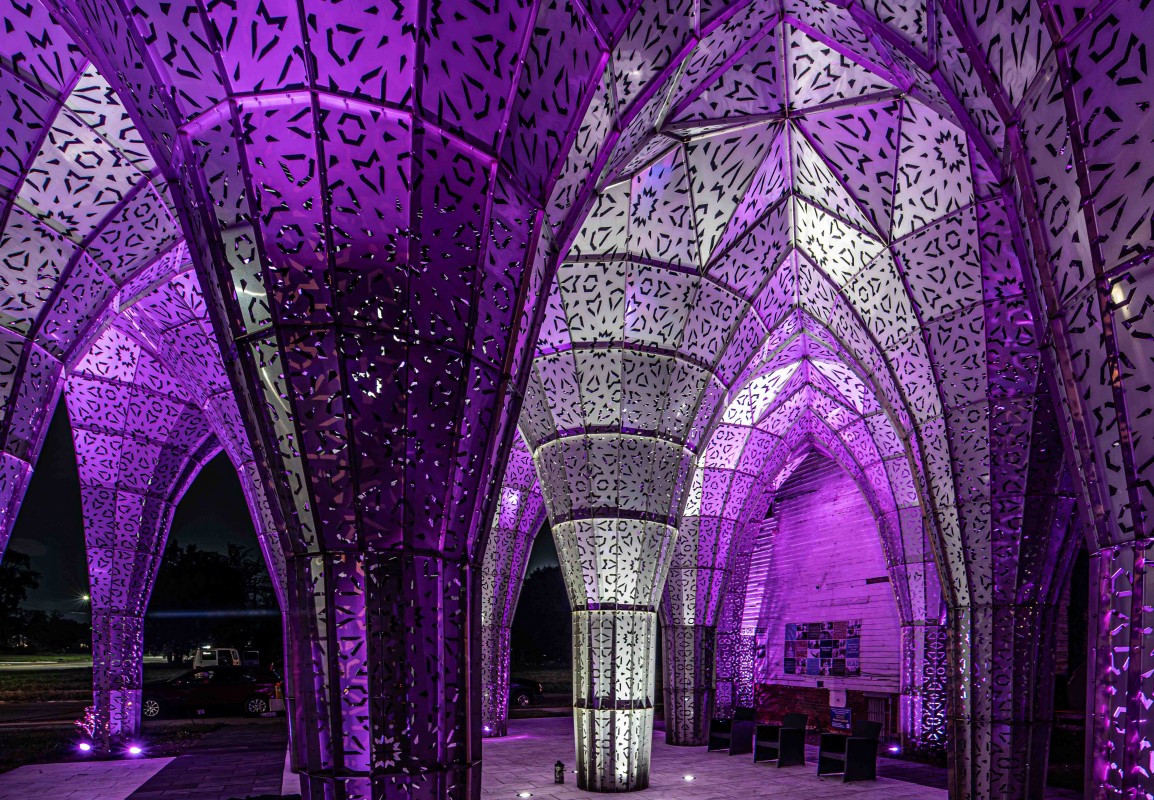
The sculpture itself has Islamic roots; it’s based on the massive shading umbrellas around Mecca that protect pilgrims on the Hajj from the desert sun, as well as star patterns common in Moroccan art. While the universities planned the architectural design, construction took place on site. Anyone with an interest was invited to pitch in; Robbins remembered an 8-year-old child and an 80-year-old woman working on it together, as well as church groups, with teens shooting hoops nearby.
Today, American Riad regularly hosts performances and other events, often for free. These include youth summer camps focused on arts or sports and concerts; a local rapper even shot a music video there. Some events are related to Islam, such as a community iftar celebration to break the Ramadan fast, open to Muslims and non-Muslims alike.
“While it’s not a religious project, one of its aspects is different ways of seeing Muslims in America,” Robbins said. “At times, there has been a lot of fearmongering about Islam and Muslims, and this is one way to have other narratives.”
The next phase
The project itself hasn’t reached its final flowering, however. The sculpture is intended to mesh with the surrounding buildings — on one side, a single-family home undergoing renovation, and expected to be livable in about a year.
But the Riad lost its anchor on the opposite side: a 12-unit building that had too much structural damage to renovate. Twelve of the 14 housing units the Riad project was designed to bring together ultimately fell to the wrecking ball, presenting a conundrum.
“How do you make an enclosed Riad when you have a big grass field on one side?” Robbins wondered.
Enter the MacDowell fellowship. For two weeks without interruption, Robbins planned the next phase, covering the walls with large sheets of drawing paper and sketching out ideas on the theme of connection. A curious knot: the remaining building is a single-family home, exactly the kind that sparked the initial ThinkTank problem.
“How can we open up the single-family house and make it public as well as private?” he asked. “How can we get across this idea about connecting communities through shared architecture?”
Another solution — fundraise and build affordable housing on the empty side of the Riad — would require an additional realm of expertise. Robbins expects that the solution, whichever form it assumes, will take shape over the next two years. After finalizing the concept, the project will become a matter of logistics: engineers, contractors and budgets, and the inevitable drive for donations.
Whatever its final form, the American Riad has achieved the ThinkTank’s goal of bringing neighbors together. The sculpture has woven connections to programs for affordable housing, an employment program for youth, art camps and ultimately a land trust. And there remain multiple opportunities to get involved, from the legal and financial aspects of the project to filmmaking, architecture, events and more.
“This project proves that starting with the Arts can bring the interest and energy to make a whole lot of other things possible,” Robbins said.