Hidden knowledges: African culture offers radically different view of the nature of reality
Philosopher Nkiru Nzegwu appointed honorary professor at Nelson Mandela University, her latest international honor
Fill a white bowl to the brim with water and cover it tightly with a white cotton cloth, securing it at the base. Then turn the bowl upside down and wait. What happens?
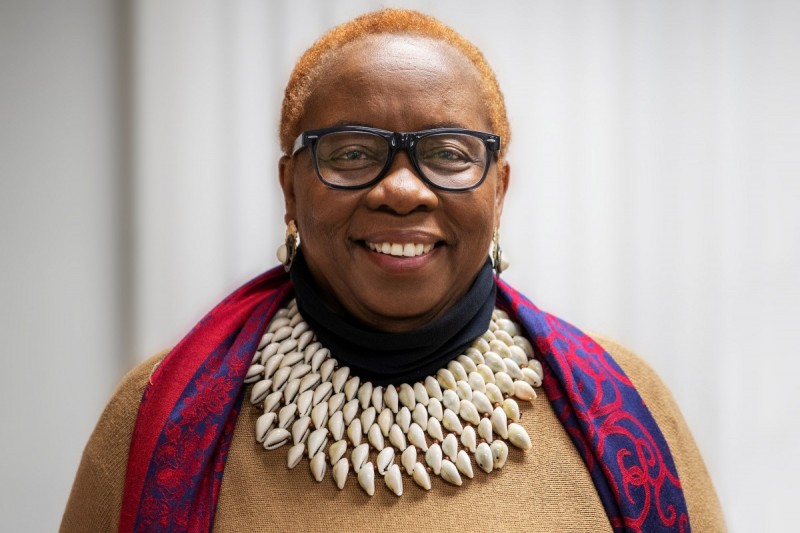
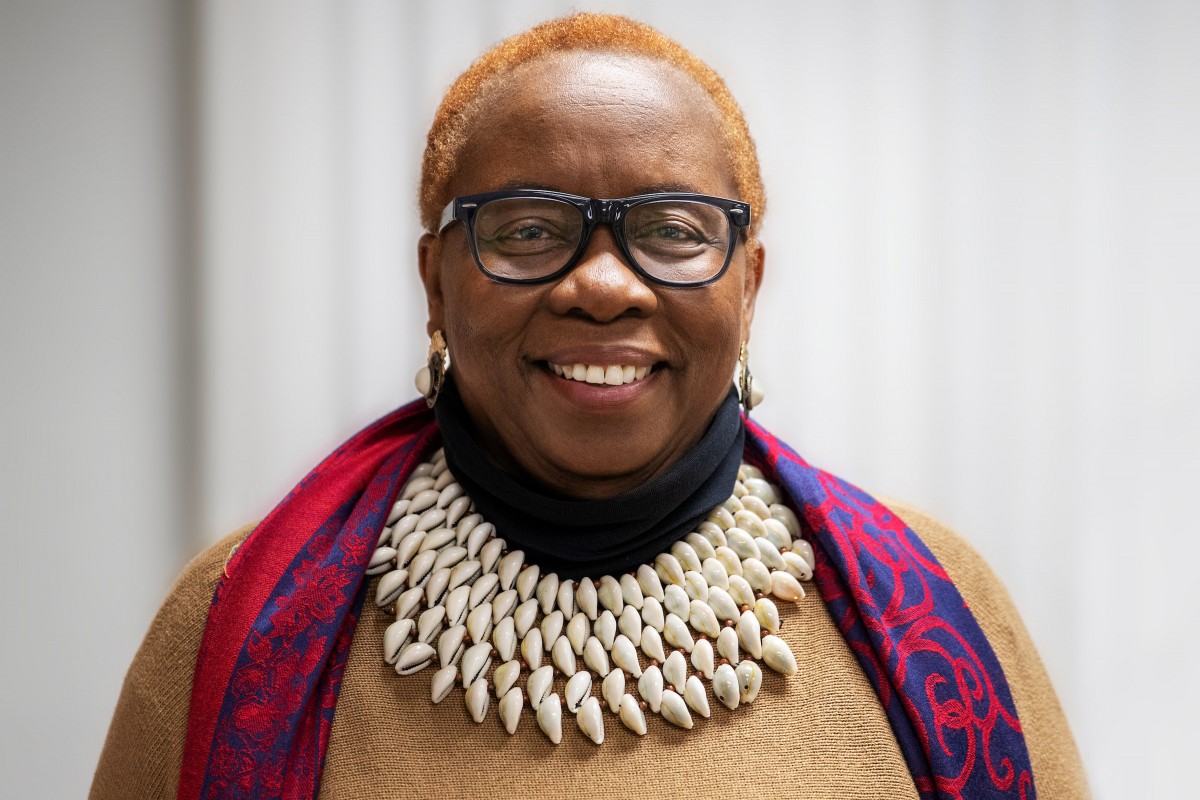
Perhaps you believe that the water will leak or pour out through the permeable cloth, pooling on the floor. But if you turn the bowl over and untie the cloth, you’ll find the water inside, according to Distinguished Professor of Africana Studies Nkiru Nzegwu.
“We don’t really understand how the world functions. How can you have an upside-down bowl of water?” she asked.
This puzzle speaks to knowledge and the framework we use to structure the world. There are risks to challenging this framework, much of which stems from the legacies of colonialism that often go unquestioned. But at this point in her career, Nzegwu is willing to take those risks.
She was recently appointed honorary professor at South Africa’s Nelson Mandela University in recognition of her scholarship and accomplishments, her latest honor in that country; she has also been named Professor Extraordinarius at the University of South Africa (UNISA) and Nelson Mandela Visiting Professor at Rhodes University.
“Some of the canon needs to be challenged if we are to expand and understand who we are as humans in this world,” she said. “We cannot keep limiting ourselves.”
Truth and tradition
The philosopher and art historian is also juggling three book projects, in different stages of development. What ties them together is, in essence, that bowl of water: knowledges that are hidden by colonial narratives and seemingly lost, but ultimately remain, open to rediscovery by the seeker.
Older women were often the custodians of these knowledges, and many African societies were originally matriarchal, mother-centered rather than male-centered, she said.
“There is a blanket assumption that women everywhere are oppressed and have always been oppressed from time immemorial, which is a way of flattening women’s histories and cultures,” Nzegwu explained.
When men codify history, they typically insert themselves as dominant figures, diminishing the importance and roles of women in that society. In Africa, colonialism gave men access to Western education, which they then used to entrench their perceived dominance. When women gained access to these systems, they adopted this male interpretation of women’s history as a template, further exacerbating the issue.
“Feminism provides a pathway for transformation, but women run into headwinds where they are being challenged for bringing in foreign ideas of women’s autonomy and empowerment, against traditional norms,” Nzegwu said. “But if you go to the traditional norms, the narrative of male dominance does not exist.”
In traditional histories — recorded, remembered, ritual and performative — a different scenario emerges, the subject of one of the books she is working on. Each chapter focuses on a particular female figure and her relationship to women’s cultural history in her region. One such figure helped set up the current government in Rwanda; after the genocide there, she helped bury the bodies of the slain.
Burial isn’t just a cultural necessity; it also stems the spread of disease. Few ask who performed this solemn task after a conflict that claimed the lives of more than half a million people.
“It turned out that it was the women, the same traumatized women who were raising orphaned children after their parents were killed,” Nzegwu said.
Traditional histories offer insight as to why: Women had been rulers and leaders in the community, which explains their stepping forward in a time of need.
Nzegwu is also an artist, and views art as a tool to uncover hidden knowledge. She’s close to finishing a book on modernism and modernity, and the relationship of art and aesthetics to the slave trade.
While African art inspired the aesthetics behind modernism, Western scholars then defined African art as distinctly notmodern because of its origins in tradition. The flow of ideas was then reversed: African artists were seen as learning modernism from the West, she explained.
“When people talk about modernity in Africa, it always presupposes the inferiority of the African,” she said. “This book takes artists and looks at how artists in the region responded to the events of the time, and redefines, centers, and restores their humanity.”
Knowledge and the fourth dimension
Nzegwu’s third project centers on sankofa epistemology, which brings African history and culture into a branch of philosophy that examines the nature of knowledge itself. In the West African language of Twi, the word means “go back and fetch it,” urging us to look to the past to harness knowledge that will allow us to shape and transform the future. It doesn’t, however, tell us what to fetch, only that we will find what we seek.
Rather than the visual-oriented, three-dimensional world of Western philosophy, sankofa presents a unitive fourth dimension: energy, which pervades all that exists. In fact, there may be dimensions beyond four, Nzegwu acknowledged.
“Once you bring in those aspects, you change the very meaning of knowledge; you widen the scope of the universe,” she said. “In the African indigenous cultural framework, these dimensions were never problematized.”
With a Western mindset, we are instructed to erect walls that define what it real and what is not, eliminating this larger, unitive picture of a complex, relational universe.
Moving to a different cultural framework can offer a more expansive view, and a different understanding of how reality and knowledge function. In the sankofa framework, everything is reducible to energy; life doesn’t end but instead transforms — which offers the potential for contact past death, as well as methods of perceptual engagement that transcend the visual.
Some individuals have the faculties to perceive the fourth dimension that sankofa addresses, although most do not, Nzegwu said. Consider children; their framework of knowledge is fluid, allowing them to see more than adults. Some adults, however, can also see beyond the conceptual walls we set around the “real.”
As she writes her book, Nzegwu is focusing one of her chapters on the upside-down bowl of water: a puzzle of unexpected possibility, of traditional knowledge that remains to be fetched and rediscovered.
“They’re telling us something significant about reality, but many of us pull back from what they’re saying,” she said of those who can see beyond colonialism’s perceptual walls. “What they’re hinting at is that we have the faculties within us to see beyond what we normally see, and the powers to navigate those realities.”