From icequakes to arias: Binghamton University professor turns Earth’s data into art
Sarah Nance discusses how she took raw numbers and turned them into artwork
Have you ever been in a doctor’s office and noticed a drawing of trees on the wall, or a painting of bright-colored flowers? We see art depicting nature all the time, but how often do you see art made from nature?
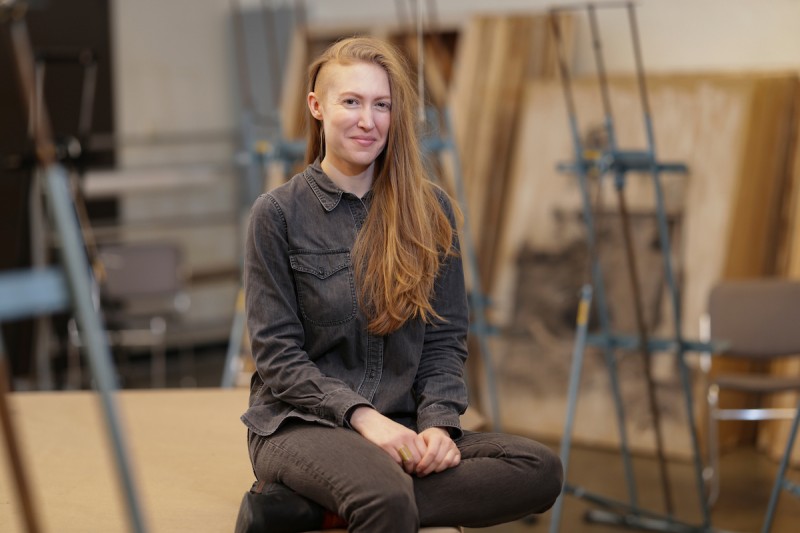
In the latest episode of “The Aha! Moment presented by Binghamton University”,Sarah Nance, assistant professor of integrated practice in the Department of Art and Design, discussed how she took data recorded from natural events and turned it into artwork that offered a new way of looking at events on our planet. Among the artworks discussed were stitch maps made using icequake seismography, as well as musical arias created with sea level data.
Much of Nance’s work in these areas surround what she calls “archived landscapes”, looking at the different changes and iterations a landscape goes through over time. In making art of the stitch maps in her series called “points of rupture”, data from icequakes, which occur when subsurface ground fractures from rapidly freezing water underground, Nance took data from four different icequakes in Alaska, Switzerland, and in the Arctic Circle between Norway and Greenland. One additional stitch map in the collection did not use icequake data, but instead used lunar seismic data recorded during the 1971 Apollo 15 mission.
Nance turned the peaks and valleys of all this data into stitch symbols in the open source program Stitch Maps, then used stitch symbols commonly used in knitting to create a design that she felt properly depicted the ebbs and flows of the event.
In creating musical art on the other hand, Nance went from the ice to the waves. For the two arias she created, she collected sea level information from tidal gauges at the Bay of Marseilles in France and in Skagway, Alaska. When composing “marseille tidal gauge aria”, Nance used information from a span of about 130 years. She took each year’s average level, assigned a note to it in her vocal register, and sang it while assigning lyrics from the book “Songs from the Black Moon” byRasu Yong-Tugen. The end result is a haunting piece of music that draws parallels to climate change in the current age. The work “skagway tidal gauge aria” differed slightly – not only using historical data, but also projective data that gives a glimpse of where the tidal levels in Skagway, Alaska could be 30 years into the future.
In discussing her art, Sarah doesn’t view her work as having a specific message, but more as a different way of accessing information that sometimes can be a bit alienating for someone to translate in an understandable way.
You can listen to the full episode now on Apple Podcasts, Spotify, or on YouTube.