Harpur College to hold its first-ever language fair
March 11 event to showcase the wide range of languages available on campus, study abroad opportunities, and more
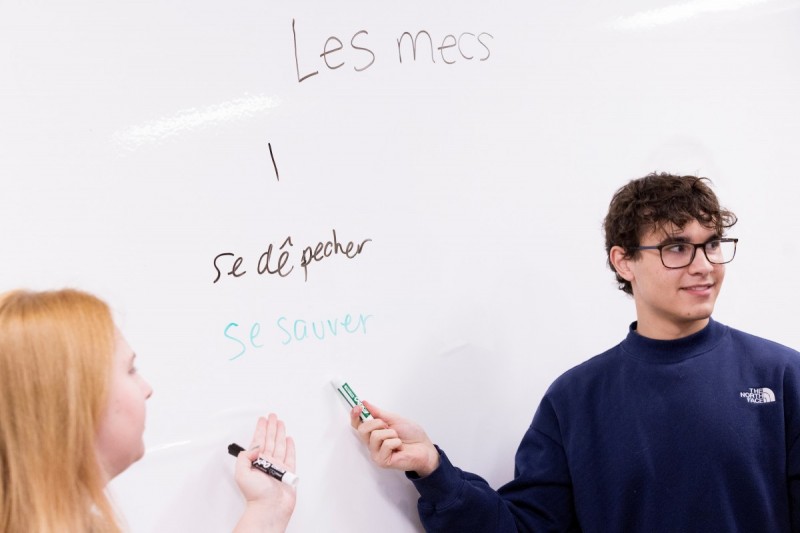
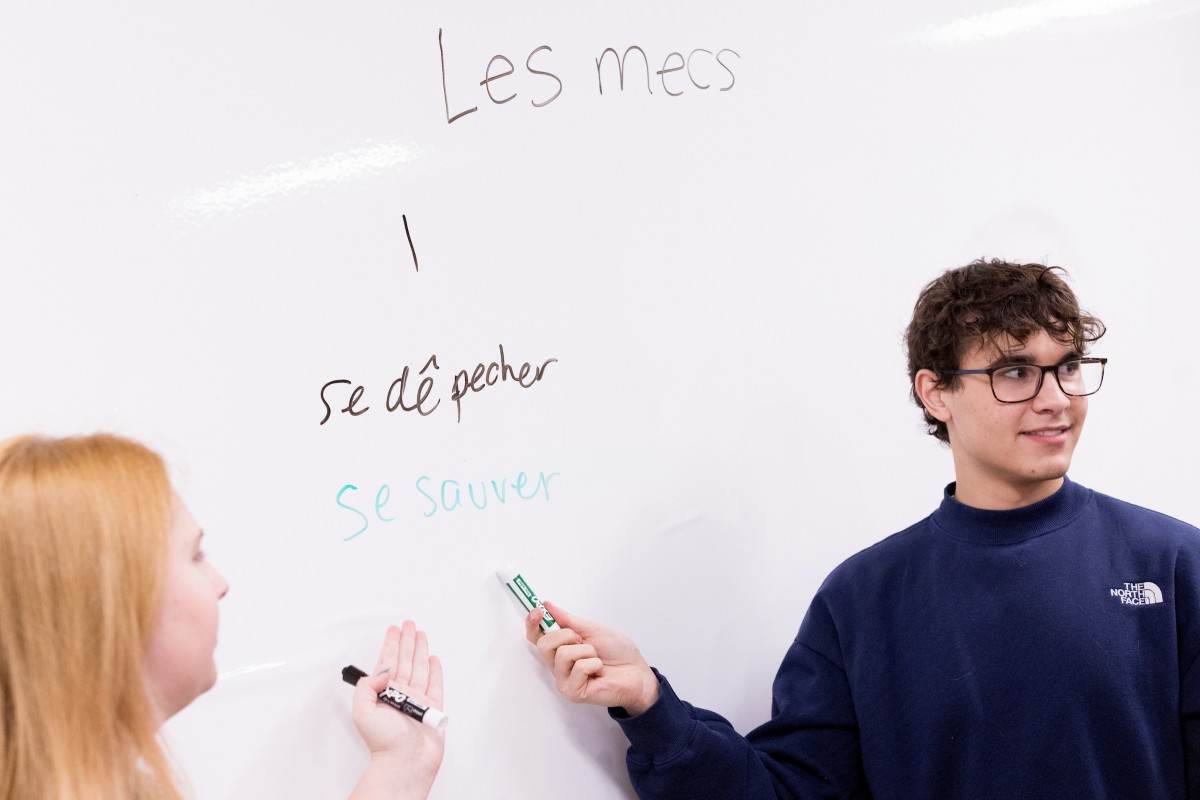
Languages are more than writing systems, verb conjugations or lists of vocabulary to memorize. Rather, they’re a set of keys, opening doors to different cultures, personal and professional opportunities, and even new understandings of yourself.
In that spirit, the Translation Research & Instruction Program (TRIP) is hosting Bing Lang 26, Binghamton University’s first-ever language fair, from 11 a.m. to 2 p.m. March 11 in University Union Room 108.
Participants include the departments of Middle Eastern and Ancient Mediterranean Studies (MEAMS), German and Russian Studies, Judaic Studies, Romance Languages and Literatures, and Asian and Asian American Studies (AAAS), as well as Harpur Edge, the Teaching English to Speakers of Other Languages (TESOL) master’s program, Harpur Academic Advising, the Fleishman Career Center, the English Language Institute (ELI), the Turkish Culture Association, and International Education and Global Initiatives (IEGI).
TRIP Director Jeanette Patterson came up with the idea as a way for language departments to connect with students across campus, while drawing attention to the many benefits that language study provides.
“There’s a really diverse ecosystem of languages on campus,” said TRIP Operations and Finance Coordinator Erin Riddle, the event organizer. “We wanted to provide a space for students to find out as much as possible about language resources on campus.”
Language learning on campus
Harpur College offers a wide range of language courses, including Persian, Arabic, Latin, Turkish, Ancient Greek, German, Russian, Yiddish, Hebrew, Italian, French, Spanish, Chinese, Japanese, Korean, and American Sign Language, as well as courses in English for international students seeking to improve their academic writing skills.
Oftentimes, students pick a target language based on a family connection, or follow their interests, whether in K-pop or Japanese anime. Others pick a language that’s useful for their majors or career aspirations.
Cross-cultural understandings are key to language-learning — and frequently missed by computer translations, which can lead to misunderstandings, pointed out Associate Professor of German Carl Gelderloos.
That’s why language programs contain much more than grammar or vocabulary. Students may participate in a Japanese cooking class, sing in Chinese, kibitz in Yiddish, or watch an engaging Korean drama. German offers a virtual exchange program, in which Binghamton students are paired with a Zoom conversation partner their age in Germany who is learning English; they chat regularly in both languages, Gelderloos said.
Language study is also a great way to find community on campus, added Korean Language Program coordinator Eunjin Park, a lecturer in the Department of Asian and Asian American Studies
“In the language program, we meet almost every day. The students become best friends, and they find clubs related to their interests. They stay together until they graduate,” she said. “This isn’t just about language or gen ed courses. We offer much more than that: courses in social sciences, critical thinking, aesthetics.”
Students, in turn, can help stem the tide of global language loss and help keep languages vibrant and alive. That’s the case for Yiddish, which is still spoken by a subset of Jewish society, the Hasidim, in parts of Brooklyn and upstate New York. But it was once more widespread; Jewish families who left Eastern Europe during the mass migration in the 1900s would have spoken the language.
“My purpose in teaching Yiddish is to alert students to the possibilities embedded in learning a language that has suffered a lot of tragedy,” said Gina Glasman, a lecturer in Judaic Studies. “For students who have this heritage, their great-grandparents and sometimes even their grandparents were fluent in this language.”
But Yiddish has practical applications, too. One of Glasman’s students works as a medical scribe in a Yiddish-speaking area in Brooklyn; knowing the language is essential for communicating with patients. Yiddish can also be instrumental for work in New York City museums and archives that deal with the immigrant experience; the New York Public Library, for example, has a large Yiddish language section.
There’s also a growing interest in Yiddish cultural forms, including theater revivals and klezmer music, Glasman said. In her classes, students sing Yiddish songs, learn idioms, and watch movies.
“We talk as much about Yiddish and what it represents as we do learning the language in a conventional sense,” she said.
Study abroad and volunteer opportunities
Many students in language programs see study abroad as an option, attending universities in their target country while earning credits back home, said Qifei Kao, a lecturer in Asian and Asian American Studies who teaches Chinese. When it comes time to navigate your study abroad options, the Office of International Education and Global Initiatives (IEGI) is here to help.
IEGI is the main point of contact for study abroad opportunities and provides students with a menu of options, from traditional coursework to international internships at locations all over the world, said Education Abroad Advisor Jordan Loretz. Binghamton students have access to more than 60 programs through Binghamton, approximately 600 programs through other SUNY schools, as well as independent options outside the SUNY system. Whichever program they select, IEGI can help with advising and preparations to go abroad, he said.
Many study abroad programs focus on language learning; Loretz himself participated in an intensive Mandarin-learning program in Nanjing, China, several years ago. Currently, he’s working with students studying Korean in South Korea and Spanish in Argentina, Costa Rica, and Peru. Binghamton programs also offer coursework in other languages, such as Arabic, German, Italian, and Japanese, among others. Other study abroad classes are taught in English but still provide students with opportunities to explore local culture and practice their language skills in more informal settings.
“You get to step outside the bubble that is the northeastern United States and experience life through a different culture’s lens,” he said.
Volunteer opportunities also give students the chance to forge cross-cultural connections without leaving campus. The English Language Institute (ELI), which teaches courses in academic writing to multilingual learners, hopes to draw prospective volunteers through Bing Lang 26.
ELI classes are mostly attended by international students, but domestic students who speak a different language at home may also qualify. While these students are already prepared to take classes in English, academic writing — for example, how to structure an essay or frame an argument — can vary by country. Learning the correct form is as much a matter of culture as of the proper language, noted Kellie Tompkins, ELI’s mentoring program coordinator.
ELI also pairs native English speakers with international students to help them transition to the U.S. academic world. During the language fair, ELI hopes to recruit participants for the conversation pairs program, as well as tutors and teaching assistants.
“You can have a global, cross-cultural exchange without leaving Vestal,” Tompkins said.
She also offered an interesting fact: Globally, around 75% of English-speakers are non-native, which means that English is more common as a second, third or additional language than as a first language.
“Some things you learn because they’re useful, and some things you learn for their own sake. Learning languages is both,” Gelderloos said. “They’re instrumental and practical, but we learn them for ourselves as well. At the end of the day, I truly believe that to be an educated person in this world, you cannot be monolingual.”