Middle Eastern and Ancient Mediterranean Studies hosts first outreach day
Chenango Valley High School Latin students visit campus and share their interest in an ancient language and culture
In seventh grade, Kyra Bolden had a choice: Would she learn Spanish, French or Latin?
She chose the last, which happens to be the parent language of the other two.
“There’s also a connection to English; there are many English words derived from Latin,” said Bolden, a sophomore at nearby Chenango Valley High School.
On March 10, Binghamton University’s Department of Middle Eastern and Ancient Mediterranean Studies (MEAMS) hosted its first-ever community outreach day in collaboration with Valerie Spiller ’08, Chenango Valley’s Latin teacher. She brought a class of 10th- through 12th-grade students to the University to experience what it’s like to pursue Ancient Mediterranean Studies at the college level.
The event was an initiative of Ancient Languages Coordinator Carina de Klerk. Students met with professors and undergraduate teaching assistants specializing in Latin and ancient Greek and experienced a lecture by Associate Professor Hilary Becker on the eruption of Mount Vesuvius in 79 AD, which destroyed Pompeii, Herculaneum and other communities in Italy’s Campania region. The day ended with a visit to Associate Professor Tina Chronopoulos’ advanced Medieval Latin class.
While Spanish or French may be more common language options at the high school level, Latin isn’t exactly unknown; the Classical Association of the Empire State, for example, includes public school teachers and advertises openings for Latin instructors in New York school districts. Spiller herself was introduced to the language as a high school student in Long Island, she said.
A passionate love of mythology brings many students to the ancient language; the popular Percy Jackson series of novels, for example, begins in the protagonist’s Latin class. Students who are more reserved may be drawn to an opportunity for language-learning that doesn’t involve regular conversations with native speakers. And then, of course, there are the history buffs, who are most likely to stick with the study of the language, Spiller said.
“I thought that it would be interesting to study an ancient language, one with connections to other languages,” said Chenango Valley senior Emma Langstaff, who is also learning ancient Greek.
It’s a useful language to know if you want to be a teacher someday, or work in a museum, Langstaff said; in college, she plans to pursue an interest in comparative linguistics.
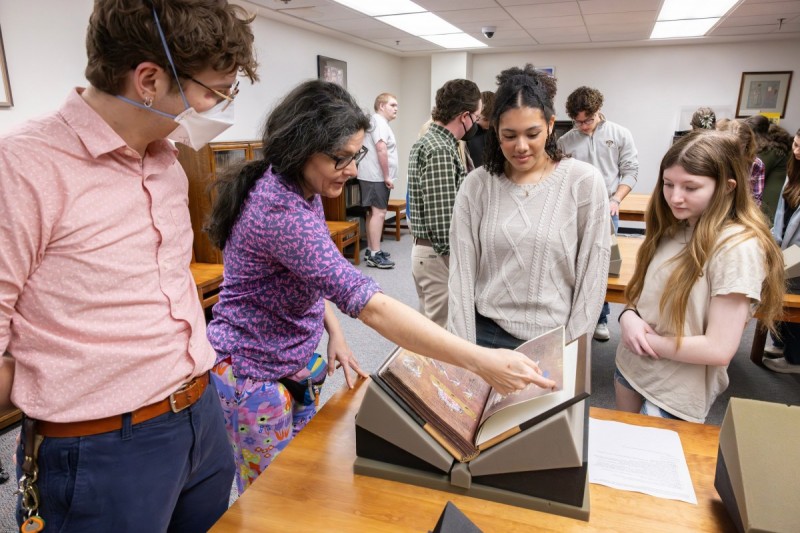
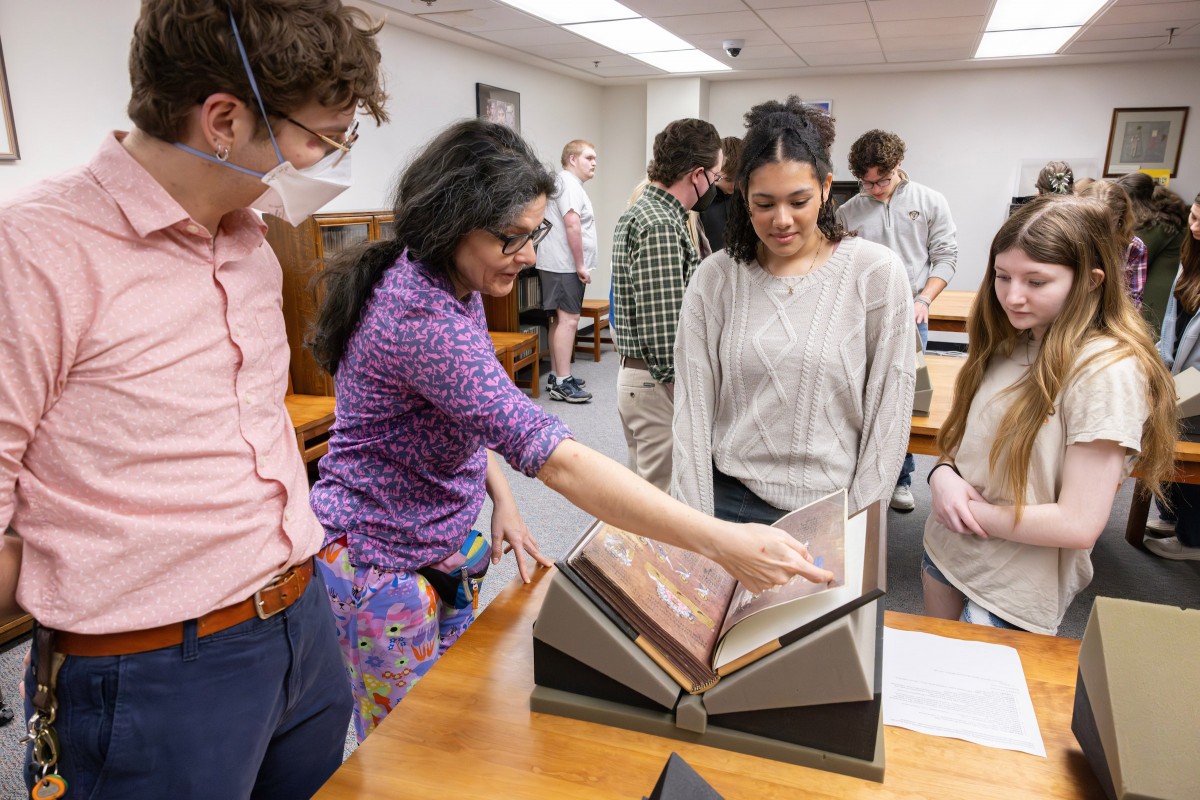
In the Libraries’ Special Collections, the students had a chance to see — and even carefully handle — medieval manuscripts written in Latin, penned by scribes on specially prepared animal skin known as vellum.
“It was so incredibly delicate and vibrant,” Bolden said of the manuscript. “When we came here, I was a little nervous, but everyone is so good at answering your questions.”
Lessons from Pompeii
Becker, a Roman archaeologist, conducts research in the ancient town of Pompeii. Around 20,000 people once lived in the wealthy seaside town, a short distance away from Mount Vesuvius.
During her lecture, Becker fielded questions from the Chenango Valley students on the tragic events of 79 AD, and combed through evidence pertaining to its exact date, the subject of a vigorous and ongoing scholarly debate.
Roman sources indicate Aug. 24 through 26, but other evidence seems to indicate October. Part of the confusion may stem from the complex system the Romans used to record dates; another arises from archaeological finds, including a coin depicting the Roman Emperor Titus that turns out to have been misdated, and a charcoal inscription on a wall made in praise of an extravagant October meal. This inscription was initially thought to be proof of a later date for the eruption. Archaeologists conducted an experiment in which they wrote a similar charcoal inscription on a wall, photographing it regularly; the inscription turned out to persist longer than expected, Becker told students.
Becker shared one of her favorite sites with students, called the House of the Painters at Work. The archaeological evidence presents a clear and very human picture: a group of painters preparing themselves for a day’s work in a villa on Pompeii’s central street. Their materials held in a wickerwork basket, they were ready to tackle the next section of wall, on which they had sketched the outlines of the unfolding mural.
“Life was normal, or so they thought,” Becker said. “They have their pigments there, their tools, their scaffolding — but their work was interrupted because they didn’t know Mount Vesuvius was going to erupt on that day.”
Pliny the Younger and his uncle, Pliny the Elder, witnessed the start of the eruption on the other side of the Bay of Naples, when it sent a cloud of pumice and ash 20 miles up into the air, expanding into an umbrella shape.
Herculaneum, to the west of the volcano, saw only 4 centimeters of ash that first day; during the second, it was buried by the pyroclastic flow. Ultimately, the town was entombed underneath nearly 60 feet of volcanic debris; only a quarter of the town has since been excavated. Made tumultuous by the eruption, the seas weren’t an avenue of escape; archaeologists later found over 300 bodies of victims at Herculaneum’s port. These individuals would have died instantly in a wave of searing heat and toxic gas, Becker said.
Pompeii, meanwhile, was suffocated by toxic gas and 13 to 20 feet of volcanic ash and pumice. About two-thirds of the town has since been excavated, along with the remains of more than a thousand victims.
Many people, however, may have been able to escape on the first day, Becker said. Even the day of the eruption offers a hint of some survivors, according to recent research; there would have been a regional market elsewhere on that day, which meant that some merchants would have been safely away from Pompeii. Becker’s lecture focused on understanding how we know what we know about the past and invited students to re-examine the evidence of the chronology of the eruption.
The three parts of the student’s visit not only showed them what Binghamton University’s students are experiencing both inside and outside of the classroom, but it also showcased the opportunities and possibilities offered by the liberal arts program at Harpur College.
One of the aims of this event was not only to bring the Chenango Valley students to campus but also to show them that the study of the ancient Mediterranean world is vibrant and interconnected, involving languages, cultures, and archaeology.
“When you’re a Latinist, this is our community: a community of scholars,” said Spiller, who previously taught Latin courses at Harpur College. “Any opportunity for students and teachers of Latin to get together is really special.”