School of Computing celebrates new leadership, innovative research, and student successes
Starting this fall, students will be able to earn a master’s degree in computer science or information systems from home
It’s been a busy 2025-26 academic year for the School of Computing, from new leadership, research, and online master’s degrees to student and alumni successes.
New SoC director
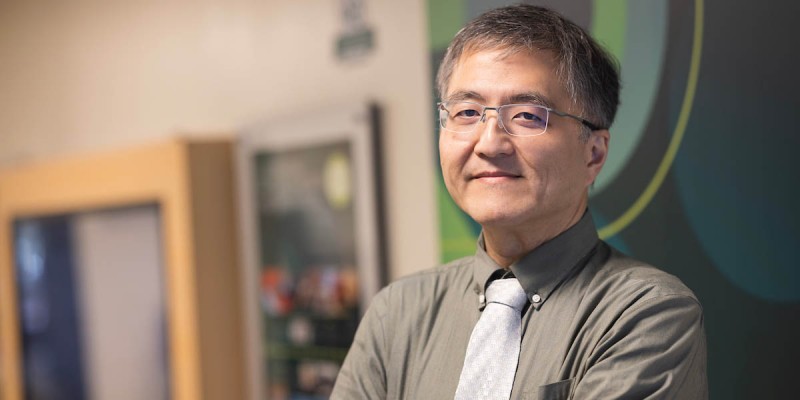
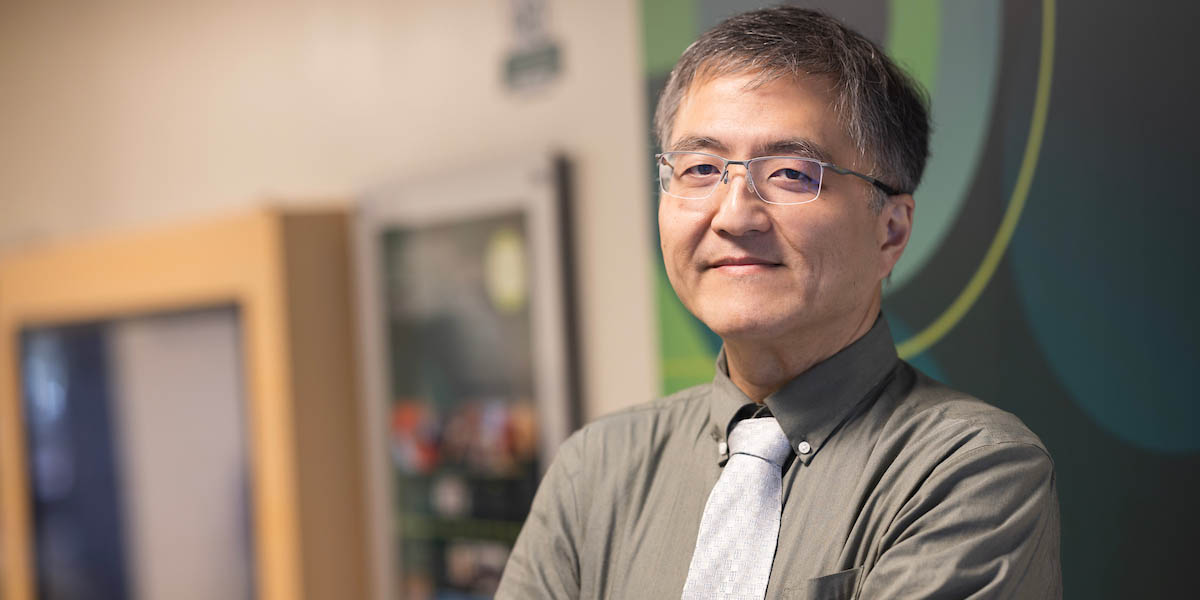
In November, Kuang-Ching “KC” Wang joined Binghamton University and the Thomas J. Watson College of Engineering and Applied Science as a Professor of Empire Innovation and School of Computing director.
At Clemson University, Wang held a variety of leadership roles and directed more than $100 million in sponsored research, including leading multi-university teams on landmark National Science Foundation initiatives such as FABRIC (a U.S.-wide testbed for the next generation of the internet) and CloudLab (a similar effort focused on cloud computing).
SUNY Distinguished Service Professor Weiyi Meng stepped down as SoC director last spring and remains on the faculty.
Online master’s degrees
Starting this fall, students around the world will be able to earn a Binghamton University master’s degree in computer science or information systems from home.
The new programs will offer the same tenure-track faculty, classroom materials and rigorous scholarship as in-person instruction, but with the convenience of high-quality pre-recorded lectures that are broken down into short segments so students can learn at their own pace.
Students in the MSCS program will study core topics such as artificial intelligence, robotics, cybersecurity, computer vision, human-AI interaction, and underlying hardware/software principles and foundations. The MSIS degree is designed for students interested in computer systems from a user and application perspective for careers centered on computer hardware and software systems operations and maintenance.
New AI center
A record-setting $55 million commitment from a Binghamton University alumnus and New York state will establish the Center for AI Responsibility and Research, the first-ever independent artificial intelligence research center at a U.S. public university.
The center will be part of the Empire AI project, an initiative to establish New York as a leader in responsible AI research and development, will be supported by a $30 million commitment from Tom Secunda ’76, MA ’79, co-founder and vice chairman of Bloomberg LP. This will be coupled with a $25 million capital investment from Gov. Kathy Hochul and the New York State Legislature.
Binghamton is one of the first members of the Empire AI Consortium using Empire Alpha, the supercomputer housed at the State University of New York at Buffalo until the full-scale Empire AI computing is completed. Faculty researchers and their students at Binghamton are working on 10 approved projects to advance AI for the public good in New York.
NSF CAREER Award winner
Assistant Professor Yincheng Jin won a $599,588 National Science Foundation CAREER grant to design a daily American Sign Language training platform using wearable technology and artificial intelligence. The CAREER Award is the highest distinction the NSF offers to researchers it has tapped to become future leaders in their fields.
Other research news
A Stanford University study that looks at the impact of scientists worldwide identified 29 current Binghamton University faculty who were among the top 2% of all researchers in the world in their fields in 2024. Among those cited were Associate Professor Jeremy Blackburn and Distinguished Professor Lijun Yin.
A story in the 2025 Watson Review magazine discussed robotics research at Watson College and featured innovative work from Associate Professor Shiqi Zhang, Assistant Professor Monika Roznere ’18, and Assistant Professor Jayson Boubin.
A story in last year’s Binghamton University research magazine highlighted Boubin’s work programming drones to find and analyze issues on the ground, including invasive species and landmines.
Also, Boubin and PhD student Melika Dastranj participated in the SUNY Summer Startup School (S4) and took home the grand prize of $50,000 as the winner of Demo Day. REMIX, Boubin’s company, aims to develop real-time processing for large amounts of drone data to determine what are true pixels of light from an object versus reflections from surrounding objects mistaken for real things.
Another research magazine story looked at cancer detection across campus, including Professor of Empire Innovation Nancy Guo’s research using artificial intelligence to examine millions of medical data points to try to discover better treatment for breast cancer.
In collaboration with the startup company Cauth AI, faculty and students have developed My Music My Choice (MMMC), a digital safeguard that empowers artists by protecting their songs from generative AI cloning. Leading the research at Binghamton is Umur Aybars Ciftci ’11, MS ’14, PhD ’21, a research assistant professor in the First-Year Research Immersion Program.
The new Watson College Seed Grant Program for Major Research Proposal Development includes several SoC faculty among the inaugural awardees. The program is designed as a catalyst for accelerating interdisciplinary research, addressing pressing scientific and technological challenges while demonstrating a path to major research funding from external sponsors.
Student news
New club StackHacks helps students develop their technical and teamwork skills through real-world projects, mentorship and networking. It welcomes members of all backgrounds and experience levels, creating a space where everyone learns and grows together.
Pallabi Mitra, MS ’27, is an international student from Kolkata, India, who now helps other prospective students as a graduate assistant for the Watson Graduate Recruiting Office. Outside of work, Mitra has found unobstructed access to explore the environment through nearby parks and trails around upstate New York.
Michael Bronikowski ’24, an MSCS student, and Luke Riddoch ’24 (now a configuration management engineer at GE Vernova) placed first in the 2025 New York Business Plan Competition’s Food and Agtech track. Their project, BuzzHive, builds artificial intelligence-powered beehives that monitor bee health, optimize pollination and increase honeybee survival rates to help secure the future of the agricultural food ecosystem.
A story in the 2025 Watson Review magazine focused on students who are volunteering their time in the community. Gianni Zaccarelli gives time to the local branch of Habitat for Humanity through Binghamton University’s Center for Civic Engagement, while Bryan Perez ’25 (before graduating last May) helped out at the Broome County Humane Society.
Another piece in the Watson Review looked at undergraduates who are doing real-world research alongside faculty. Rowan Devereux-Smith ’26 is working on optimizing transistor routing in computer chips with Associate Professor Patrick Madden.
Last year, SoC students matched wits with teams from around the world in the MITRE Embedded Capture the Flag Competition. They finished at #26 overall and #2 in New York — respectable rankings for an inaugural outing. Associate Professor Aravind Prakash serves as the team’s advisor.
The Watson Future Faculty Fellows (WF3) Program, launched last year, will foster tomorrow’s academic leaders with professional training for selected doctoral students to encourage successful faculty careers. PhD student Amir Esmaeili was among the first cohort.
Alumni news
James Bankoski ’91, a vice president of engineering at Google, was honored last year by the Binghamton University Alumni Association. He has more than 30 years of experience managing teams and developing technologies that have significantly impacted the web. He has played a key role in creating video and image codecs used by billions globally. His leadership has driven advancements in web performance, capabilities, security and privacy, benefiting many Google businesses. He currently leads 540 engineers for Google Chrome.
John MacDonald ’92, MS ’98, has worked in industry for more than 25 years, where he’s had a front-row seat to the evolution of computer science at IBM Corp. and Cisco Systems. He’s also been an adjunct lecturer for more than 12 years at the School of Management, teaching courses in project management, databases and strategic business communications.
Michael Fasching, MS ’25, had experience with software development and programming languages but felt attracted to the information systems master’s program because it offers more hands-on, applied instruction rather than the theoretical hardware and software foundations of traditional computer science.
While she was still a student, Rimjhim Singh, MS ’25, helped to build new software for the Doctor of Physical Therapy program at the Decker College of Nursing and Health Sciences. B-Competent is a dashboard created that displays competency-based assessment data to DPT students, giving a clear understanding of their performance.