Vissi d’arte: Alumna returns to campus to share her opera journey
Caitlin Gotimer ’15 discovered her gift at Binghamton. Now she sings on stages around the world
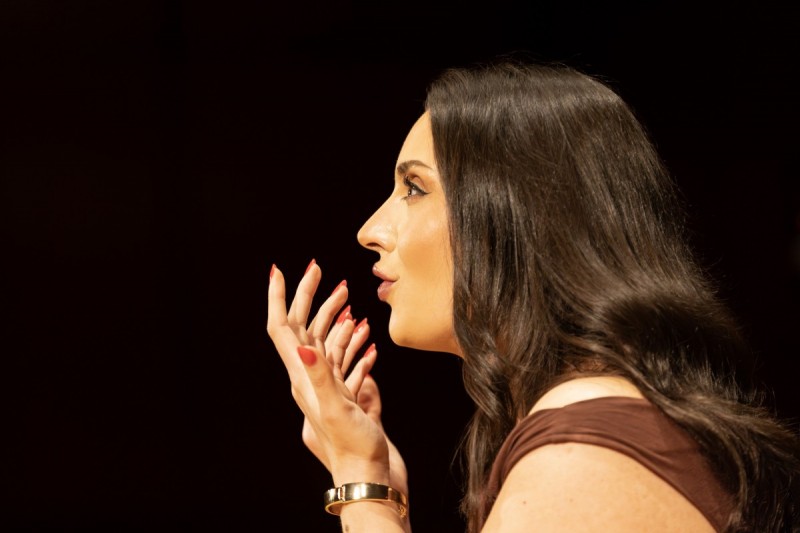

Though your dreams be tossed and blown
Walk on, walk on, with hope in your heart
And you’ll never walk alone!
Growing up in her Long Island town, Caitlin Gotimer ’15 never had a real voice lesson — save for a single session at age 8, when she was taught how to use a microphone. She took part in her high school’s musical theater productions just for fun.
She was just 17 years old when she arrived at Binghamton University, a biology major lonely for the kind of friends that only the performing arts can bring. With that in mind, she decided to audition for the chorus for that season’s musical theater production. An added perk: Students invited to join the show’s chorus would receive a free voice lesson, courtesy of a graduate student.
The song she chose, “You’ll Never Walk Alone” from Rodgers and Hammerstein’s Carousel, is a piece with a more operatic bent than the typical musical. Not that Gotimer knew a thing about opera; she didn’t grow up in a household that listened to classical music. When she took to the stage that day, she was trying to mimic the singer on a recording she listened to.
To this day, Associate Professor of Voice Thomas Goodheart can hear every single note that Gotimer sang, ringing through his head.
Although students in the chorus typically don’t major in voice, the coordinator of Harpur College’s voice and opera programs had dropped by to offer some support to the young singers. During those 5 minutes, he recognized the rarity of Gotimer’s gift — not just a beautiful voice, but an exceptional ear, and a dedication to the art.
He asked her to stick around after the auditions ended. His voice studio was already booked for the semester, but he offered her a spot; he would make it work.
Gotimer was stunned.
“You really like my voice? I couldn’t even get the lead in my high school,” she said at the time.
“You’re much better than you think you are,” he replied
Eleven years later, the soprano is a rising star in the opera world. She returned to campus for the Music Department’s Artist in Residence program March 2 through 5, along with Chandler Johnson, director of the Santa Fe Opera Apprentice Program.
It’s the second time that Gotimer has returned to campus as an alumna artist in residence. In addition to giving a master class, she also performed in the Casadesus Recital Hall, alongside Assistant Professor of Voice Brenda Iglesias and student singers, accompanied by pianist Curt Pajer.
“It just happens that my voice is meant to do this,” she said, reflecting on that fateful audition at Binghamton. “From there, things just kept happening.”
“She is one of the best young singers in the world — not America, the world,” Goodheart said. That’s my opinion, but that’s the opinion of other people as well.”
A dream made real
Gotimer honed her art at Binghamton. In addition to productions, she also sang the national anthem during President Barack Obama’s visit to the University.
After Binghamton, she earned her master’s at the University of Cincinnati’s Conservatory of Music, where she won the Corbett Award, which recognizes the program’s best singer. From there, she became a resident artist at the Pittsburgh Opera, where she had her first leading roles on the main stage. Then it was off to the Arizona Opera’s resident artist program, right in the middle of the pandemic.
In Arizona, she had her first opportunity to sing the titular role of Puccini’s Tosca, which is typically performed by artists later in their career. She has sung it many times since, including the Santa Fe Opera’s Apprentice Program. This summer, she’ll sing the part at the Glyndebourne Opera Festival in Great Britain for their first-ever production of Tosca.
Glyndebourne is one of the most famous opera festivals in the world, and to be hired as their first-ever Tosca is a major deal, Goodheart pointed out.
“If you had asked me if I would have thought my calling card would be Tosca, I would have said, ‘Absolutely not,’” Gotimer reflected. “But I feel that my path has been laid out, as long as I do the work.”
Her dream role: Leonora in Verdi’s Il Trovatore. As a sophomore, Gotimer ran the Forum Theater’s supertitles during the Tri-Cities Opera production of Il Trovatore, which required her to read the score closely.
“I fell in love with that opera by sitting there, reading the score every night and watching it happen,” he said. “I thought, ‘This is the pinnacle of what opera is like.’ Every scene has absolutely incredible music.”
Gotimer often tells the story of her Binghamton audition and her accidental arrival into the world that has since defined her. Young singers are often advised on the difficulties of a performing life: the constant practice and memorization, the heavy competition, the risks — the sheer necessity of putting all of yourself into a career that may never take flight.
But she wants students to see the other side, too: The life of an artist is both possible and fulfilling.
“I love my life — traveling, seeing the world, doing what I love. Oftentimes, I think young singers only hear about how difficult it is, how hard they have to work, how cutthroat it can be,” she said. “We need to know the realities of what we’re going into, but I always say that hard work puts you in places where luck can find you. It is a beautiful dream to chase.”
It’s also a dream that requires support and participation, and not only from family and friends. If you want to support the next generation of artists and performers, Gotimer has some simple advice: Show up. Attend concerts and shows, and showcases.
Chances are that you’ll also have a great time. Recently, her parents attended a community college performance of a musical they had seen on Broadway several times; they enjoyed it just as much, she said.
“These days, I am working at a high level, but it means something to me when people are in the audience,” she said. “And I know that it means a lot to students when they have midday recitals or do scenes; it matters that ears hear it and that people talk to them afterward.”