NSF Energy Storage Engine enters second phase with ambitious plans
Binghamton University-led initiative awarded $45M
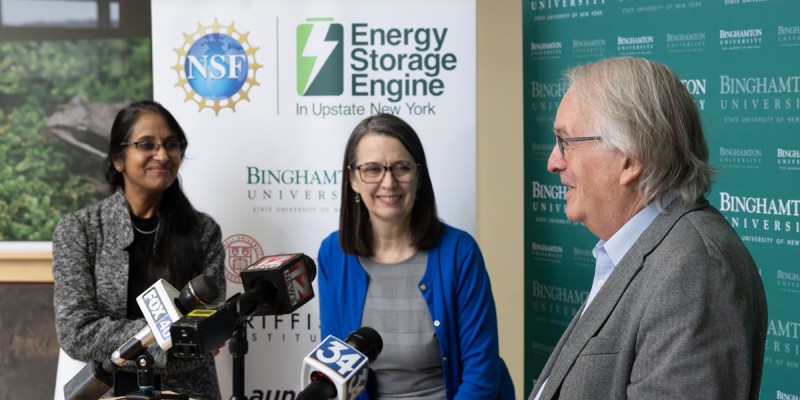
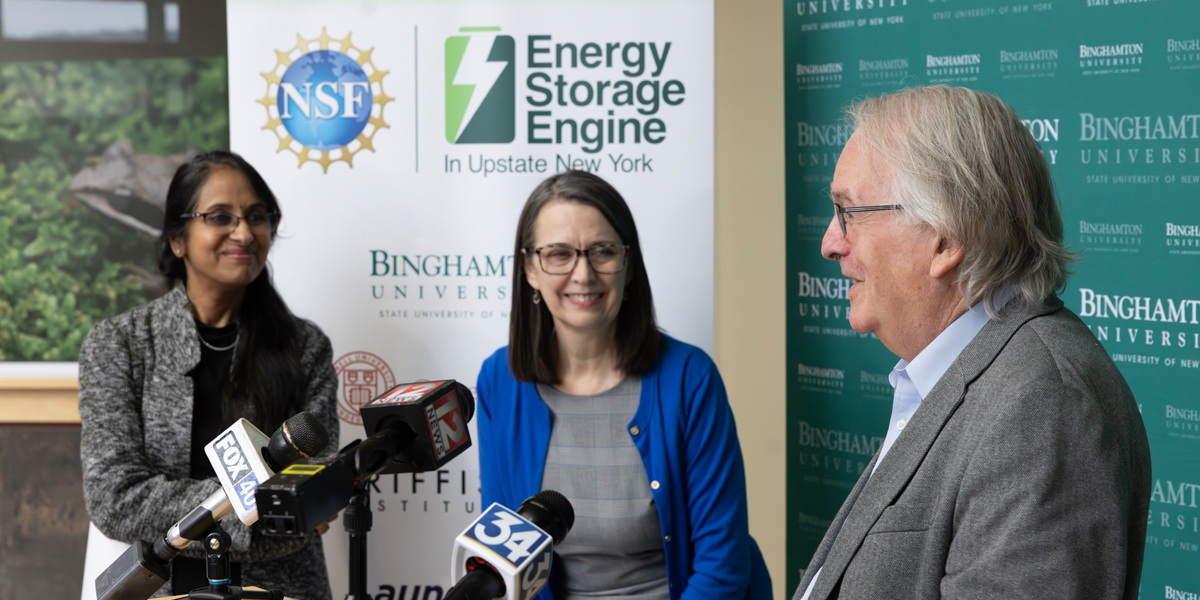
Nobel laureate M. Stanley Whittingham, chief innovation officer for the NSF Energy Storage Engine, addresses local reporters on March 23 with Binghamton University President Anne D’Alleva, center, and Engine CEO Meera Sampath. Image Credit: Jonathan Cohen.
The National Science Foundation Energy Storage Engine in Upstate New York, which aims to transform upstate into America’s battery tech capital, will receive $45 million over three years for the second phase of the program.
The initiative, led by Binghamton University and its core partners — Cornell University, Rochester Institute of Technology, Syracuse University, Griffiss Institute, Launch-NY, and NY-BEST — is one of nine inaugural Engines launched under NSF’s Regional Innovation Engines program.
Since its launch in 2024, the Energy Storage Engine has received $15 million from the NSF. The initiative may receive up to $160 million over 10 years.
“The NSF Energy Storage Engine in Upstate New York has already demonstrated its capacity to advance next-gen battery and energy storage systems that will be critical for our nation’s energy needs in the years to come,” said Erwin Gianchandani, NSF assistant director for Technology, Innovation and Partnerships. “We have already seen NSF’s initial investment attract matching private-sector investment and create job training opportunities — and we look forward to it ultimately building a durable U.S. competitive advantage in energy storage innovation.”
In this second phase, the Energy Storage Engine will prioritize next-gen battery systems and solutions that advance safety, address challenges in building power systems for energy storage applications, drive cost and resource efficiency in manufacturing, and integrate AI into all aspects of energy storage from materials discovery to production efficiency. It will deepen its focus on the needs of regional corporations and the defense sector, as it continues to support startup companies.
Binghamton University President Anne D’Alleva congratulated the Engine team for its successes during the past two years. “This renewal acknowledges the Engine’s remarkable progress and early impact, the collective strength of its extensive partner ecosystem, and the bold vision guiding its future,” she said. “The NSF Energy Storage Engine is already successfully advancing an ambitious plan to establish upstate New York as America’s battery tech capital, building on our region’s strong legacy of innovation and manufacturing excellence. We thank the National Science Foundation for its support and unwavering commitment to this program.”
The Engine’s portfolio includes research and innovation, technology transfer, workforce development, and community engagement initiatives with partners across its 27-county region of service in upstate New York and beyond. In less than two years, the Engine has:
• Supported 15 industry-academia teams driving leapfrog innovations in next-gen cell manufacturing and process innovation
• Funded more than 15 high-tech battery startups
• Aided companies with access to infrastructure, capital, and technology resources
These startups have received more than $20 million in follow-on funding in the past year alone. They have also won national recognition, including the Battery Manufacturer of the Year award.
“With two years of sustained momentum and demonstrated success, we are on track to become a national leader in solving the U.S. battery industry’s most critical challenges with exceptional speed, scale, cost-efficiency, and quality, while driving transformational growth across upstate New York’s battery ecosystem,” Engine CEO Meera Sampath said. “Our strategy is strongly aligned with national R&D priorities: advancing critical technologies that strengthen national security, securing American energy dominance, and driving economic growth through regional innovation. Our motto for the next phase is ‘bigger, bolder, and better’ with programs and partnerships that will help us deliver on our vision.”
The Engine has served more than 300 learners from K-12 to adults across upstate New York through its energy storage workforce development network. It will launch an advanced battery safety testing facility, the first of its kind in the Northeast, at Rochester Institute of Technology this summer. Its community outreach programs have reached more than 8,000 constituents.
During phase two, special emphasis will be given to preparing the next generation of engineers and scientists to meet the growing workforce demand in the battery industry, both locally and nationally.
The Engine will receive up to $16 million in matching funds from Empire State Development. In phase one, ESD invested $3 million.
“Upstate New York is home to world-class innovation assets, and the NSF Engine exemplifies how we leverage those resources to lead in important sectors like energy storage,” said Ben Verschueren, executive director of Empire State Development’s Division of Science, Technology and Innovation (NYSTAR) and a member of the Engine’s governance board. “ESD is thrilled to support this next phase of building an already expansive ecosystem that drives long-term economic impact for the region, the state, and the entire nation.”
The Engine has built a coalition of more than 60 academic, industry, nonprofit, community, and government partners who have been the driving force behind these accomplishments.
Heather Hage, president and CEO of the Griffiss Institute, chairs the Engine’s Governance Board. “This next phase of extraordinary investment in our community will catalyze new technologies, new ventures, and a highly skilled workforce to stimulate more good jobs for upstate New Yorkers,” she said. “A stronger domestic battery supply chain is essential to American national security and economic competitiveness, and upstate New York is ready to lead.”
M. Stanley Whittingham, who was awarded the Nobel Prize in Chemistry in 2019 for his work in developing the lithium-ion battery, serves as the Engine’s chief innovation officer. He said the award is vital to building a secure supply chain in the United States.
“Batteries for America by America is our goal,” said Whittingham, a distinguished professor of chemistry at Binghamton University. “The Engine, combined with the other key capabilities we are building in upstate New York, including Battery-NY, a peerless battery pilot manufacturing facility, are moving us toward realizing this goal.”
The NSF Engine complements the robust set of initiatives offered by New Energy New York (NENY), which earned the U.S. Economic Development Administration (EDA) Build Back Better Regional Challenge (BBBRC) award in September 2022 and designation as a federal Tech Hub in October 2023. Binghamton University is the only school to lead initiatives that received all three designations.