Distinguished Binghamton Professor and Nobel laureate elected AAAS Fellow
Distinguished Professor of Chemistry M. Stanley Whittingham elected for his decades of lithium-ion battery research
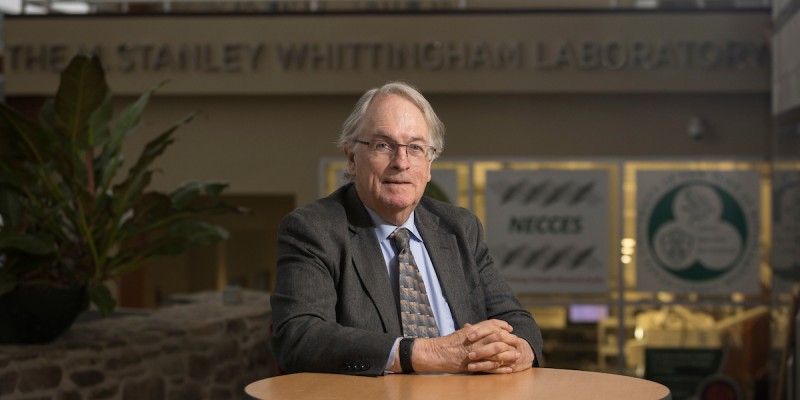
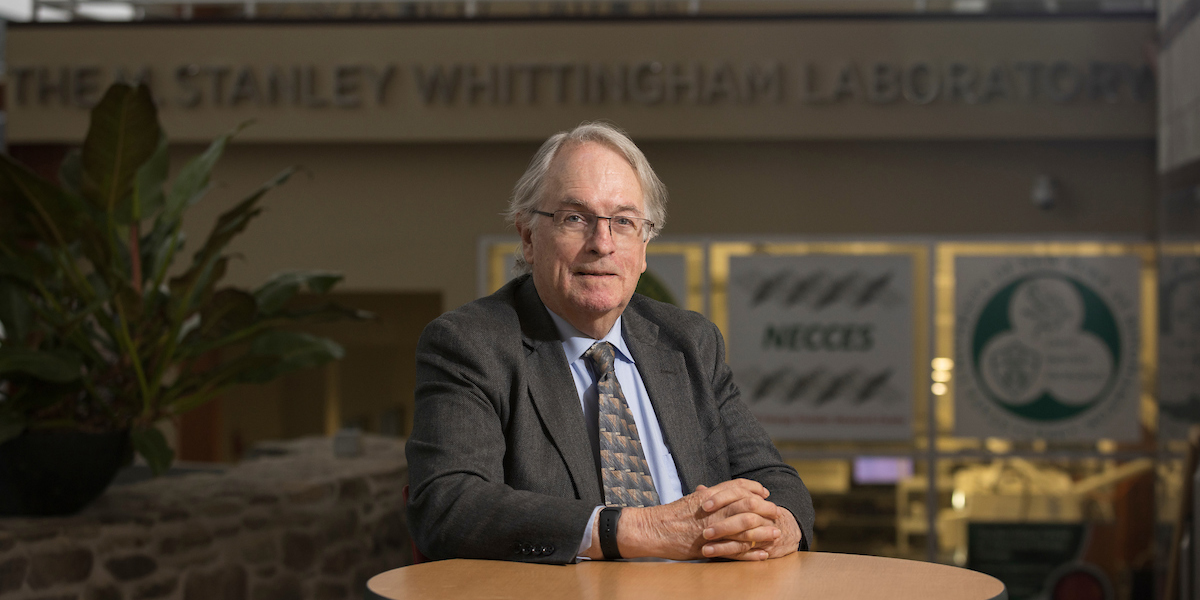
Binghamton University Distinguished Professor of Chemistry and Nobel laureate M. Stanley Whittingham has been elected to the rank of AAAS Fellow by the American Association for the Advancement of Science.
Those who are selected to receive the prestigious title are chosen based on their scientific or socially distinguished efforts to advance science or its applications. Members are elected by the Council of the American Association for the Advancement of Science to receive the lifetime honor.
Specifically, Whittingham is being honored for “discovering the underlying science of intercalation chemistry and its applications to the lithium-ion battery.”
“The importance of lithium-ion battery research cannot be understated, and I’m proud to have contributed to the advancement of such a pivotal technology over the past three decades,” Whittingham said. “I am incredibly thankful for the American Association for the Advancement of Science, not only for this distinction, but for its work of promoting scientific progress to create a better world.”
Whittingham invented the first lithium-ion battery in 1973 while working at Exxon Research and Engineering Co. and holds the original patent on the concept of the use of intercalation chemistry in high-power density. Lithium-ion batteries are now the standard for the modern devices we use on a daily basis – including laptops, power tools, portable electronics, and electric vehicles.
He came to Binghamton University after 16 years at Exxon and Schlumberger and continued his groundbreaking research, publishing hundreds of articles in leading journals and receiving 16 patents. Whittingham also helped establish the Materials Science and Engineering Program, and had held leadership positions at the American Chemical Society, the Electrochemical Society, and the Materials Research Society.
“I warmly congratulate Distinguished Professor Whittingham for his election as a fellow of the American Association for the Advancement of Science,” said President Anne D’Alleva. “This is a significant honor for Dr. Whittingham, who is most certainly worthy of recognition for his meritorious contributions to science. I am also deeply grateful for his contributions to the Binghamton University community in his many capacities as a researcher, teacher, mentor, and friend.”
Whittingham was awarded the 2019 Nobel Prize in Chemistry for his contribution to the research and development of the lithium-ion battery.
“Our congratulations to Distinguished Professor M. Stanley Whittingham as he adds AAAS Fellow to his long list of accolades,” SUNY Chancellor John B. King Jr. said. ”Professor Whittingham is a leader of lithium-ion battery innovation, which has spurred a growing industry in the Southern Tier region, and for the State University of New York at Binghamton and the entire SUNY system, an enthusiastic researcher that inspires students to never give up as they pursue their dreams.”
Whittingham is the second AAAS Fellow at Binghamton University. Michael Little, Distinguished Professor Emeritus of Anthropology, was elected in 1980.