Binghamton University celebrates graduate student achievements
Doctoral students receive awards for teaching, research, and service excellence during annual ceremony
Pursuing a doctorate is a bit like surviving on the Red Planet, as depicted in the 2015 Ridley Scott film The Martian.
Persistence and resilience are essential ingredients to graduate study, observed Terrence Deak, vice provost and dean of Binghamton University’s Graduate School. Like Mark Watney, the film’s protagonist, graduate students can face seemingly insurmountable challenges and find innovative ways to overcome them, on their journey to academia’s highest degree, he said.
The achievements of Binghamton’s doctoral candidates were highlighted during the University’s 2026 Graduate Student Excellence Awards ceremony and reception, held March 26 in the University Union.
Doctoral students play an outsized role at the University, linking full-time faculty with undergraduates, observed Provost Donald Hall, executive vice president of Academic Affairs. Academic success depends on mentorship, and graduate students aren’t just recipients of guidance and encouragement; they also provide inspiration to undergraduates just starting their scholarly adventure.
Binghamton University’s Graduate School alumni become leaders in academia, business, media and the arts, said President Anne D’Alleva, noting that the University’s graduate programs, faculty and students are renowned across the world. She knows this firsthand: As a University of Connecticut faculty member, she visited campus in 2011 to give a talk and seminar for Binghamton graduate students.
“Graduate students contribute so much to this campus through research, teaching and service, and it’s very important that we take a moment to celebrate you for all of your many talents and contributions,” she said. “Events like this are so important because they help establish community and continuity linking the University’s past and its future.”
Award for Excellence in Teaching Recipients
Recipients of this award were honored for their engaging lectures, mentorship and dedicating to teaching:
- Kenyon Cavender, Sociology
- Colin Clark, Chemistry
- Katherine Elacqua, Clinical Psychology
- Sophia Fabrizio, Cognitive Psychology
- Yiming Hong, Political Science
- Youngin Jang, History
- Abdinasir Jimale, Political Science
- Nicholas Kanaar, English
- Rachel Kruger, Biological Sciences
- Nermin Mohamed, Biological Sciences
- Christopher Schroeder, Mathematics
- Iana Shchetinskaia, History
- Lisa Timmerman, Comparative Literature
- Stefan Viola, Mathematics
Award for Excellence in Research Recipients
- The work of Prabhu Bharathan, in Materials Science and Engineering, advances clean energy technologies. He has developed efficient, low-cost catalysts for hydrogen production and water splitting.
- Mahmood Chahari in Mechanical Engineering investigates innovative transduction mechanisms to convert motion to electricity for health monitoring of total knee replacements.
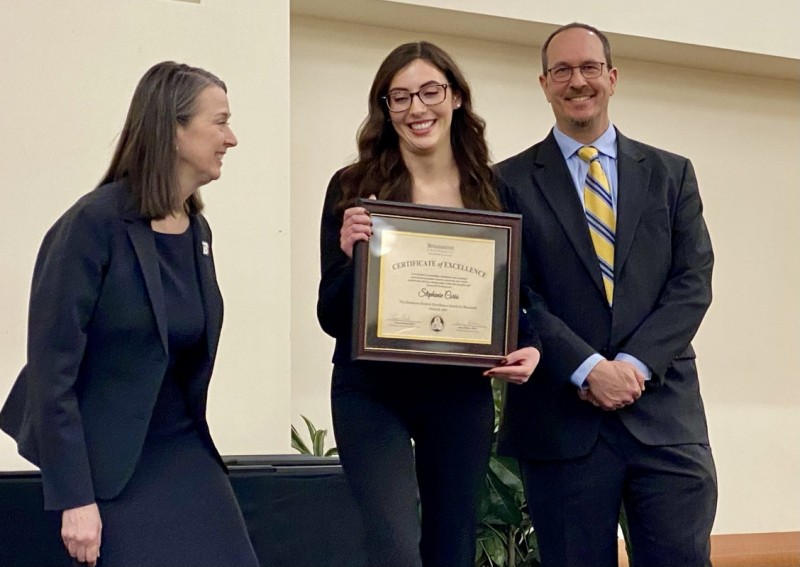
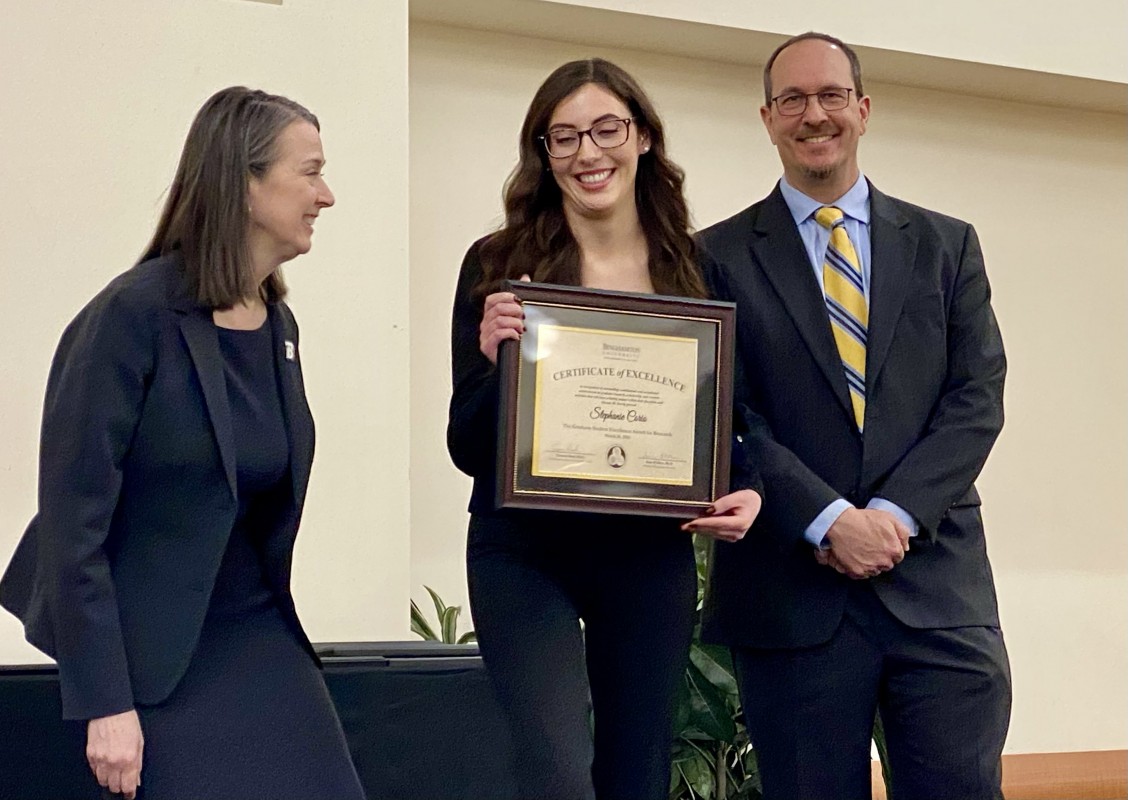
- Stephanie Corio, in Chemistry, studies reaction mechanisms using computational and experimental techniques to generate predictive models for improving catalyst design and reaction discovery.
- The work of Yang “Lexi” Gao, in Electrical and Computer Engineering, advances sustainable, self-powered wearable electronics. She has developed innovative energy devices that harvest electricity from skin bacteria and ambient moisture, as well as a long-lasting, power-free glucose sensor.
- Tamas Gerocs, in Sociology, studies the geopolitical effects of green industrial transformation in the periphery of the global economy. He uses examples from Eastern European electric car and battery industries and West African green extractivism.
- The research of Mohsen Hatami, in Electrical and Computer Engineering, bridges the physical and digital worlds by using power grid signals as security footprints. His work protects smart grid infrastructure from sophisticated cyberattacks and enables trustworthy virtual representations of critical systems.
- In her dissertation, doctoral candidate in English Shruti Jain mobilizes a global archive to address the changing status of caste between the 18th and 19th centuries. In addition to her publications, she is also involved in public-facing scholarship such as the Race and Regency podcast.
- Andrea Liss, in Behavioral Neuroscience, investigates astrocytic mechanisms of alcohol-induced cognitive dysfunction to identify new drug targets for alcohol use disorder.
- Yulin Liu, in Industrial and Systems Engineering, works on additive manufacturing and advanced sintering of metallic materials.
- Charlie McDonald, in Clinical Psychology, studies trauma and stressor-related disorders. He uses a multimethod approach, including fMRI and brain stimulation, to understand the cognitive and neural pathways of disconnection to internal bodily signals common in PTSD and dissociation.
- The research of Jaime Mendelis, in Educational Theory and Practice, highlights how relationships and emotions matter in teaching, even as education becomes more automated.
- Abdullah Faisal Pasha, in Chemistry, has developed novel electrochemical approaches to create highly efficient nanoporous materials and advanced alloy structures. His work enables tunable mechanical and catalytic properties, offering new possibilities for clean energy technologies, electronics, and sustainable manufacturing.
- Shyam Patel, in Materials Science and Engineering, uses advanced imaging and spectroscopy to observe how materials change in real time under reactive conditions. His discoveries reveal atomic-scale transformations with implications for energy and catalytic technologies.
- Mohammad Najeh Samara, in Industrial and Systems Engineering, applies data-driven approaches to improve healthcare systems. His research has resulted in several peer-reviewed publications and partnerships with hospitals and veteran care organizations .
- Christopher Schroeder has earned a doctorate in Physics and is working on a second in Mathematics, producing papers that deepen our understanding of how internal symmetries govern complex systems. He also translated an 833-page German mathematical text into English during his spare time.
- Akbar Sohltalab, in Mechanical Engineering, proposed a new theory explaining how brain connections form and reorganize as the human brain grows and folds, providing insights into both healthy development and developmental disorders.
- The research of Sevgi Soylemezgil, in Finance, examines how credit markets price biodiversity risk. She found that creditors began requiring a biodiversity risk premium following the 2021 UN Biodiversity Conference, penalizing firms that harm biodiversity.
Award for Excellence in Service and Outreach Recipients
- Eunji Hong, in Biomedical Engineering, translates cutting-edge research into engaging educational outreach programs, including entrepreneurship initiatives and workshops to encourage K-12 students to pursue careers in science and technology.
- Aly Milks, in Biological Sciences, organizes Binghamton University’s EcoBlitz, which brings together hundreds of participants to engage in citizen science. She expanded the EcoBlitz to the Ross Park Zoo, creating educational stations about New York’s biodiversity.
- Michael Williamson has served as treasurer for the Graduate English Organization, organized the English Department’s annual conference, chaired numerous sessions at national conferences, and helped those afflicted with addiction in the Binghamton community.
- Kiana Tanghatar, in Community Research and Action, is a graduate assistant on Speech-Language Pathology. In addition to serving on the Presidential Search Committee and as vice president of her graduate student organization, she also provides speech services in the Binghamton community, tutors adult learners and develops innovative training tools as a Digital Scholarship & Communications Fellow.
A joint effort of the Binghamton University Council and the Binghamton University Foundation, the Council/Foundation Award for Service to the University is given to students who have served the campus with outstanding dedication, exemplary service and leadership. This year’s award went to Anthropology doctoral candidate Margaret Duris, who has served as research coordinator for the Lyme Disease Research Project. Also a graduate assistant, she revitalized the undergraduate Anthropology Club, organized events such as World Anthropology Day, and created a new LinkedIn page highlighting student achievements.
“Service is often under-appreciated and forms the invisible structure of our departments and our disciplines. It’s the committee work, the peer mentorship and the community outreach that ensures our academic planet keeps on spinning,” Deak said.