Earth Systems Geophysics: New textbook named a PROSE Award finalist
Professor Emeritus Steve Dickman spent years writing the massive text, which explains how the Earth functions
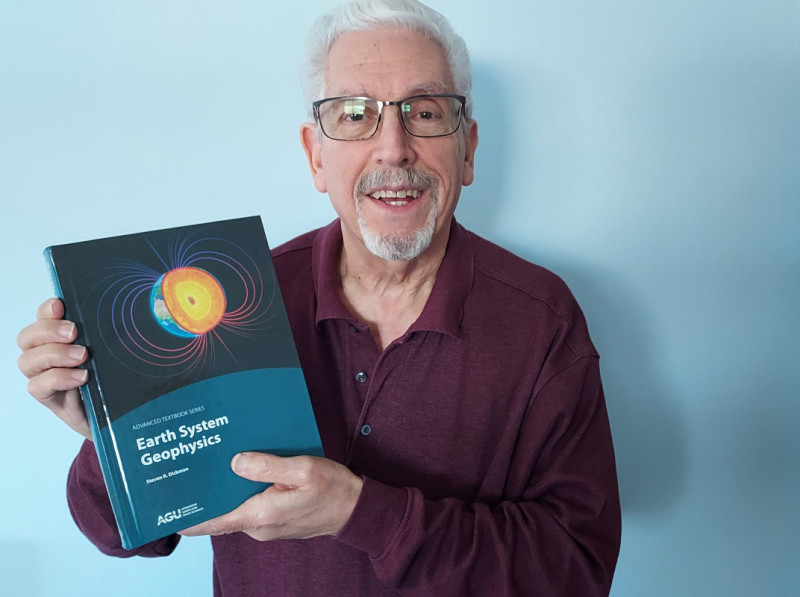
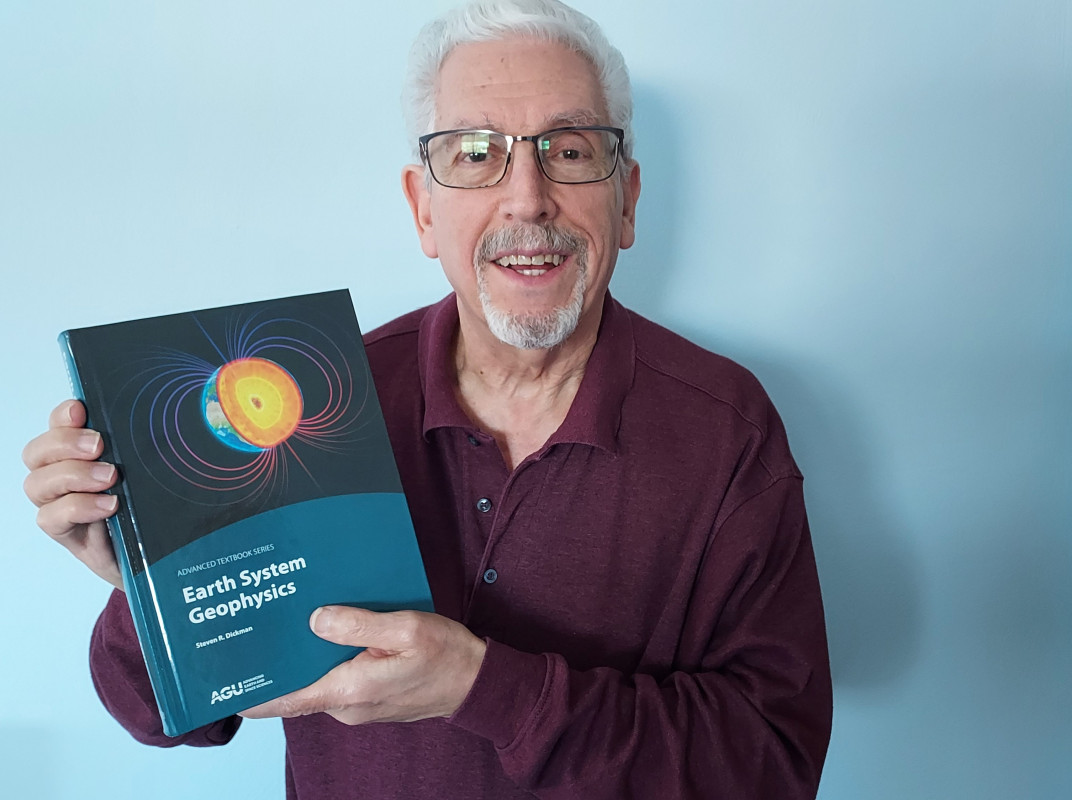
Perhaps it’s no surprise that Binghamton University Professor Emeritus of Earth Sciences Steve Dickman’s textbook Earth System Geophysics took years to complete.
The book is about how the Earth works, a massive topic, much of which is the subject of ongoing, active research around the globe. The end result is also massive: around 900 pages long, with a 20-page index and 100 pages of references.
“My book is an attempt to present geophysics from a modern, unified perspective,” explained Dickman, who retired from Binghamton in 2015 after a 38-year career.
Published jointly by Wiley and the American Geophysical Union (AGU), his book was a finalist for the 2026 Association of American Publishers Awards for Professional and Scholarly Excellence (PROSE Awards) in the Earth Science category. That makes it one of the top three Earth Sciences books published in 2026.
The length and numerous color figures dissuaded one publisher from taking on the project. But the size also provides an unexpected benefit: Part of the AGU’s Advanced Textbook Series, the textbook can be used for multiple courses in traditional geophysics, global warming or planetology, and its extensive bibliography is useful for graduate seminar courses.
Dickman worked on it intermittently over the years, buckling down on the project in 2006. But after obtaining a three-year research grant in 2007, he sidelined the project until 2013.
“Beginning in 2014, I dedicated almost every free moment and then, after retiring, worked on it full time,” he said.
The importance of convection
Traditionally, geophysics has tended to be discussed from the standpoint of plate tectonics, in which the outermost, crustal layer of Earth is divided into different sections, known as plates. Plate tectonics successfully explains phenomena such as earthquakes, which occur when plates collide, rub or pull apart as they move. Their movement is slow, typically a few inches per year; over vast periods of time, this leads to continental drift.
“What interests me more is the reason continents and plates move,” Dickman said. “The underlying solid earth is actually moving, dragging the plates along, very slowly but inexorably; that underlying motion — called mantle convection — is driven by temperature differences within and at the top and bottom of the solid earth.”
The way convection works is simple, and familiar to anyone who has heated a pot of water on a stove, Dickman pointed out. The heat expands the water nearest to the heat source, making it less dense and therefore subject to rising. The water at the top is relatively cool, giving off its heat to the air above; that cooler water is therefore denser and sinks back down.
Every component of the Earth system — the central core, the mantle, the oceans and the atmosphere — exhibits convection as a consequence of boundary or internal temperature differences, he said.
“Such convection is important, as it initiates and contributes to (or even dominates) that component’s behavior,” he said. “This unified perspective has not previously been emphasized in geophysics textbooks.”
The book highlights the role that convection plays throughout the Earth system, presenting the information in a clear and readable way. Worried about math? Don’t be: The math needed to understand the Earth’s physical processes is presented gradually and gently, so the reader doesn’t become intimidated.
“Given my efforts to make the writing clear and readable despite the subject matter being technical, I really got a kick out of the competition being named the prose award,” Dickman quipped.