Binghamton students contribute to international report on gender inequality through project at United Nations Headquarters
Students learn more about women in diplomacy through an ongoing initiative launched by the London School of Economics and Political Science.
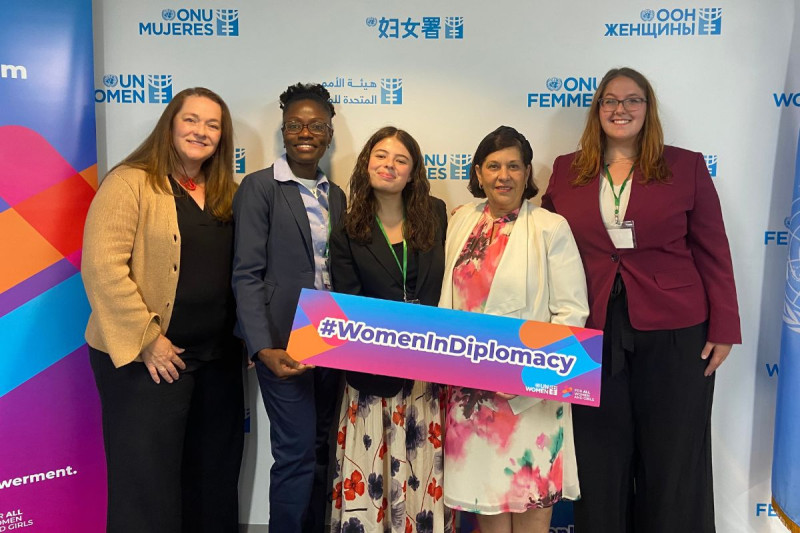
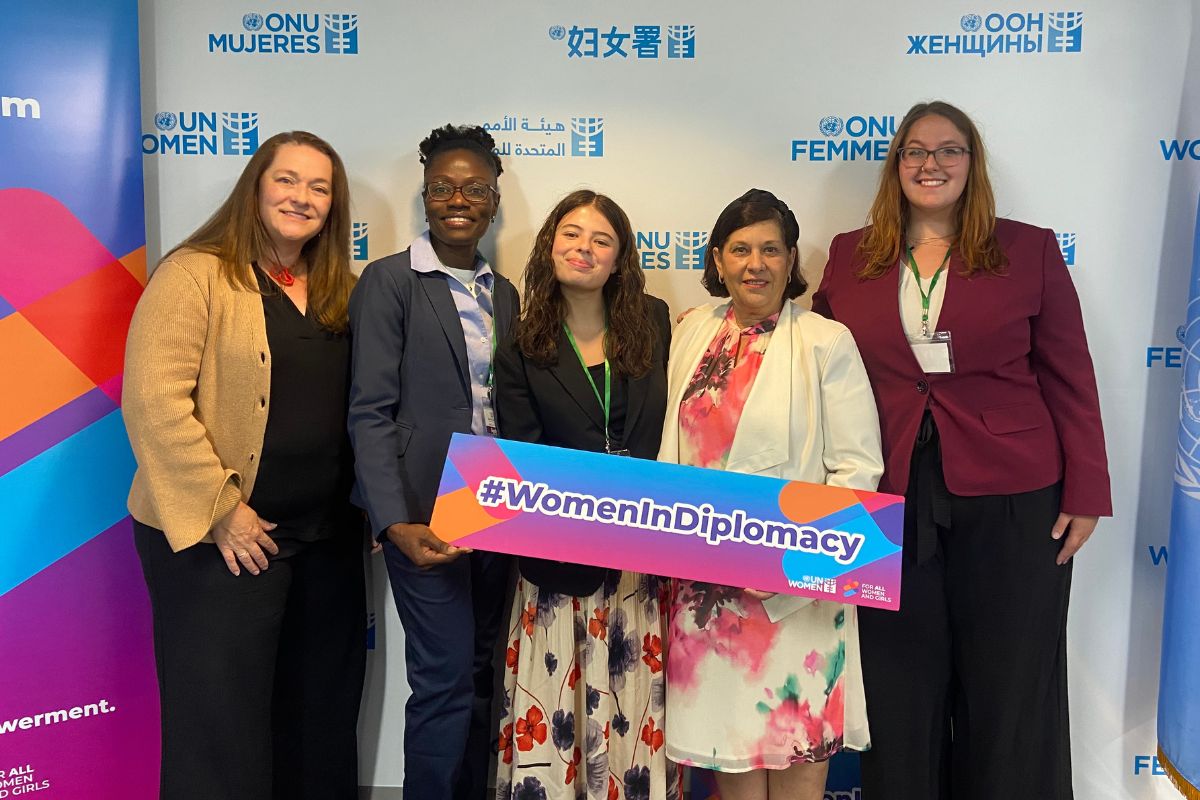
Three Binghamton University students are seeing their work make a difference after contributing to a major report on addressing the challenges facing women in diplomacy.
Binghamton students Ammcise Apply, Laurie Kern, and Lauren Wilner participated in the Women in Diplomacy Project held at the United Nations (UN) Women Headquarters in New York in September 2025. The project focuses on strengthening women’s voices in international diplomacy through open conversation and dialogue. Students took an active role in the project by attending these meetings and compiling the information.
The report, which launched on March 5, is titled “Strengthening the Representation of Women in Diplomacy: Lessons from the Field.” The final report aims to “situate the challenges to women’s representation in diplomacy within their broader institutional and socio-political contexts and identifies practical, actionable and transferable solutions,” according to London School of Economics and Political Science (LSE), the organization that created the Women in Diplomacy Project.
“It felt surreal, actually seeing my name in the acknowledgments section of this report. Often times, students are the backbones for reports, and receive little credit. I appreciate that the Kaschak Institute ensures that you will be given credit for your work,” said Kern. “I think that this project has the capability to make real change in the diplomatic world. I am so excited that my contributions will be used in something feasible.”
The Women in Diplomacy Project is an ongoing initiative that was launched by LSE in 2022. The project has three main goals: explore the misrepresentation and underrepresentation of women in diplomacy, to understand and overcome the obstacles to representation, and to make policy recommendations to improve the representation of women in diplomacy.
Binghamton’s Kaschak Institute for Social Justice for Women and Girls collaborated with UN Women and LSE. Through this collaboration, Apply, Kern, and Wilner, were sent to participate in the conversation about women in diplomacy. At the meeting, they listened to female delegates from all over the world discuss how to solve sexism in international diplomacy.
“What struck me most during the dialogue was hearing women diplomats openly discuss the systemic barriers they continue to encounter: gender bias in appointments and negotiations, unequal access to high-level positions, and the persistent questioning of their authority in male-dominated environments,” Apply said.
The students’ role in the project was to transcribe the delegates’ verbal communication from the meeting into written notes, as the meeting was not allowed to be recorded due to privacy concerns. Following the discussion, Apply, Kern, and Wilner synthesized all the notes, including what each country said and sent them over to LSE, where they were used in the final report to shape the ideas and policies that they hope to implement.
“The experience was very enlightening,” Wilner said. “Sexism is a problem every woman faces, but it was really interesting to see this problem affect women on such a large scale all over the world in a space like international diplomacy, a lot of people in America are not informed about.”
The Women in Diplomacy project identified a range of structural, institutional and cultural barriers, leading to the co-creation of a practical toolkit that addresses these barriers. Four additional papers will be published between April and July to provide more detailed evidence of good practices.
Overall, this project helps “provide leaders, networks and individual managers with ideas for organizational and policy changes that can strengthen women’s representation in diplomacy and foreign policy,” the report said. Binghamton students helped make this possible by being a part of this ongoing project through their personal contributions.
“This experience was transformative,” Apply said. “I came to the meeting as an emerging researcher working at the intersection of climate, gender, and health, and left with a deeper understanding of how diplomacy itself is a critical site for advancing gender justice.”