A million uncoordinated everyday decisions
Binghamton University Distinguished Professor of Education and History Adam Laats places children at the center of his ‘new’ history of American public schools
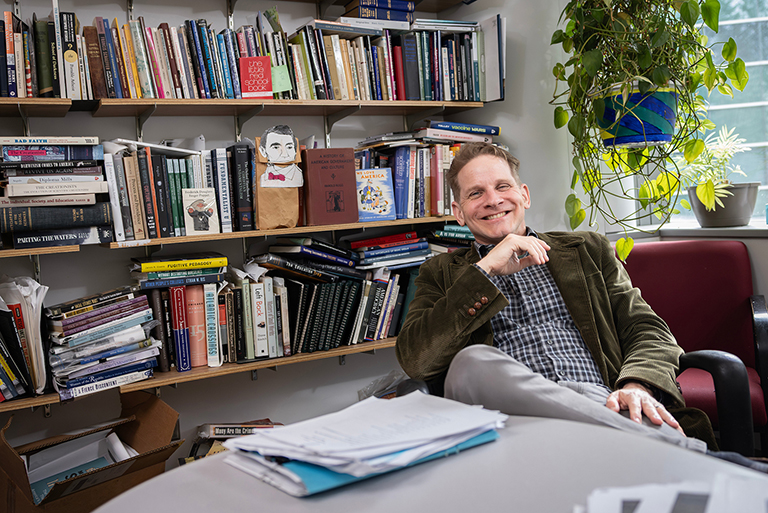
For the most part, the history of America’s public schools is an incomplete story. When we think about the evolution of public schools in the United States, we typically think of seminal figures such as Horace Mann, often considered the father of the American public school system.
However, in his new book, School Children: A New History of American Public Education, Distinguished Professor of Education and History Adam Laats argues that Mann is just a small part of a much bigger story.
“For such an enormous institution, we don’t really have a comprehensive history of how schools have evolved,” he said. “Most of the histories we have — and some of them are very good — cover a small slice of white, middle, and upper-class schools in the Northeast. How you attended school as a white middle-class child in Boston is a familiar story, but American schools have never had just one story.”
He explains that earlier historical accounts focused primarily on institutions, resulting in a narrow narrative that unintentionally excluded white children in the South, as well as poor, enslaved, and Indigenous children, all of whom influenced public education in the United States.
With his extensive work examining the American educational system, Laats offers a new perspective in his latest book, focusing on schoolchildren and highlighting the diverse, expansive, and grassroots development of public schools. It was while writing a book about the notorious school reformer Joseph Lancaster that he came to this understanding.
“While all of the adults and administrators were on board with the Lancastrian reform, the main reason these schools didn’t work is that the children stopped going,” he said. “Enrollment plummeted, and a school without children is just a building.”
Laats began researching this book in 2017 with support from the American Antiquarian Society, which enabled him to conduct summer research visiting archival collections in cities along the Eastern Seaboard. In early 2026, he received an individual fellowship from the National Endowment for the Humanities, allowing him to take a sabbatical during the 2026-27 academic year to fully immerse himself in writing the manuscript.
A very American institution
Laats’ book-in-progress examines the period from 1790 to the Civil War as a formative era for public schools. It was during this period that schools emerged into the form we know today, largely due to broad social shifts in how Americans thought about childhood.
“In 1790, it was common for children to be viewed as remunerative property,” he said. “The concept of ‘fatherhood’ was, for most of us today, uncomfortably close to ‘mastership.’ Parents were seen as owning their children and could transfer this ownership to other adults through apprenticeships or other forms of servitude. By the 1860s, however, there was a significant shift, at least among white elites, toward recognizing children’s autonomy and the belief that they should attend school.”
The history of American public schools parallels the nation’s civic development and its exclusion of contributions from marginalized groups. While public schools during the period Laats examined primarily served white students, Black children were educated in schools founded by Black communities, often in defiance of prohibitive laws. The Cherokee Nation was among the first to enact educational laws, establishing a strong, state-supported system that mandated education for Cherokee children.
The House of Refuge in Albany, New York, is one example of an early 19th-century education initiative aimed at addressing newly emerging social concerns about juvenile delinquency. Although these institutions were ostensibly established to keep children safe and off the streets, they were, in fact, attempts to regulate and control what children were doing. But it’s this tension between adult efforts to control children, children’s desire for autonomy, and the often-overlooked contributions of non-white people that has helped shape public school systems today, Laats argues.
“No matter what it looked like, and often it looked very different,” he said, “every kid—white, black, rich, or poor—was getting educated.”
Laats contends that the top-down, institution-first approach to understanding the history of American public schools has overlooked the significant influence of parents, families, and, most importantly, children. Whether the schools were trying to keep all the children in, as they did in reform institutions, or keep some children out, as took place in segregated systems, it was those children pushing back that forced the institutions to respond and adapt.
“It was a million uncoordinated everyday decisions which were the most powerful forces in shaping schools,” he added.
For Laats, what’s past is prologue. While public schools are imperfect, they remain essential to American public life, shaped by generations of struggle and reform. He points to the failures of privatization, which disproportionately harm poor, rural, and non-white communities and a segregated past that excluded millions of American children, making the case that a strong public educational system is crucial for social justice and the health of American democracy.
“Public schools are a fundamental American civic institution,” Laats emphasized. “And if history has taught us anything, it’s that we cannot be complacent or take public education for granted. Our public schools require ongoing investment — continued attention, resources, and collective commitment from all of us to ensure they remain strong, inclusive, and effective for generations to come.”
Learn more about Laats’ previous works of non-fiction on the history of American education >