Clinician, administrator, scientist, and academic
Decker nursing alumna Katherine Gregory ’96 wins 2026 Alumni Achievement Award
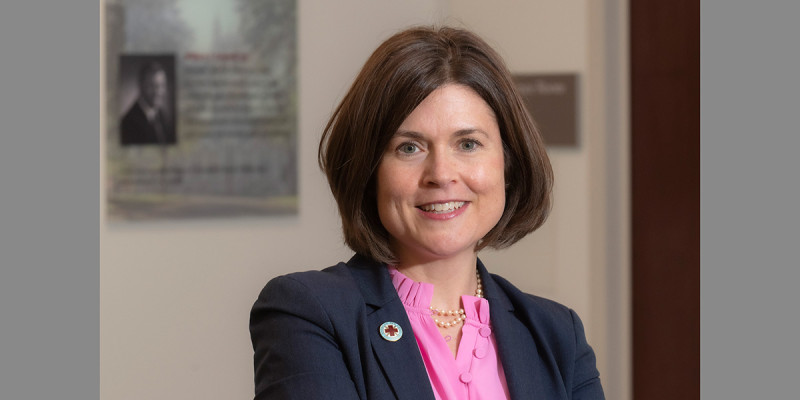
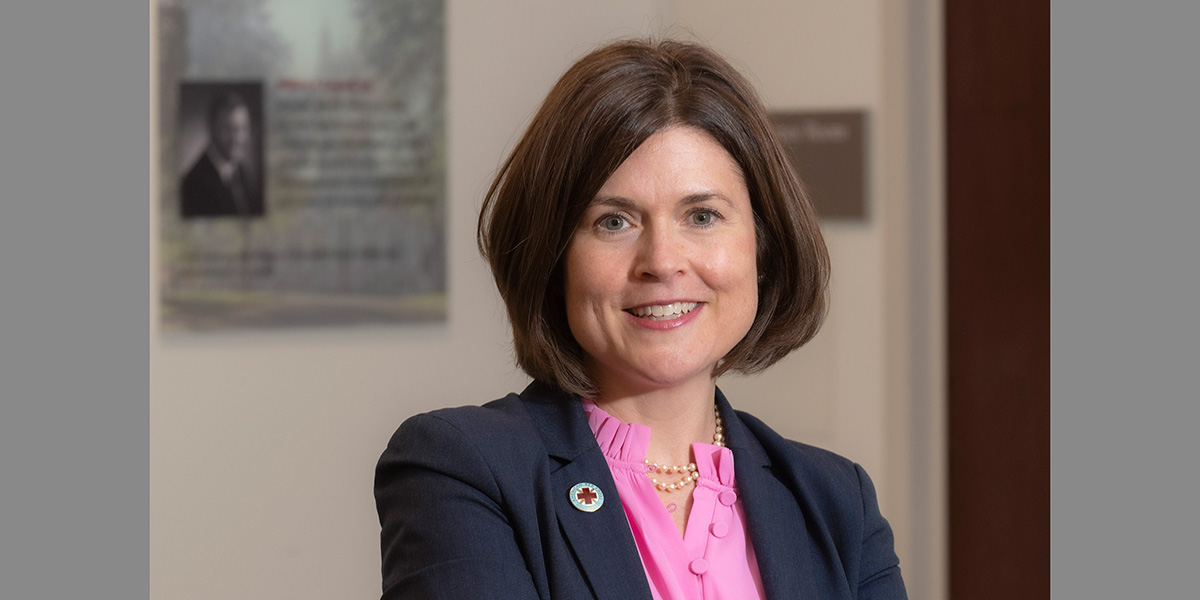
Katherine Gregory’s journey at Binghamton University officially began in 1992, but her story started long before that. As a toddler, she was already soaking up the college atmosphere, sitting alongside her father, John Clarke, as he earned a degree in accounting at Harpur College of Arts and Sciences in the 1970s.
When Gregory returns to campus to receive the University’s 2026 Alumni Achievement Award on April 25, Clark will be right by her side.
Growing up in central New York with a parent who is a 1975 alumnus made Binghamton University — and its in-state tuition — an easy choice for Gregory. She came to the University to study science, but by her sophomore year, she had transferred to the Decker School of Nursing.
Gregory found a strong sense of community at Binghamton, one she is grateful for. In addition to being part of the Decker nursing family, her three years living on campus in the Newing College residential community (first in Bingham Hall and then as a resident assistant in Delaware Hall for two years) left lasting impressions. To this day, she maintains friendships with some of her nursing classmates.
“I felt very well prepared by Binghamton to enter practice as a registered nurse; I felt the clinical education I received from Decker was excellent,” Gregory said. “I also think my Binghamton education helped me learn to think critically and ask questions.”
After graduation
Gregory’s first role after graduating from Binghamton in 1996 was in the newborn intensive care unit (NICU) at Crouse Hospital in Syracuse, New York, where she loved caring for patients and families. Initially, she thought she would spend her entire career as a NICU nurse.
“But it was the late ’90s, and hospitals were going through the first wave of managed care and cost-cutting, and I was very curious about how those decisions were being made,” Gregory recalled. “There was a lot of impact on nursing practice, but I could see very few nurses involved in those conversations. And I realized that if I wanted to be part of those conversations, I was going to have to learn more about administration, management, and finance.”
That decision led Gregory to the University of Pennsylvania, where she completed a master’s degree in nursing in 1998, with a concentration in healthcare management. The program, which combined nursing and business courses, also gave Gregory her first taste of research when she served as a research assistant to a faculty member studying how babies in the NICU are fed.
“That was the first time I really understood that nurses could be principal investigators and conduct research,” Gregory said.
After earning her master’s degree, Gregory worked as a healthcare management consultant in Boston, which she admitted was a little unusual: “At the time, large companies hired people with clinical backgrounds who understood patient care, but who could also help with management principles and strategy.”
She would eventually transition to the same type of work at Brigham and Women’s Hospital, where she focused on strategic development and quality improvement. At the same time, Gregory maintained her clinical skills as a NICU nurse at Tufts New England Medical Center. She also began considering a doctoral degree in nursing to develop her research skills.
“I was specifically interested in learning more about a devastating gastrointestinal disease that preterm babies experience, necrotizing enterocolitis, which has a lot to do with their prematurity and the protective nature of human milk,” Gregory said. “That led me to Boston College to get a PhD.”
Gregory completed her doctorate at the William F. Connell School of Nursing in 2005 and then joined the school’s faculty. Her research focused on preterm infants, and she secured funding from the National Institutes of Health. The work kept her traveling between the school and the large Boston hospitals where she conducted her research.
In 2014, she rejoined Brigham and Women’s Hospital as a research scientist and continued to expand her research program. A few years later, her clinical and business skills led to a role as an associate chief nurse, overseeing inpatient operations in women’s and children’s health. When the COVID-19 pandemic hit, Gregory found herself working in the hospital’s incident command center.
Academia calls again
Gregory returned to academia in 2021 as dean of the Connell School of Nursing. She’s now in her fifth year in the role.
“I think we need strong leaders in higher education, and we’d benefit from more nurses being engaged in the administration of higher education,” Gregory said.
Among her many accomplishments as dean are the college’s development of a nurse-midwifery program and the addition of a global public health major.
“There is a crisis in maternal mortality and morbidity here in the U.S., and nurse midwives are a really important part of solving that problem,” she said. “We just admitted our second class, and the students are terrific, the faculty are great, and we’re well on our way to educating and graduating nurse midwives who we hope will work in some of the many places that are now characterized as ’birth deserts’ and really underserved communities.”
Despite a heavy workload as dean, Gregory loves being a scientist and continues to conduct research.
Her early research focused on identifying biomarkers for necrotizing enterocolitis that would alert healthcare providers to the disease before it became clinically apparent. While they successfully identified some biomarkers, the findings haven’t changed practice — yet. However, the work proved that the disease can be detected early, with the hope for prevention.
Another focus of Gregory’s current work is examining the human milk microbiome: “I am most interested in understanding how and why human milk, and specifically the microbiome of human milk, is protective against necrotizing enterocolitis and what that means for the long-term health of the baby.”
It all started at Binghamton
Although it has been 30 years, Gregory has fond memories of Binghamton University, especially the inordinate amount of time she spent studying in a carrel in the basement of the Science Library.
If given the chance to do it all again, would she?
“Absolutely! For me, there was no better place to be a college student, and I really remain enormously grateful for the education I received at Binghamton,” Gregory said.
She also shared some advice for current students: “There is no one path for a Binghamton nurse. Your Binghamton nursing education will take you wherever you want it to, so stay curious and be open to opportunities.”