Biomedical engineering graduate learned to love the lab
Manar Mabrouk ‘26 immersed herself into Binghamton University campus life, sets her sights on research and development
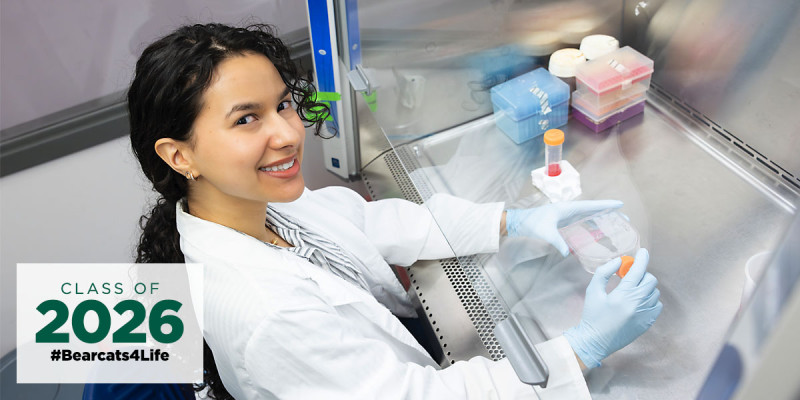
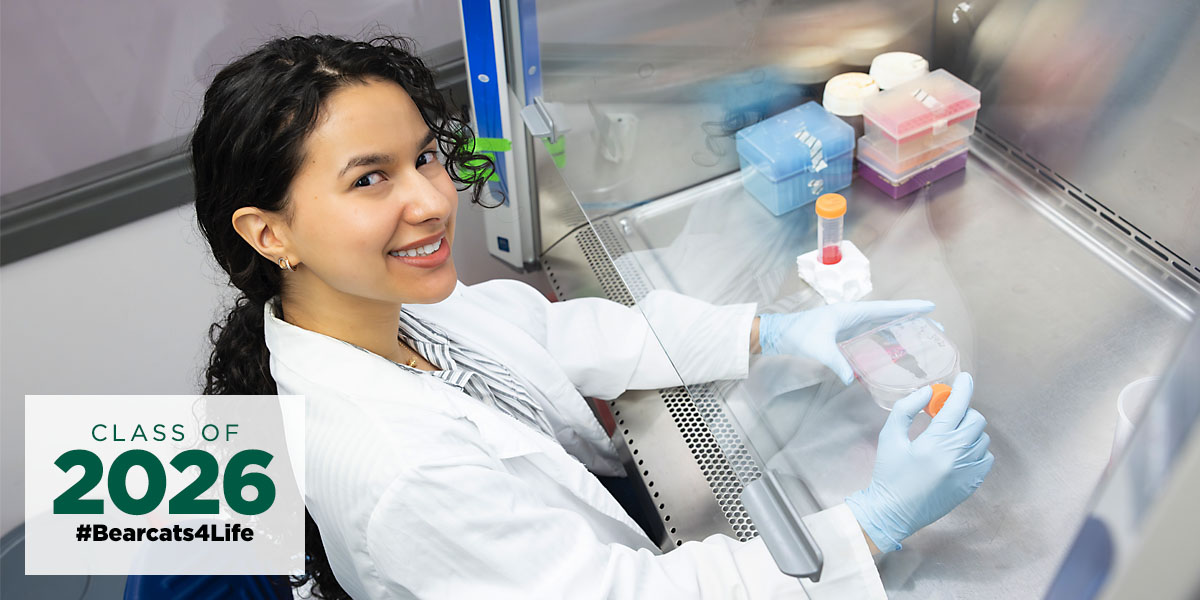
Manar Mabrouk ‘26 was certain about one thing from a young age — she did not want to be a doctor. However, she knew that she wanted to contribute to the medical field by discovering and building new technology.
This led her to Binghamton University’s Thomas J. Watson School of Engineering and Applied Science and its Biomedical Engineering Department, where she will be earning her bachelor’s degree this spring. From there, she plans to attend Boston University to pursue a master’s in biomedical engineering to work in research and development (R&D).
At Binghamton, Mabrouk immersed herself in the BME community as vice president of the Biomedical Engineering Society as well as through hands-on research, primarily in the lab of Professor Gretchen Mahler, BME interim department chair.
In Mahler’s lab, Mabrouk has worked on a project to model the heart’s aortic valve, which regulates blood flow. As people age, calcium deposits can build up in and around the valve, impairing movement and circulation. Currently, treatment often requires invasive heart surgery, which is risky for older patients.
Mabrouk learned that research is never linear — it requires trial and error that can prolong the process.
“It’s definitely the evolving learning ideology that is really cool,” she said. “You never get bored in the lab. There’s always something that pops up, whether it be an issue with your experiment or a contamination issue. There’s always something that you have to troubleshoot, and it definitely keeps life interesting while also teaching me new skills.”
Mahler found the experience of working with Mabrouk to be rewarding.
“From the beginning, Manar demonstrated strong motivation, curiosity, and great teamwork skills,” Mahler said. “I provided guidance on basic lab techniques, refining the research question, developing appropriate methodologies, and interpreting results, but Manar has learned to think independently and has truly taken ownership of the project."
Mabrouk and her team developed an in-vitro model to mimic both healthy and diseased conditions. Through this, they hope to understand how heart tissue changes over time and create a platform that supports testing for new treatments.
“I think Manar has shown significant growth in both technical skills and confidence, becoming increasingly capable of working independently and contributing original ideas,” Mahler said. “She has also successfully met the project’s goals and produced meaningful and high-quality results. Overall, it has been very rewarding to see Manar develop into a confident and capable researcher.”
Mabrouk’s research has been supported by the Collegiate Science and Technology Entry Program (CSTEP), which funded her work for two summers. The program aims to help students from different backgrounds succeed in fields like STEM through academic enrichment and research experience.
Her undergraduate years also took her off campus and all the way to San Diego, where she attended the Biomedical Engineering Society conference with Binghamton’s undergraduate BMES chapter. There, she joined a national community of scientists in the field, who shared work across various subgroups of biomedical engineering.
“It was fun to be in a space with so many smart and talented individuals who were doing phenomenal research,” Mabrouk said. “Being able to see people from all different walks of life coming together and looking at different posters, or attending various talks and chatting with each other, whether it be during the conference or post the conference at various socials, was very nice and refreshing to see.”
As the end of her time at Binghamton approaches, Mabrouk is making the most of Binghamton’s spring weather and spending time with her friends before graduation.
She emphasized the importance of getting involved at Binghamton.
“There are so many opportunities here, and there are so many cool and interesting people here that it’s definitely overwhelming at first, but if you just jump in and figure out what you’re interested in, Binghamton becomes a good place for you,” Mabrouk said. “Joining clubs and being a part of research really broadened my horizons. The people you meet and the opportunities you take advantage of shape your experience here.”