Graduate finds her calling in speech-language pathology
Emilie Ng '24, MS '26, is part of the first cohort of Decker College's new program
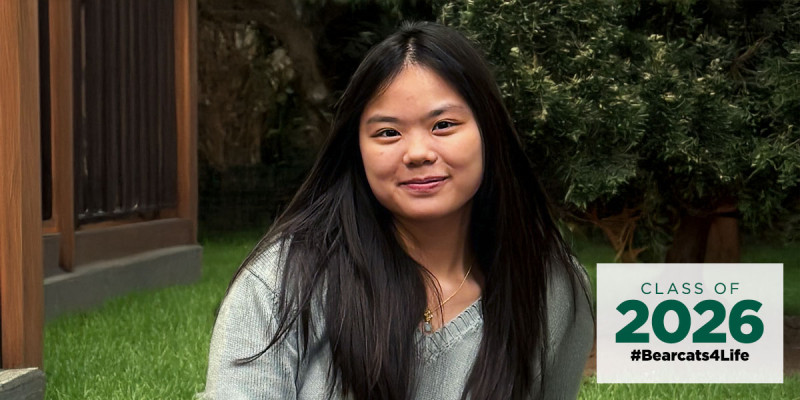
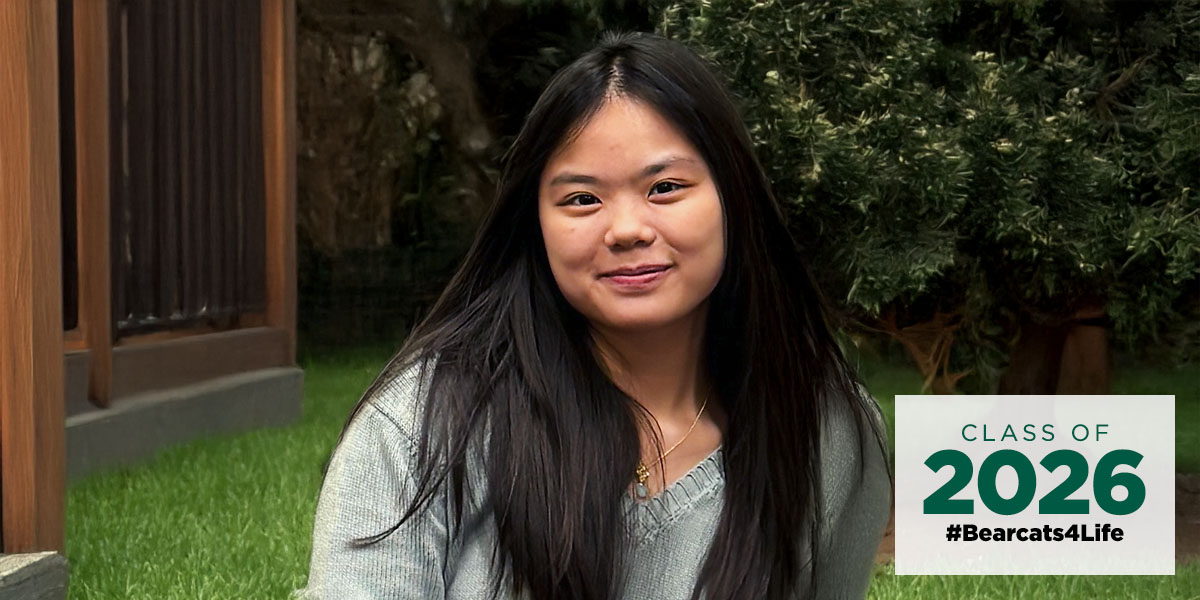
As a member of Decker College of Nursing and Health Sciences’ first graduating class for the Division of Speech and Language Pathology, Emilie Ng ’24, MS ’26, will not only be graduating with a master of science degree but also closing a chapter she helped write.
As part of her master’s degree, Ng gained experience in speech-language pathology through research and interning in private clinics and high schools, all while shaping one of Binghamton University’s newest professional programs.
“We were the first cohort,” she said. “A lot of things were yet to be set, so the professors and students were all trying to figure out how a master’s program should work. My cohort had a lot of input into the methods in which the program will be taught for future students, with the professors being very open to our feedback.”
Ng had an unconventional background, entering the Master of Science in Speech-Language Pathology (MS-SLP) program as a Binghamton undergrad double-majoring in integrative neuroscience and Korean studies. Typically, those going into SLP programs start off as communication sciences and disorders (CSD) majors — and that’s often a requirement for admission.
Her interest in combining her linguistic and STEM-based majors grew throughout her four years as an undergraduate. Ng originally wanted to pursue neurolinguistic research on code-switching, but soon realized she wanted a more public-facing career, which is why her acceptance into Binghamton’s MS-SLP program, despite her nontraditional background, was a perfect fit.
“My aunt works in a school and was the first to tell me about SLPs — what they do, how they work with students and adults, and I learned that you’re able to pursue so many different parts of the field,” Ng said. “I didn’t want to only be stuck in a lab — it was exactly what I was interested in doing.”
Throughout her master’s studies, Ng worked in the Vocabulary and Reading in Youth and Children (VARY) Lab with Associate Professor and Interim Program Director Dawna Duff on eye-tracking research focused on reading novel words. The work inspired Ng to create a poster for her capstone project examining differences between monolinguals and bilinguals in how they approach reading in first and second languages.
“We noticed that the monolinguals would skip over words, while bilinguals, who were mostly second-language learners with lower English fluency, would try to figure out what every single word means,” Ng said. “We theorized that while the monolinguals were more efficient, they were only understanding the big picture of the whole passage. They didn’t care about every single word, as long as they knew what the passage meant.”
Pursuing her master’s required Ng to catch up to her peers who studied SLP as undergrads, but she has been able to excel.
At the annual American Speech-Language-Hearing Association convention, Ng was selected for the Minority Student Leadership Program, a six-day experience that brought her into contact with influential individuals in SLP-related careers, including CEOs and field leaders.
“Dr. Duff introduced me to the [Minority Student Leadership Program] because I was submitting my research to the ASHA convention,” Ng said. “I was very honored to be a recipient — it was a really humbling experience where I could also meet students from other schools.”
After graduation this spring, Ng plans to work in multiple areas of SLP throughout her career. First, she’d like to pursue pediatric feeding and swallowing in a hospital setting, specifically in a neonatal intensive care unit (NICU) or pediatric intensive care unit (PICU). Long-term, however, she wants to work as an SLP in a school.
“What sets Emilie apart is her ability to transform genuine curiosity about the field of speech-language pathology into innovative, meaningful clinical practice that benefits her clients,” said Kara Nunn, clinical assistant professor of speech-language pathology. “She doesn’t just engage students — she meets them in their world and builds from it, even creating new tools to support their growth.
“This was seen in her development and interprofessional collaboration to develop an AI-generated trivia app to support client language growth. The combination of empathy, creativity, and initiative makes her an exceptional emerging clinician.”
Reflecting on being part of the first cohort of the SLP master’s program, Ng said the experience was sometimes challenging. However, it helped her understand the importance of flexibility both in and out of work.
As her time at Binghamton comes to a close, Ng offered some advice for students interested in SLP careers: “Accept that everything is not going to go as planned, and that’s OK. Just work with it. Be flexible, be calm, and go with the flow. Always have a plan, but expect that you are not always going to be able to follow it.”