14th century manuscript is history in your hands
University Libraries and Center for Medieval and Renaissance Studies acquire book from 1350
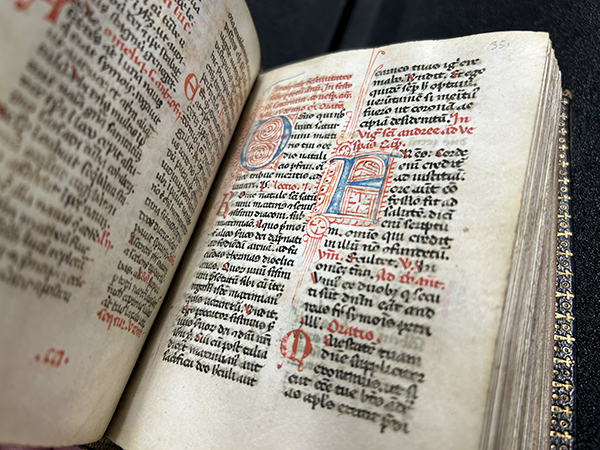
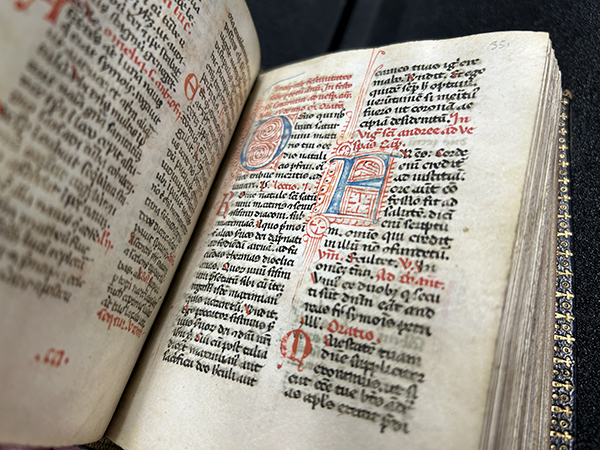
Walking into the reading room in Special Collections at the University Libraries, the recently acquired book set out for special viewing looks like a quintessential “old book.” It is everything you expect it to be: dark brown leather binding, a crest detail molded onto the back cover, metal grommets on the corners, slightly worn edges, and tan pages stuffed to the brim. What may look like an average old manuscript is now one of the oldest items in Special Collections, dating back to the middle of the 14th century.
The Binghamton University Libraries along with the Center for Medieval and Renaissance Studies (CEMERS) recently purchased this manuscript for the university’s collections. The book, specifically called a breviary, was written about 1350 by Franciscan friars in northern Italy, and later bound in Scotland around 1870. The breviary functioned as a mobile reference tool for friars to use in their position in the church. One of three types of popular devotional books, in addition to psalters and books of hours, the addition of this breviary to the collection expands Binghamton’s resources for study and teaching of medieval culture.
“Breviaries are books of prayers and divine offices,” Special Collections Librarian Jeremy Dibbell said. “So rather than a book that a devout lay person would have had, this would have been for use by a particular priest or in a particular religious house. This one was produced by Franciscans, an order of traveling friars. The breviary complements our other medieval manuscripts in order to do something slightly different than what the rest of the collection does. It’s also older than most of our collection as well, so it’s a nice addition on that front.”
The acquisition of this manuscript helps both expand teaching opportunities for professors and learning experiences for student researchers. Students studying languages use manuscripts to help practice translations and understand writing styles. Written by several scribes over many decades, the breviary is particularly helpful in the field of paleography, the study of handwriting, and how letters and abbreviations evolve and change in comparison to modern letters and style of writing.
“It’s a very good manuscript to practice transcription,” said Marilynn Desmond, SUNY Distinguished Research Professor for English and Medieval Studies. “It’s also perfect for paleography, because it has so many different hands and we do, from time to time, have students do independent projects on paleography.”
More directly, the breviary can be incorporated directly into classes to provide undergraduates a material contact with the premodern past.
“A lot of what we’re doing with this manuscript collection that we’ve been collaborating with special collections on building is thinking about manuscripts that fit both in our undergraduate curriculum and that we can use as training tools for our graduate students,” said Elizabeth Casteen, associate professor of history and director of CEMERS. “Teaching students how to work with medieval materials, getting them ready to do the kind of research that they’ll need to do when they go into the field.”
While technology has advanced to provide digital copies and facsimiles of ancient texts, which can open opportunities for certain types of text analysis and research, the impact of having an original manuscript for students to learn from is unmatched.
“There’s something about having it physically in front of you,” Casteen said. “No matter how high the quality of the image, no matter how much you can sort of zoom in on it, there’s just something really different about having it in front of you. My students are always really struck by that. You can tell which side is the hair side of a piece of vellum.”
Aside from the practical uses of a manuscript, it is the connection to history that often has a great impact on the viewer.
“When I hold it, I respond to its presence and its amazing survival as a very portable artifact,” Desmond said. “The material quality of these books is so exquisite that we can still, hundreds of years later, read them. We can still page through them. And also this was an object that was used for devotion, so you sort of feel all the devotional energy that would have been expended praying from it.. It just feels like it’s continuing to speak to us from the past.”
The breviary was purchased with contributions from the Bernard F. Huppé Fund and the Aldo and Reta Bernardo Fund. Huppé and Bernardo were faculty members who founded CEMERS in 1966.
“Items that we acquire have to tick a lot of boxes,” Dibbell said. “We want to make sure that they have research potential as well as teaching potential, and that they can be used in classes, that they’re not either falling apart or too fancy. The breviary caught our attention, partly because of the age and partly because of the complementarity of it and what it does.”
Having materials like the breviary available is just one element of what the University Libraries and programs like CEMERS can offer students, along with instruction from research experts. Specifically, the breviary connects us to a far distant past, yet still manages to feel current and everlasting.
“I think it’s often easy to think of the past as done and static,” Casteen said. “And I think being able to interact with a text like that, particularly with the sort of the material object that is in front of you, is a good reminder of the fact that it wasn’t static, and there’s so much that we still don’t fully understand. The mission of the Franciscan Order was to preach and to teach and to serve the community. And I think that there is something really poignant about the fact that this manuscript is now in the special collections of a state university, that it is here for the public, for people to learn from, for a new generation of students to have contact with and to be able to understand that sort of long, long connection with teachers deep in the past that is quite poetic.”