Husband and wife graduate from Binghamton together
Mubarak Adams and Melissa Caceres both earned Doctor of Physical Therapy degrees in May
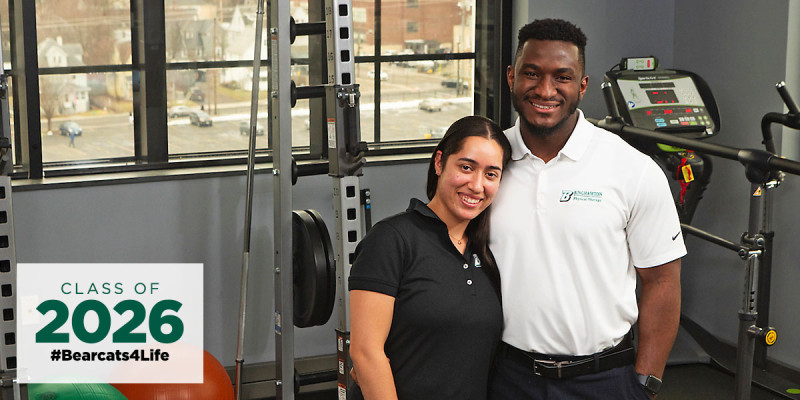
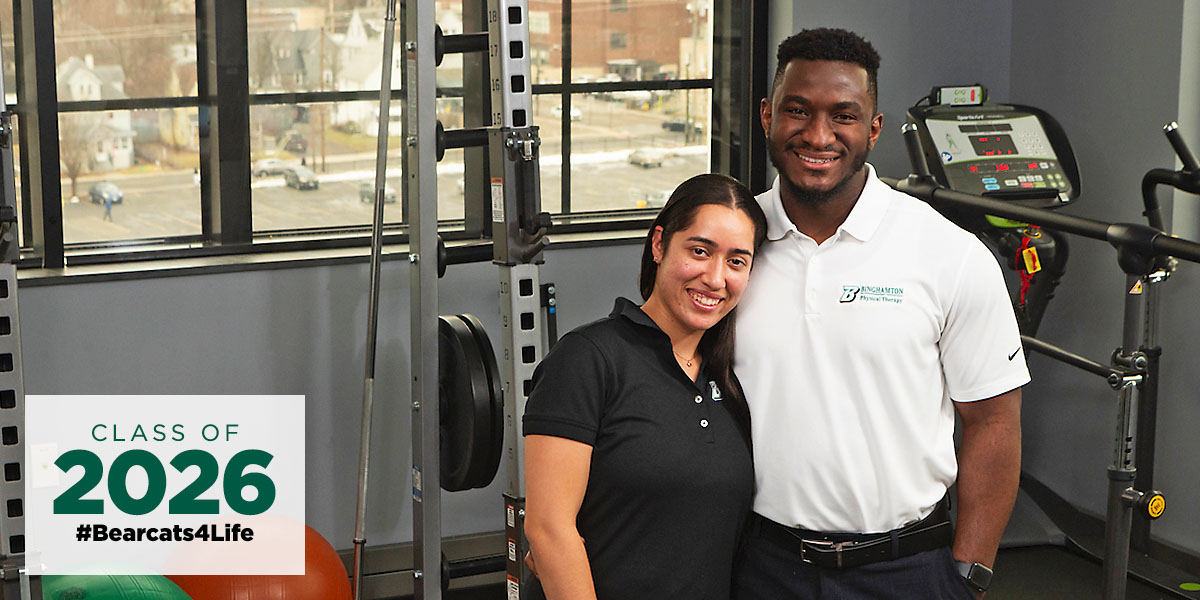
Mubarak Adams and Melissa Caceres noticed each other in one of their first classes at Hostos Community College in the Bronx in 2019. They then saw each other in another class, and another, but it was a few days before they talked. When they did, they realized they were both interested in healthcare careers, were completing associate degrees in liberal arts and science, and planned to transfer to four-year programs. What they would ultimately pursue was still to be determined, but physical therapy appealed to both.
They soon became study buddies, meeting in the library to compare notes, finish homework, and cram for tests. Even during the COVID-19 pandemic, their connection held strong; they helped each other navigate the transition to online learning, which was new to both of them.
They began dating in 2020.
After earning associate degrees at Hostos, they went on to complete bachelor’s degrees to prepare for entry into Doctor of Physical Therapy (DPT) programs, both having decided that was their goal. Adams graduated from Hunter College in Manhattan with a degree in human biology, while Caceres earned a degree in health science (pre-physical therapy) from Mercy College in the Bronx.
In May, the couple, who have since married and had a daughter, will graduate together again, this time from Binghamton University’s DPT program.
The road to physical therapy
Adams chose physical therapy to help others and raise awareness of its benefits in West Africa, where he was born. His family moved from Accra, Ghana, to the U.S. just before high school.
“My parents don’t rely on medication when they don’t feel well; they turn to physical activity and diet to get better. Growing up, they always told me to look into the health field so I could help people,” he said. “I have two sisters; one is a nurse, and the other is a social worker. When I was considering what profession I wanted, I saw physical therapy and thought it would be a good fit, especially since I have played sports since I was 6.”
Adams noted that although many West Africans who migrate to the U.S. for education become physicians or nurses, few choose to become physical therapists. This piqued his interest.
“I want to raise awareness of what physical therapy is and how it can help people,” he said. “One of my goals is to eventually go back to Ghana and advocate for physical therapy, which I feel many Africans would love, because it relies less on medication.”
Caceres’ passion for physical therapy was more of a slow burn. In high school, she saw firsthand how PT could help people recover from injuries when her mother fractured her wrist and elbow.
“My mom was the primary provider for our family at the time because my dad was unable to work due to a disability, so when she got hurt, it impacted all of us,” she recalled. “She had to take time off work, and with four kids at home, that wasn’t easy. Seeing how PT helped her get back to her prior level and return to work was really eye-opening. It made me realize how much of a difference physical therapists can make in people’s lives, and I wanted to be a part of that one day.”
Adapting to graduate school
Adams and Caceres are among the 35 students in the first cohort of the Decker College of Nursing and Health Sciences’ three-year Doctor of Physical Therapy program, which began in 2023.
“It was a little challenging initially,” Adams said about transitioning from undergraduate to graduate school. “You’re learning how each professor teaches, how to get the most out of what they’re teaching, and how to apply it. So that first year was challenging for me because I was looking at it as if it would be the same as undergrad: they taught me, I took notes, I went home, studied, took the exam, and passed it. But that wasn’t the case. On our exams here, you have to apply clinical reasoning and build a rationale, rather than just memorizing what the book says. You’re given more of a scenario or case study, and you have to use your clinical reasoning to come up with the answer.”
Caceres also struggled at first, especially with anatomy, noting that “it was like starting over.”
Her advice for others in a similar situation is to “Learn what works for you: your learning style and how you study best. That comes from trying different approaches, whether it’s studying with others or on your own, and realizing what works for one class may not work for another. Once you figure that out, you’re good.”
Along with classroom learning, DPT students complete more than 30 weeks of clinical experiences.
Adams’ first clinical rotation was at Guthrie Lourdes Hospital in Binghamton, where he provided inpatient physical therapy. His second clinical provided outpatient PT experience, helping patients with a wide range of needs at UHS Chenango Bridge. His third clinical, completed in the final semester of the program, was another outpatient physical therapy rotation at St. Luke’s University Health Network in Northern Pennsylvania.
Meanwhile, Caceres’ first clinical rotation was at a private physical therapy practice in Binghamton, where she provided outpatient care. Her next experience was an inpatient clinical rotation at the New York State Veterans’ Home in Oxford. Her third clinical experience, also completed in this final semester, was an outpatient rotation with St. Luke’s University Health Network at a campus different from Adams.
Finding balance
When Adams and Caceres began the DPT program, they relocated to Binghamton with their then two-year-old daughter, Aleah, and Caceres’s parents.
“I’m forever grateful to my parents,” Caceres said. “They’re both retired, so they moved with us and take care of Aleah so we can go to school.”
“We wouldn’t have been able to do it without them,” Adams added. “Sometimes when we’re in school or clinicals, we’re out of the house for 8-10 hours a day.”
Even with family support, the couple acknowledged that balancing family life and a demanding graduate program is difficult.
“It has been intense, but we were able to navigate it through hard work, consistency, and patience, along with support from faculty and friends we made along the way,” Adams said.
Still, it’s hard to find time as a couple, and things like date nights are rare.
“Every class is back-to-back, and once you finish class, you have to study for the next exam, practical, or class, so you stay at school to get that done before you go home,” Adams explained. “And when you do go home, you’re tired and just want to shower, eat, and sleep. So, it’s just a cycle going back and forth — but we’re almost there.”
Organizing tasks and splitting responsibilities has been essential for the couple. For instance, they meal prep for the whole week. Additionally, there are specific things their daughter enjoys doing most with each of them separately.
“She loves both our foods, but she enjoys my food a little more. She just loves my recipes,” Adams joked. “When I make my chicken, she always finishes it.”
Life after graduation
After graduation and passing the National Physical Therapy Examination (which will license them as physical therapists), both Adams and Caceres hope to work in outpatient physical therapy. Caceres plans to specialize in pelvic health, while Adams aims to focus on sports medicine.
“If I could choose a job, I would like to work in a hospital, corporation, or large organization that has both inpatient and outpatient physical therapy, so I could get a lot of experience and grow in my career,” Caceres said.
“One day, we would like to open up our own clinic and work together,” Adams added.