GMAP graduate student is ready to bring support and community to those who need it most
Aleena Paulson ‘25, MA ‘26 has built a college career based in advocacy and coalition-building
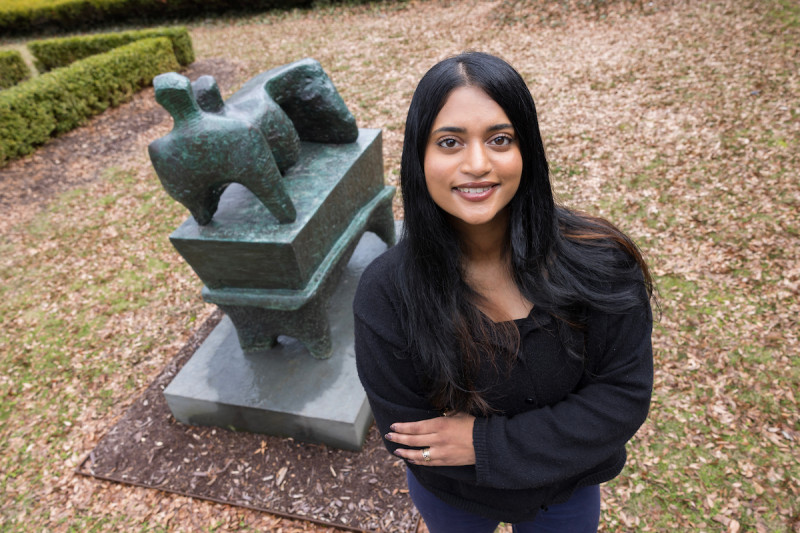
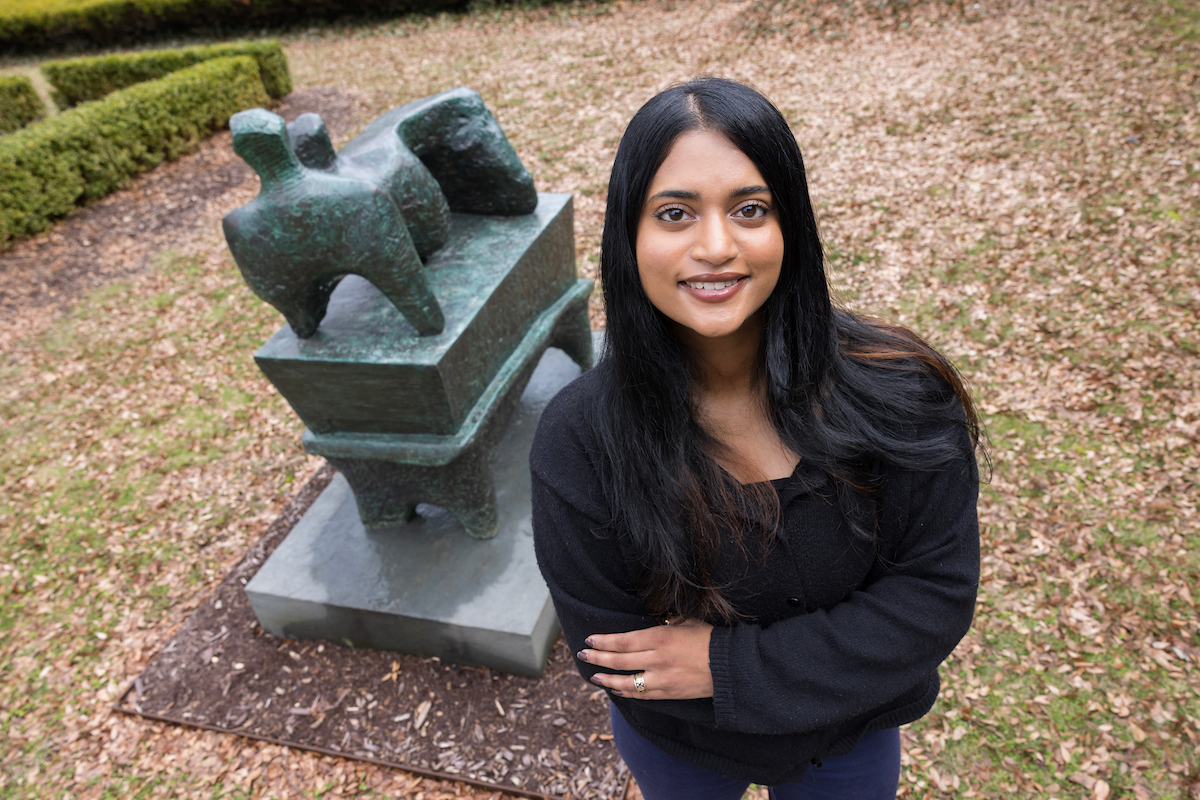
Aleena Paulson ’25, MA ’26 is blazing trails in generating social consciousness and uplifting marginal communities.
The Long Island native has been working to positively impact communities since she was an undergraduate majoring in political science with a minor in history. Her internship at the nonprofit Advocates for Youth kicked off the path she decided to take.
“I worked with school administrations and helped plan the roll-out of medicated abortion for students in a way that was accessible, ” Paulson said. She advocated for the University to expedite student access to medicated abortion under Senate Bill S1213B, which guaranteed safe and available options at higher-education institutions in New York state.
Paulson’s path to advocacy did not stop there. She joined the Feminist Collective, an intersectional student advocacy group on campus, where her work culminated in “Take Back the Night,” a large-scale, annual student showcase demonstrating solidarity with survivors of sexual abuse and assault. A centerpiece of the event was the “Survivors Speakout,” an open forum where survivors talk about their own experiences.
“It’s great that Binghamton focuses on a lot of things that they should be focusing on, but we thought we should be doing even more since sexual assault is experienced by so many students,” said Paulson, who is a former president of the group.
Paulson described how she received messages thanking the group for providing a space for survivors to feel heard and supported. These exchanges were proof that the work she was doing was making a meaningful impact.
“We had gotten a DM from someone who was working at the event. They said it completely changed their life just being there and knowing that there were people out there like them. That had to be one of the most moving parts of being president at the time.”
Paulson’s advocacy work extends beyond women’s rights. One of her most formative experiences was studying abroad in South Africa, where she worked with communities affected by the legacy of Apartheid. Paulson worked in District Six, Cape Town, where a diverse community of ethnicities and religions was forcibly displaced by Apartheid policies.
Paulson worked intimately with the people of Cape Town, speaking with taxi drivers on her daily commute about their experiences of violence in their hometown. She helped bring the community’s underappreciated beauty to the forefront, working with a museum’s exhibitions department to organize a knitting collection and drag show that highlighted District Six’s queer history, called the “Salon Kewpie” project.
“Working on the Salon Kewpie project taught me that memorialization is not a process that strictly concerns itself with the past but also incorporates itself within the current community, particularly the youth,” Paulson said.
Paulson is grateful to have found lifelong friends at Binghamton, and wanted to continue to be a part of the community she built during her undergraduate years. That’s why she decided to pursue her Master of Science in Genocide and Mass Atrocity Prevention (GMAP).
“It felt right to continue my education here,” Paulson said. “I’ve established so many genuine connections with the town, my professors, and fellow students.
“Interpersonal relationships relate to atrocities. In a way, knowing who your neighbors are is a preventative strategy,” she said. “For me, the Feminist Collective is a microcosm of my work and the Institute for Genocide and Mass Atrocity Prevention is a macrocosm.”
Paulson is looking forward to a future career in the NGO or nonprofit space, where she will continue research into mass incarceration and prison systems — something that her graduate coursework in the GMAP program has already exposed her to.
For Paulson, the work on and off campus all connects back to one principle: building community.
Whether its combatting sexual violence or researching practices in decolonialism, Paulson’s work will bring support and community to people who need it the most.