Alumna to fund new endowed professorship in computer science
Internet pioneer Geraldine MacDonald ’68, MS ’73, LittD ’17, is a longtime donor to Watson College
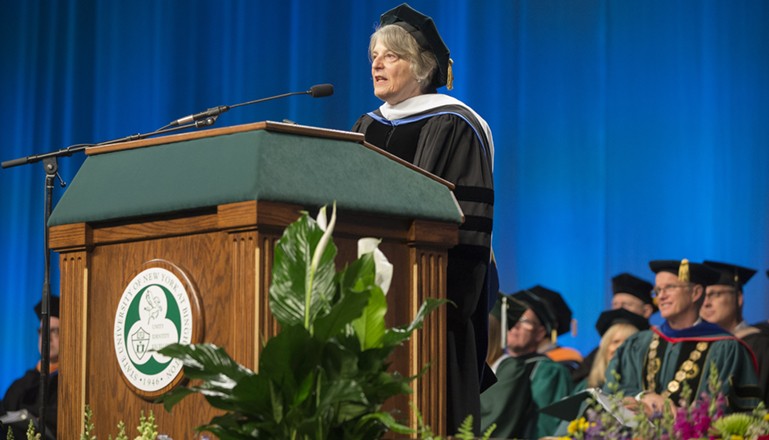
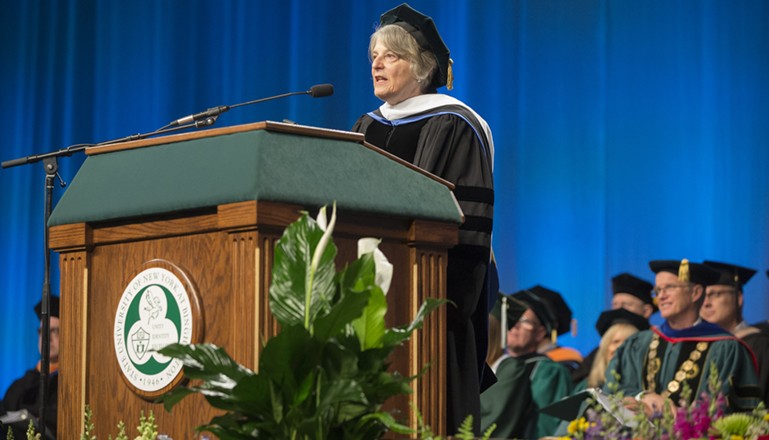
A transformative gift from a distinguished Binghamton University alumna will establish an endowed professorship at the Thomas J. Watson College of Engineering and Applied Science, strengthening the college’s ability to recruit exceptional faculty and advance innovation in a rapidly evolving digital world.
Geraldine MacDonald ’68, MS ’73, LittD ’17, is an internet pioneer and Binghamton University Foundation board member who has generously funded projects, scholarships, professional development, and student activities around campus for more than 40 years.
The Geraldine Knoll MacDonald Endowed Professorship in Computer Science, which will support a tenure-track assistant professor at Watson College’s School of Computing, is just the latest way for her to say thanks for the education that set her on the path to success.
From 1995 to 2005, MacDonald served as a senior vice president at America Online, overseeing the construction and expansion of AOL’s access networks through narrowband and broadband technologies.
Before that, she led the development of Binghamton University’s computing infrastructure, rising to the role of associate vice president. She steered the transition from mainframe computers to minicomputers, workstations, and personal computers, and she was instrumental in the initial construction of computer pods and smart classrooms on campus.
“Going to Binghamton opened so many doors for me,” MacDonald said. “I support the University now because it’s still changing the lives of many people, and because it’s a much bigger university than when I attended, there’s more space for young people to come and explore and learn the way I did.”
President Anne D’Alleva praised MacDonald as a longtime champion for Binghamton.
“The generosity and the lasting influence of our alumni continues to amaze me," she said. "I thank Geraldine MacDonald for her longstanding support of the University and her vision for the future of Binghamton through the creation of this endowed professorship. In addition to boosting the career of an early career faculty member, this professorship will also cement Geraldine’s legacy as an innovator in technology and inspire students and faculty for many years to come.”
Watson College Dean Atul Kelkar added: “We are profoundly grateful to Gerry MacDonald for her visionary support of our computer science faculty. In a field as dynamic as computing, the ability to recruit and retain world-class scholars is paramount. This endowed professorship provides the sustained resources necessary for our researchers to explore the frontiers of AI, cybersecurity, and data science, further cementing Watson College’s reputation as a hub for technological excellence.”
“We are deeply grateful for Gerry’s visionary leadership and longstanding commitment to Binghamton,” Vice President for Advancement David K. Whitmore said. “Her involvement, generosity, and unwavering support make a world of difference in the continued excellence of our faculty and the outstanding education of our students.”
An unexpected path
As a first-generation American growing up in New York City, MacDonald and her brother and sister learned early about their parents’ expectations for their futures.
“There was no doubt in their mind that all three of us were going to college,” she said. “So that was ingrained in me. We didn’t even question it — the path to success was predicated on getting the best possible education.”
When MacDonald graduated from high school at 16, she chose Binghamton over the City University of New York (and its free tuition) because she wanted to get the full college experience — leaving NYC, meeting people from other places, and living on her own. (Her sister made the same choice and came to Binghamton.)
After earning her bachelor’s degree in psychology, MacDonald moved back to NYC and considered becoming a teacher before seeing a “help wanted” ad for an insurance company looking to hire for computer work. A logic class that she took at Binghamton unexpectedly gave her the background she needed.
“I fulfilled the philosophy requirement with the logic class, but I didn’t realize that I was really learning the fundamentals of how all computers work,” she said. “When you go to college, you take a lot of courses and you never know what doors are going to open for you. After four years, you’ve picked up interests and skill sets you had never imagined!"
MacDonald returned to Binghamton University to help integrate rapidly evolving computer technology into classroom learning and research. She also decided to further her own education, which helped her stand out from the pack when AOL recruited her in the mid-1990s.
“My master's degree in computer science — advanced technology at the time — changed the world for me,” she said. “I did it part-time while I worked at the University, so tuition was reduced — an added bonus of working there. It took me a couple of years, but having that degree meant everything. I never would have risen to the levels that I rose to in industry without that additional educational experience."
A legacy of giving
Over the past four decades, MacDonald has supported many campus activities, from the art museum and business internships to scholarships and the Binghamton University Rover Team.
“Some people say, ‘Well, you could write all this in your will and leave it for after you’re not here,’” she said. “It’s much more fun to give the money when you’re alive, so you can interact with the people who actually benefit.”
She sees the Geraldine Knoll MacDonald Endowed Professorship in Computer Science as the latest way to boost her alma mater by helping to fund travel, equipment, online resources, publication expenses, stipends for student assistants, and matching funds on grant applications.
Watson College faculty and students in particular face challenges as artificial intelligence remakes the technology industry much like the internet did in the 1990s.
“Watson really changed everything for me, and it’s still doing that for people,” MacDonald said. “Students come to Watson, they’re not quite sure what they want to do, they get a fantastic degree, and it sets them up to work almost anywhere. Because it’s so much bigger now, students also have this great network of people who they can interact with to find that next step.”