Astronaut proves the sky’s the limit as Research Days keynote speaker
Jeanette Epps highlights importance of collaboration, perseverance
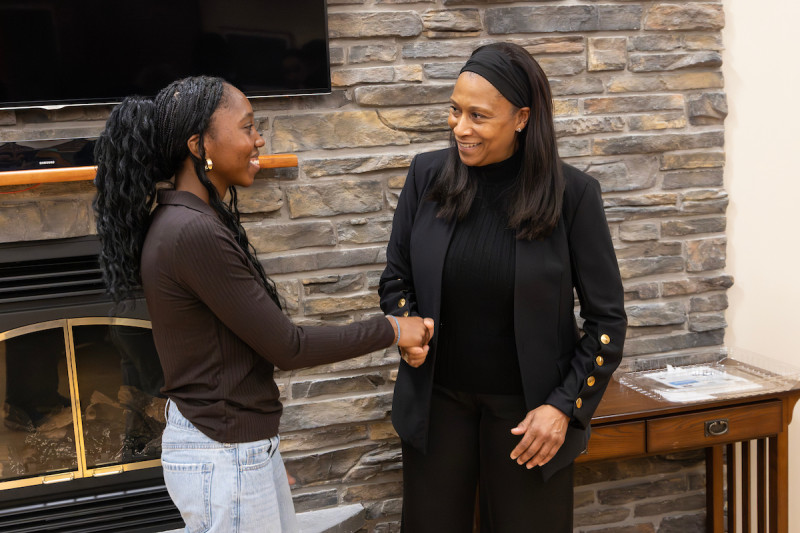
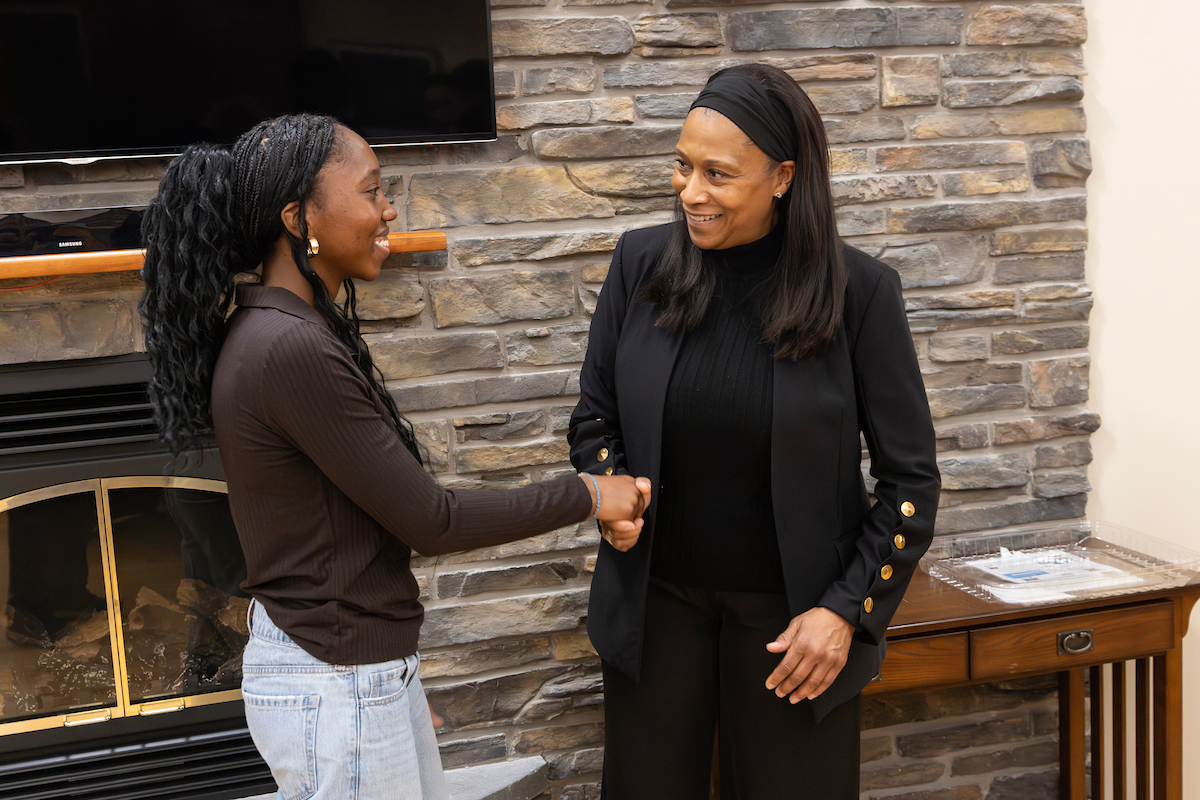
Record-breaking astronaut and engineer Jeanette Epps touched down Tuesday at Binghamton University to share her journey among the stars and experiences aboard the International Space Station.
Epps delivered the keynote address for the University’s Research Days and Festival of the Arts — a week-long series of events highlighting academic research and creative work on campus.
In her presentation at the Anderson Center Chamber Hall, titled “An Astronaut’s Journey,” Epps reflected on her path from growing up in Syracuse to going to space, highlighting the importance of perseverance and collaboration to a crowd full of students, staff and faculty members, and aspiring scientists of all ages.
“Years ago, I was back here at Binghamton and gave a speech and I’m honored to come back and tell you what the end of the story is,” Epps said. “So tonight, I just wanted to go through and tell you a little bit about my career as a young girl from Syracuse who went on to work at several companies and then finally made it to space. And I hope that this story will inspire some of the young people in the audience to know that great things can happen in the state of New York, and can happen to you as well.”
Epps credits her mother with encouraging her to pursue higher education and be endlessly curious. Epps studied physics at LeMoyne College before obtaining her master’s and doctorate degrees in aerospace engineering at the University of Maryland. She spent a decade working on smart materials to enhance vehicle performance as a two-time patent-earning researcher for Ford Motor Company, and was later recruited to join the Central Intelligence Agency.
Epps’ time as a technical intelligence officer at the CIA taught her about taking calculated risks and embracing opportunities, including acting on lifelong aspirations to be an astronaut and finally applying in 2008. Epps was accepted and welcomed into the 20th NASA astronaut class in 2009, joining a diverse nine-person team that included military personnel, airline pilots, and medical doctors.
“Teamwork is one of the biggest themes that you’ll see throughout our training,” said Epps, who discussed her intensive physical and mental training across terrains like land, sea, and sky to become an astronaut.
Among those experiences were flying T-38 jets alongside fighter pilots, where Epps learned to communicate effectively and operate safely at high-altitudes, and conducting simulated spacewalks underwater, where she learned how to fight fatigue and conserve energy over hours. Epps also learned how to operate robotic equipment to make repairs, conduct emergency medical triage in the field, speak foreign languages like Russian through an immersive trip to Moscow and brave the wilderness in the canyonlands of Utah.
Epps also acknowledged the real world, potentially fatal, consequences of each one of the analog missions she embarked on, whether that was in the coral-filled depths off the coast of Florida or dark caverns of Slovenia. She emphasized the importance of teamwork and awareness with her crew mates, despite coming from different backgrounds and cultures.
“If you’re underwater with a group of people who aren’t your friends and don’t look like you, and if you’re not flexible and adaptable, you can’t get along,” Epps said. “Nine days might as well be nine years and it’s just going to be a long, long time. And you likely will not be successful. Coming together as a team, rallying around the notion that we have a mission that we have to complete, was how we ended up becoming great friends.”
Epps trained in Star City, Russia as part of the backup crew for Expedition 55 — completing survival training to prepare for worst case landing scenarios and passing all her oral exams in 2011. After a couple more reassignments, Epps eventually joined NASA’s SpaceX Crew-8 as a mission specialist — where she prepared for launch and ventured into space for nearly eight months in 2024.
The crew was unsure if they would take off due to technical issues, and Epps described the lift-off experience as “surreal” with all of them being captured by a sense of childlike excitement and wonder.
“It was a beautiful launch. It was something we trained for, so we understood all the forces that would act on your body, all the Gs, and then weightlessness,” Epps said. “And so it was a beautiful time for me, especially because I was just stunned that we actually took off and we’re actually going to the space station after so many years.”
Epps shared anecdotes from her time aboard the ISS, which quickly became her second home. She described frequent camaraderie-building activities among her colleagues, celebrating with birthday parties and taking advantage of the zero-gravity environment to participate in Olympics-inspired games.
On the ISS, suspended 250 miles above the Earth’s surface on the largest floating laboratory in existence, Epps and her crewmates performed all the maintenance on board and conducted scientific research. She described how the removal of gravitational force leads to changes in chemical and biological processes, like flames burning higher, genes being turned on and off, and crystals growing differently.
“We were learning all kinds of new things,” said Epps, who holds the record as the Black astronaut who has spent the most time in space. “Not just to help us get to the moon and stay on the moon, but also to help us here on Earth, to understand how to make better materials.”
From the ISS’ Cupola window, astronauts were able to look out on the Earth and see dark swarms of storm clouds, smatterings of golden city lights and glowing ribbons of aurora australis rippling over the planet.
Epps explained that going to space and seeing the world from a vantage point very few have access to allowed her to renegotiate her own perspective as a human being, understanding how connected society truly is.
“Going back to the moon and going to Mars — it’s not instead of taking care of Earth,” Epps said. “The whole goal was to take care of planet Earth and then go on and do things, expand out further meanwhile taking care of home. So that is the thing that I took away. How do we be good to each other? How do we share what we saw in space and try to convince people to be good to each other?”