Feathered friends: Binghamton’s chapter of the Audubon Society aims to make campus bird-safe
Volunteers paint a massive mural on the Science Library, a spot known for bird strikes
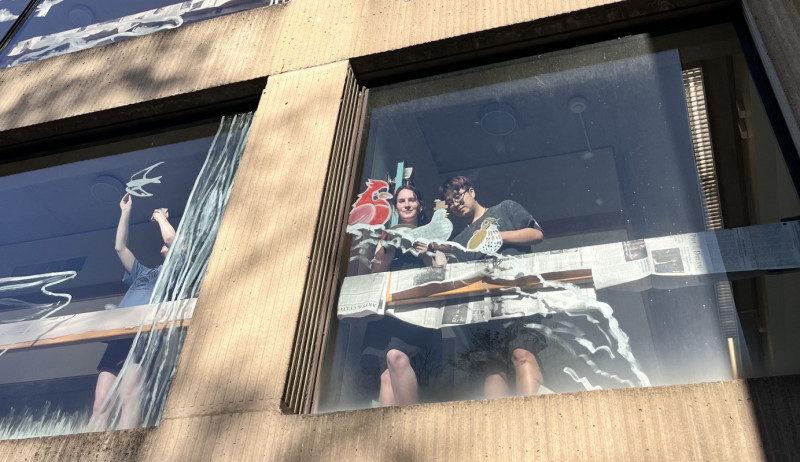
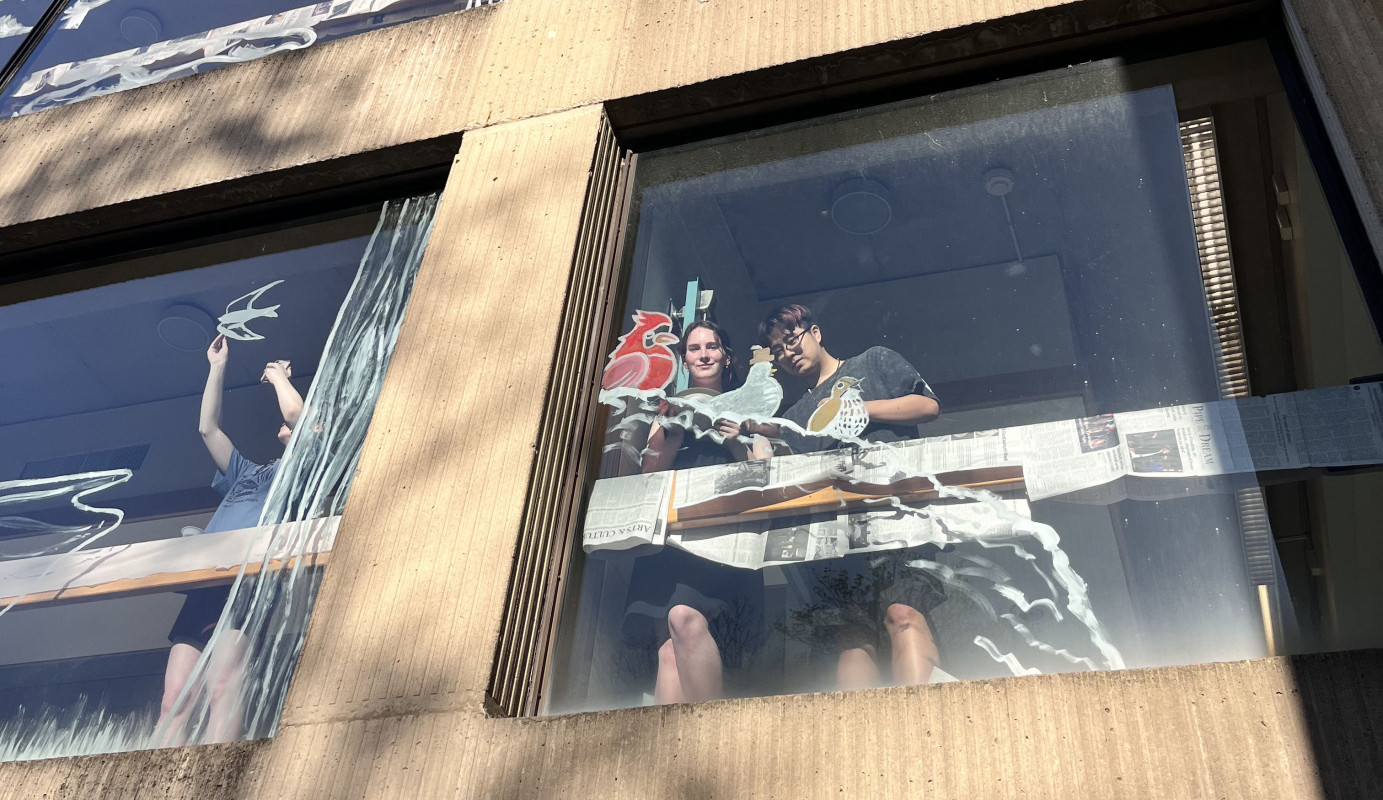
On the Science Library’s windows, birds wing, perch, and wade through a variety of environments. But the mural isn’t just a work of art; it’s also a mechanism to safeguard real birds, at a spot that has all too often proved a graveyard.
Designed by Binghamton University’s chapter of the Audubon Society, the mural is intended to prevent bird strikes during spring migration, which runs from April through early June, according to Associate Professor Emerita of Biological Sciences Anne B. Clark. Twenty-five volunteers came out to paint the mural in April.
There is an emphasis in the environmental and wildlife conservation fields in making infrastructure safer for birds, said Club President Hailey Faurot, a senior environmental science major. Binghamton has made efforts in this direction, including the installation of a bird-deterrent window treatment on the adjoining Science Library walkway in 2023; the subtle pattern of dots prevents birds from crashing into the walkway glass.
“The Science Library is one of the spaces where reflections and bird strikes are a big issue,” said Cedar Shamson, a junior biology major and the club’s art director.
Glass facades pose a danger to birds, and plantings close to buildings can exacerbate the problem. During the day, reflections can turn a window into an apparent mirror of the open sky. Nighttime has its own risks; many birds migrate at night to avoid predators and can crash into tall buildings, led astray by interior lights.
U.S. estimates on the toll of bird strikes range from 100 million to nearly a billion annually; researchers believe the phenomenon may contribute to the 30% decline in North American bird populations since the 1970s.
In the spring and summer, the Science Library and Science III are among the most dangerous campus buildings for birds; Academic A becomes a problem during the fall migration. Because dead birds are typically removed by facilities staff, the campus community may not realize the extent of the problem, Faurot said.
Finding solutions
In collaboration with the University’s Office of Sustainability, the club is applying for a grant through the U.S. Fish & Wildlife Service’s Chesapeake WILD program to fund additional window retrofits on campus. In the meantime, members brainstormed with Clark about how to make Binghamton safer for birds; the mural was Clark’s idea.
The club worked with Physical Facilities to obtain the necessary approvals. The paint consisted of a mixture of tempera, soap and cornstarch, which made the images both opaque and easy to remove.
Shamson designed the mural’s scenery, which is centered on a large tree that symbolizes the unity and connectedness of the natural world. Club members customized it by painting birds of their choice that fit into the landscape.
“Obviously, it had to be bird-themed, but it also shows the different environments that birds live in,” they said. “There are forests on one side, a river on the other, a marsh above that, and the clouds and sky.”
While the mural is slated for removal at the end of the semester, students expressed interest in keeping it up longer, said Julia Kennedy, the club’s publicist and a sophomore majoring in biology and environmental science. The intent is to replace it in the fall with a different design.
“We really liked how people came together to work on it. Having a recurring event would be really special,” Faurot said. “We’d like to have it up when birds are migrating and really active, which is September, October and November in the fall and March, April and May in the spring.”