PhD graduate breaks new ground in biobattery, papertronics research
Yang 'Lexi' Gao, PhD '26, contributed her chemistry background to Watson College's Bioelectronics and Microsystems Lab
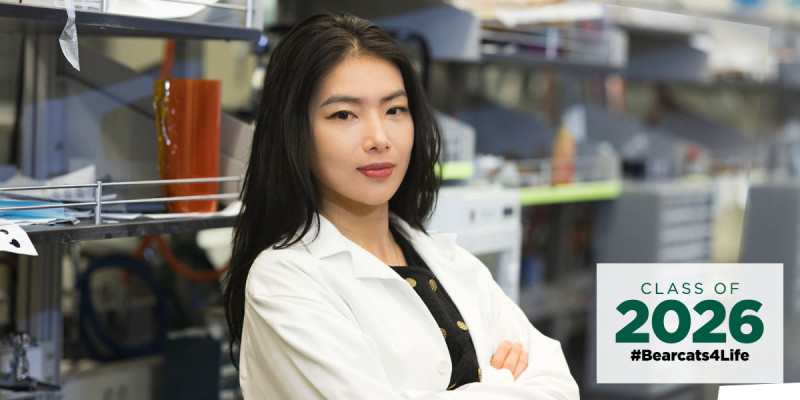
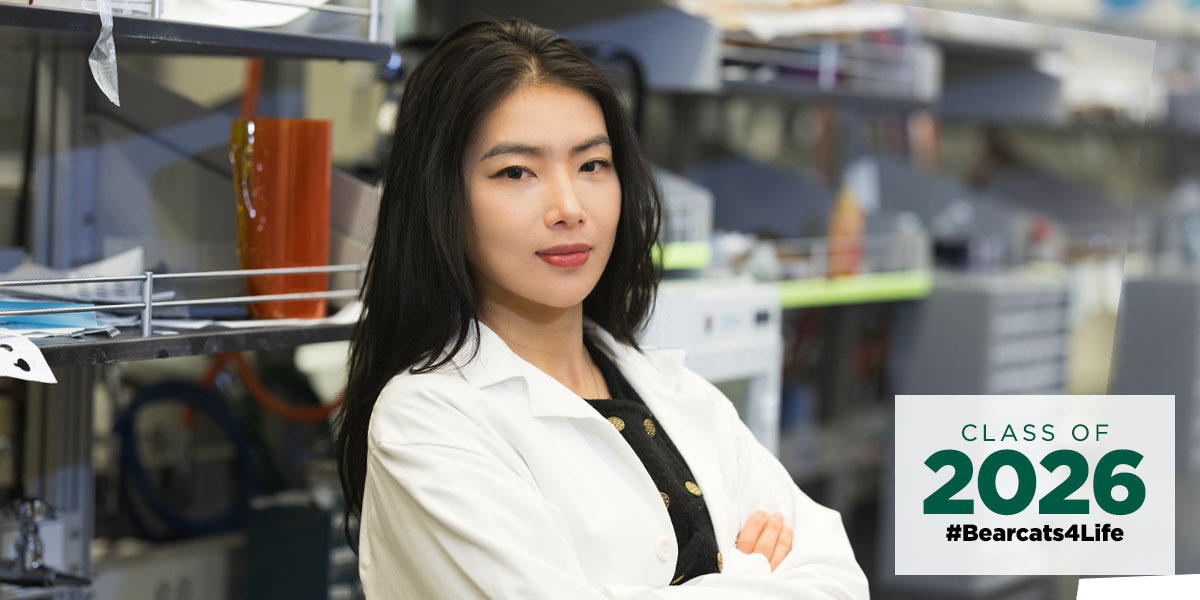
After earning her undergraduate and master’s degrees in chemistry at the Chinese Academy of Sciences, Yang “Lexi” Gao saw clearly the path she wanted to take.
Step 1: Find a university where she could pursue her PhD.
Step 2: Earn that doctoral degree (getting her research published along the way).
Step 3: Find a faculty role in academia to combine her love for teaching and research.
When Gao found Professor Seokheun “Sean” Choi’s Bioelectronics and Microsystems Lab at Binghamton University, she knew how she could achieve those goals. She’d studied paper-based sensors for her master’s thesis, and Choi is determined to make biodegradable “papertronics” a key part of the interconnected Internet of Things.
“It was the right fit at the right time,” Gao said. “Everything just feels like destiny.”
This May, she will walk across the Commencement stage and receive her doctorate — then, in the fall, she will start as an assistant professor at Monmouth College in Illinois.
As the kids say: Achievements unlocked.
Breaking new ground
When Gao arrived at Binghamton, she brought her materials science skills in bioelectronics and biosensors to Choi’s multidisciplinary research team, which allowed her to hit the ground running.
“I didn’t need to spend much time training, and I didn’t have to spend a lot of energy getting familiar with the equipment,” she said. “I immediately started working, and everything went very smoothly.”
During her five years at the Bioelectronics and Microsystems Lab, Gao has been part of several groundbreaking and innovative discoveries, including a device that generates electricity from moisture in the air, self-powered mechanical bugs that run on ocean bacteria, a stainless-steel component to boost the power output of bacteria-based biobatteries, and a “living metal” infused with endospores that could bridge the gap between biological and electronic systems.
Her favorite project? A skin sensor that could use bacterial spores to measure a person’s glucose levels based on potassium levels in sweat — a device that would revolutionize diabetes management by eliminating the pain and hassle.
“We have done things that nobody has ever done before,” she said. “I'm a pioneer, and there's no Bible for all the disciplines I've been working on. The bad part is that there's no reference. I have to frequently check in to see if I'm doing everything right. Does this thing make sense or not?”
Before they decided on which ideas to pursue, Gao and Choi did an extensive search through research papers to know what had already been published, and the avenues that remained unexplored.
“He has two big shelves full of binders in his office, and those are filled with papers he has read,” Gao said. “Before we start one project, we usually spend a week reading 100 or 200 references to build the foundation of what we hope to do. What data do we need? What can be improved from previous research? Along the way, we'll have more of a sense about how the research will end up and approximately how long the project will take.”
Mutual admiration
Gao sees Choi as a mentor not just in her academic journey but also in her professional career. One important lesson is about work ethic. She likes to start her day around 6:30 or 7 a.m. with a run around campus — and if she stops beforehand at the lab or his office at the Innovative Technologies Complex, he’s usually already there.
“Professor Choi always says that if you're working very hard and you get some accomplishment, you need to continue,” she said. “That's how you keep the momentum that leads to something very good.”
The professor, in turn, has nothing but praise for his PhD student, who won a Binghamton University Graduate Student Award for Excellence in Research in 2025.
“Lexi is one of the most exceptional graduate students I have worked with,” said Choi, a faculty member at the Thomas J. Watson College of Engineering and Applied Science’s Department of Electrical and Computer Engineering.
“She has made outstanding contributions to our research in bioenergy, wearable electronics, and healthcare technologies, particularly through her work on paper-based bacteria-powered batteries and self-powered biosensors. I am excited to see her continue this work as an assistant professor at a liberal arts college.”
Gao calls her faculty role at Monmouth College — where she will teach materials science and engineering — a “perfect fit.”
“It merges everything I know and everything I can teach,” she said. “Because it’s a liberal arts school, they gave me the freedom to develop whatever course I want.”