Tyrone C. Howard delivers annual Couper Lecture on educational equity
A leading scholar on race, culture, and educational equity discusses how mental health stigma impacts marginalized communities
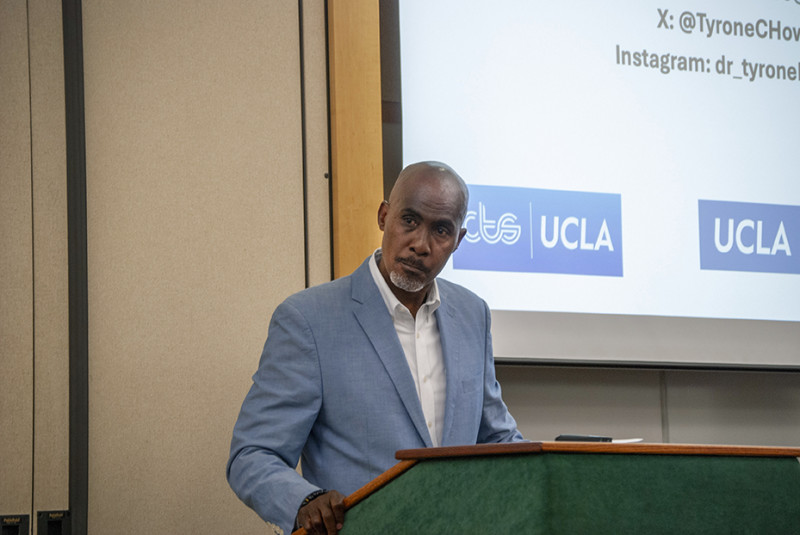
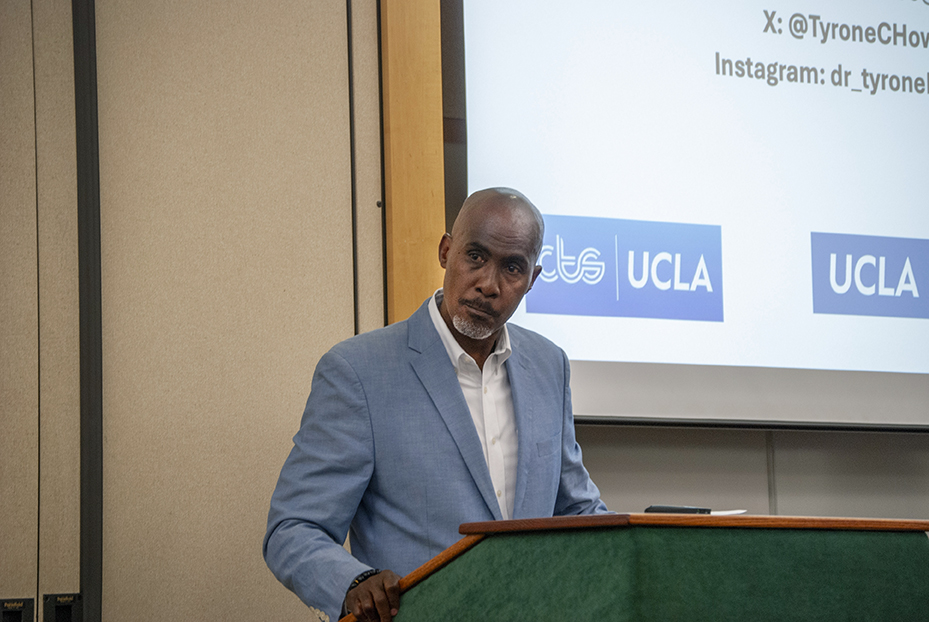
On Friday, May 1, Tyrone C. Howard, professor at the UCLA School of Education and Information Studies and a leading scholar on race, culture, and educational equity, delivered the 2026 Edgar W. Couper Lecture at Binghamton University’s Downtown Center. His lecture was titled “Equity Now: Transforming Education During Turbulent Times.”
Howard’s talk centered on how children of color, low‑income, and immigrant children are routinely misidentified and underserved in U.S. schools because educators and systems fail to recognize their unique trauma and mental health needs. He noted that mental health stigma in many immigrant and communities of color, along with cultural mismatches between families and providers, can further marginalize these groups.
For example, Howard described the burden on immigrant children, or children of immigrants, who often assume multiple roles in the household, acting as translators or “navigators” for their parents. These responsibilities can cause emotional and academic challenges that are frequently misdiagnosed, leading students to be labeled as needing special education rather than being recognized as talented or gifted.
Additionally, Howard points to the current climate of fear that is pervasive and harmful to all children due to the presence of immigration agents in neighborhoods and at schools.
“I often reflect on the students I work with who share the challenges of being young and undocumented,” Howard said. “They are told early on not to ask for help or seek support, because anything they say could backfire and be used against them or their families.”
Howard also noted increasing rates of anxiety, depression, and suicide, particularly among boys, LGBTQ+ youth, and Black and Latinx students. He emphasized the unique and multiple stressors these groups face, as well as the cultural and gender-based barriers to seeking help.
“Understanding the ways in which there's such a stigma attached to mental health explains why this moment is challenging,” Howard notes. “We have so many young people who are walking around who are not well, but who have not been given the tools to say, ‘I need help.’”
In response, Howard calls for systemic change through an intersectional lens. He advocates for trauma-responsive, culturally and linguistically relevant supports to strengthen school–family trust and improve use of community mental health resources. He also recommends enforcing policies on disproportionality, reallocating funds to early intervention, diversifying assessment and Individualized Education Program (IEP) processes, and preparing teachers with sociopolitical awareness, relationship-building skills, and mental health literacy.
“I tell my teacher education students that for many young people, they don't care what you know; they want to know that you care,” Howard said. “And so, part of our training around teacher education has got to be rooted in building that relational capital with students so that they see teachers as true advocates and true allies as they attempt to navigate the world around them.”
Howard holds the Pritzker Family Endowed Chair and is a member of the National Academy of Education. He is also the founding director of the UCLA Pritzker Center for Strengthening Families and the UCLA Black Male Institute. He has published seven books and authored more than 100 peer-reviewed articles, book chapters, policy briefs, reports, and other academic works. His research explores how systems, structures, policies, and practices affect individuals’ pursuit of self-actualization and advocates for equitable, affirming work, teaching, and learning environments.
The Edgar W. Couper Endowment Fund for Educational Excellence provides Couper Fellowships annually to one or more full-time students in Binghamton University's doctoral program in Educational Theory and Practice and supports the annual Couper Lecture.