Decker College celebrated research days with innovative projects
Faculty and student work highlights collaboration and academic excellence
Binghamton University Research Days is an annual, week-long celebration that showcases groundbreaking research across the University. From April 24 to May 1, 2026, faculty and students from Decker College of Nursing and Health Sciences participated in the events. The college also hosted Decker-specific special programs throughout the week, highlighting the remarkable achievements of its researchers.
Decker College Research Days Opening Keynote Presentation
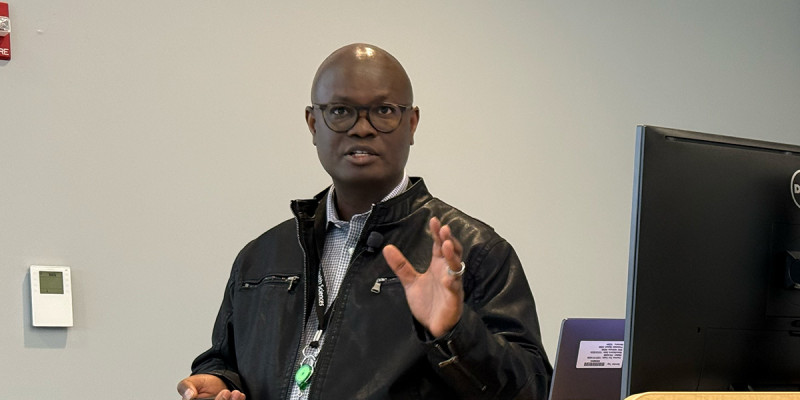
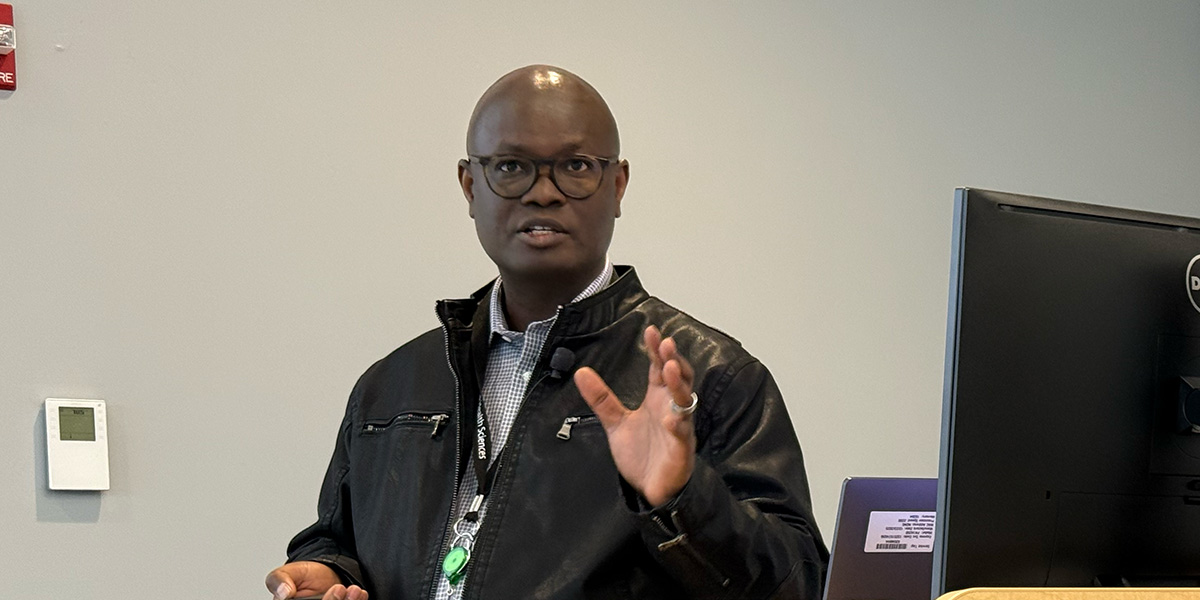
Decker College’s Research Week events kicked off on April 28 in the Health Sciences Building with a keynote by Bernard Muriithi, associate professor of occupational therapy, titled “Sustainable Health Science Research: Responsibility, Power, and Limitations in Advancing Societal Health.”
Muriithi’s keynote emphasized that advancing healthcare requires research that meaningfully improves the care experience, enhances health outcomes, and reduces costs. According to Muriithi, achieving these goals depends on building genuine trust with community partners and strengthening collaboration within and across disciplines.
“As a college, expanding both the reach and impact of our scholarship demands intentional, coordinated approaches,” he said. “The Occupational Resilience Framework offers a valuable guide for pursuing research that is not only rigorous but also sustainable, collaborative, and responsive to real-world needs.”
Faculty and Student Poster Presentations
Poster presentations and research discussions were held April 29 and 30 in Rooms 101/102 of the Health Sciences Building, featuring faculty and students from across Decker College.
Additionally, research projects stemming from strong partnerships among faculty, students, and the community were highlighted during the Community-Engaged Learning and Research Showcase, held May 1 at the University’s Vestal campus.
Decker College undergraduate and graduate students and faculty from academic divisions and laboratories represented at the event included the divisions of Health and Wellness Studies (including the B-SMART and B-MINDS student research groups), Nursing, Occupational Therapy, Physical Therapy, and Speech and Language Pathology, as well as the Metabolic and Exercise Physiology Lab, Motion Analysis Research Lab, and Brain and Swallowing Lab. Also included were researchers from the Source Project's Stereotypes and Stuttering stream, led by Rodney Gabel, professor of SLP.
Decker College Research Days Closing Keynote Presentation
Daniel Miller, lecturer in the Division of Health and Wellness Studies (HWS), concluded Decker College’s research week with his presentation, “Bridging the Gap: Sleep, Stress, Metabolism, and Human Performance in the Future of Care” on May 1 in the Health Sciences Building. His talk spotlighted the division’s Metabolic and Exercise Physiology Lab and the critical contributions of its student-researchers. Supported by HWS course fees, the lab integrates research with student education.
“The Metabolic and Exercise Physiology Lab is an education-based lab that also does research,” he said. “The research that we do has a direct impact on the student population we interface with.”
After a brief introduction, Miller turned the podium over to student presenters and key lab staff: Rania Khan, Nema Sayeed, Sara Saleh, Madison Gangi, Victoria Madej, Zaid Ashar, and Maxime Argenson. The student presenters explained that the lab conducts resting metabolic rate and graded exercise tests, yielding significant findings, including metabolic inflexibility in young adults and the effects of caffeine and dietary habits on health. The lab also addresses gender disparities in ACL research, focusing on female athletes. The team emphasizes the importance of integrated care, student-led research, and community engagement.
“The lab is meant to be a student-led and student-driven initiative, and that's what really makes us unique,” explained Khan, who serves as lab manager. “The difference between a regular lab and our lab is that in a regular lab, it's usually the [principal investigator] who has a question that they want to figure out and answer. Then they have postdoc, doctoral, and graduate students doing research, and the undergrads are at the very bottom, just doing data collection. But here, undergraduate students are doing all the work under the mentorship and guidance of Dr. Miller. We collect the data, but we're also asking the research questions. We're looking into the literature. We're writing our posters, and we're disseminating our findings on our own, and we see that this kind of support and leadership is really important and actually has very long-lasting impact.”