Building successful pharmacy faculty careers through mentorship and support
Binghamton University Pharmacy and Pharmaceutical Sciences hosts national symposium for pharmacy faculty professional development
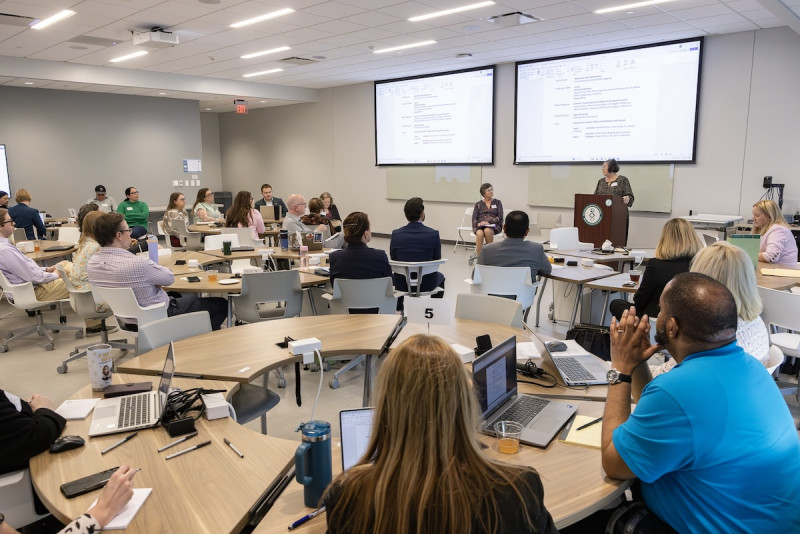
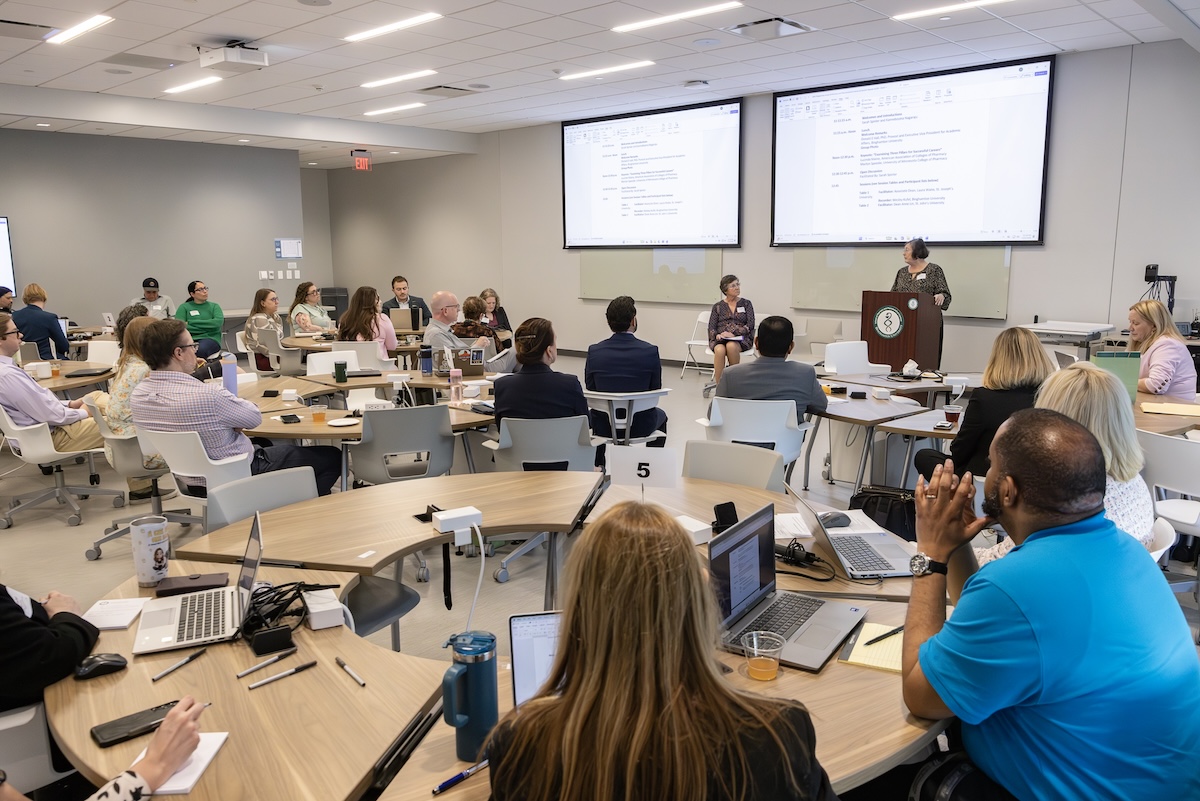
The “Binghamton University Symposium: Cultivating Generations of Successful Pharmacists - The Journey to a Fulfilling Pharmacy Academic Career” was held all day on Friday, April 24, in the School of Pharmacy and Pharmaceutical Sciences.
The conference included a keynote followed by three breakout sessions led by the deans of other pharmacy schools across the Northeast. Its goal was to develop strategies to build, network, and retain successful faculty relationships across university systems and career stages.
"This was an outstanding symposium that brought together nationally respected and accomplished leaders in academic pharmacy who have persisted, excelled, and continue to serve as role models for current and future generations of pharmacy faculty,” said Kanneboyina Nagaraju, dean and SUNY Distinguished Professor.
“The symposium created a unique forum for honest dialogue, professional development, and intergenerational mentorship, while inspiring young and emerging pharmacy faculty to pursue excellence in teaching, scholarship, leadership, and service. The discussions highlighted not only the challenges of academic pharmacy, but also the importance of resilience, community, mentorship, and institutional support in cultivating the next generation of leaders in the profession."
Facilitated by Nagaraju and Sarah Spinler, PharmD, FAHA, FCCP, FSHP, AACC, professor of pharmacy practice, the event began with a tour and lunch for general discussion, along with remarks from Provost Donald Hall.
Hall opened with the upward trajectory of the School of Pharmacy and Pharmaceutical Sciences (SOPPS), outlining the two dozen conference presentations, 65 published papers, millions of dollars of funding, and nationally leading post-graduate pharmacy residency match rates.
Still, he said, there is always work to be done.
“We want to benefit from your experience, and especially the junior faculty that we have here. There is no textbook; no article can replace this interaction,” Hall said. “I'm truly grateful for those of you taking the time to come here to Binghamton to share your collective wisdom.”
The symposium continued with "Examining Three Pillars for Successful Careers," a keynote discussion between Lucinda Maine and Marilyn Speedie, whose experiences in the field run long and deep.
Their discussions focused on faculty development and three pillars for success: community-building, individual success opportunities, and recognition and appreciation. They emphasized the importance of mentoring, scholarship, and work-family-life integration. These are critical, the pair argues, in a rapidly advancing world where career timelines have significantly changed.
“With the expansion of the enterprise — going from 84 schools to 142 schools over a period of 15 years — you have a lot of new administrators and department chairs, a lot of junior faculty, and so you're putting them on the end of the diving board, and they're going to willingly jump off, dive in, and they haven't even learned how to swim,” Maine said. “That is not a recipe for success, and as a result, people will pack up and leave.”
They outlined the pillars with questions that both faculty and administrators can ask themselves while pursuing new career paths.
- Building a sense of community: Does each employee feel that he or she is a contributing member of the group? Are they proud to be a member of this college? Do they relate to the students and the students’ success?
- Creating opportunities for individual success: Does the school support your growth over a career and encourage you to think ahead? Are the leaders willing to invest in your future?
- Recognition and appreciation: Do you feel appreciated for your contributions and recognized for your successes? Do the people responsible for your career recognize you as an individual with your strengths and your weaknesses and your complications in your life?
Everyone, the pair continued, must feel part of a community. That support is essential in creating senior faculty. Spinler, who facilitated the event in part because of the mentoring she received as a junior faculty member, agreed.
“When you see others whom you have mentored becoming successful in their careers, it’s a huge boost for middle-career faculty who are looking to make a difference in the academy,” Spinler said. “Even a small moment of mentoring, whether personal or professional, can mean so much. It's that personal touch. What we want for this symposium is to discuss barriers, learn from others, and provide a place to look for solutions that are going to help. People always have other things going on, whether it's your pets, your family, your own health. All of those are equally as important [as your career].”
Later in the event, breakout sessions included "Primed for Success: Improving the Transition Between Student, Post-Graduate Trainee and Early Career Pharmacy Faculty," "Managing Middle Career: Bridging the Gap," and "Aligning Personal Expectations with Career Aspirations".
These topics centered on specific challenges for early and mid-career faculty, such as integrating teaching and research; the gap in senior leadership and the need for future leaders; and managing personal and professional responsibilities.
Anne Lin, dean and professor at the College of Pharmacy and Health Sciences at St. John’s University in New York, has championed innovation in pharmacy education. She facilitated the breakout on “Graduate Trainee and Early Career Pharmacy Faculty” along with Sarah Michel, dean and professor at the University of Maryland. She attended the event in the hope of identifying and sharing strategies to help early-career faculty develop successful careers; she believes that if the faculty are successful, the student body will follow.
To ensure that success is possible, however, administration must listen and learn, especially to faculty who are newer to academia.
“You really need diversity of thought. At each stage [of your career], your perspectives change,” Lin said. “As we get further away from being a newer faculty member, we may forget what it's like and what the needs are. You need diversity of thought to get the best solutions you can.”
Elena Umland, dean and professor at the School of Pharmacy, Albany College of Pharmacy and Health Sciences, focused on the mid-career in her breakout session, when the future paths in academic pharmacy are being developed. Keeping that group engaged could make all the difference, she thinks.
“How do we keep mid-career faculty refreshed, challenged, and provide them with opportunities?" Umland said. "It goes back to the mentoring — having the correct mentors to say, ‘Did you think about this?’ Your career isn’t a race, it’s a marathon.”
Guests reflected on the great impact of the many deans with national acclaim who attended the event, who gathered to explore the theme of keeping both faculty — and by extension, students — happy, satisfied, and fulfilled.
“This symposium gives us an opportunity to talk to people at multiple stages of their career, to try to identify where they're finding their job satisfaction from, and how to continue to make sure that those needs are met,” said Anne Schweighardt, associate professor and chair of pharmacy practice and administration at St. John Fisher University. “We tend to not think of faculty as employees and forget that they are people, too. How can we make sure that folks that we're investing this time in and that are investing in the future of pharmacy have contentment in their job, and continue to share their expertise with their students?”