New computer science class offers guidance on technical interviews, job recruiting
Alumni and students work with School of Computing to develop curriculum that gives advice for internships, careers
For computer science graduates, landing a dream job — or even an internship — at a large tech firm takes more than technical knowledge and what’s taught through traditional coursework.
In addition to the usual discussions to make sure candidates are a good fit, the hiring process for CS roles generally includes a technical interview, where applicants are not only expected to solve presented coding problems but also explain why their answers are the best solutions available.
Some Binghamton University alumni and current students say technical interviews can be difficult and intimidating, but are key to unlocking doors of opportunity. The graduates worked with faculty at the Thomas J. Watson College of Engineering and Applied Science’s School of Computing to design a new class that teaches how to navigate the technical recruiting process successfully.
“Technical interviewing is its own unique skill, and it can land you a job at the most prestigious and competitive companies in our industry,” said Clay Battle ’25, now a software engineer at Bloomberg. “If you don't practice technical interviewing, you can get a good job at a smaller company — but if you want the highest salaries, the best resources, and the best networking potential, those jobs are kept behind this wall of technical interviews.”
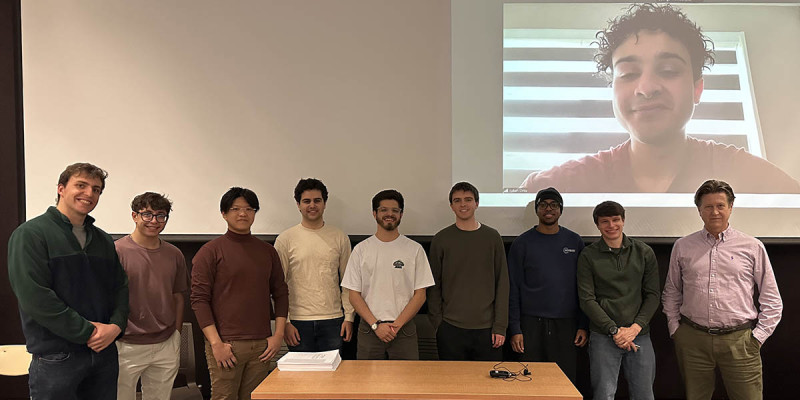
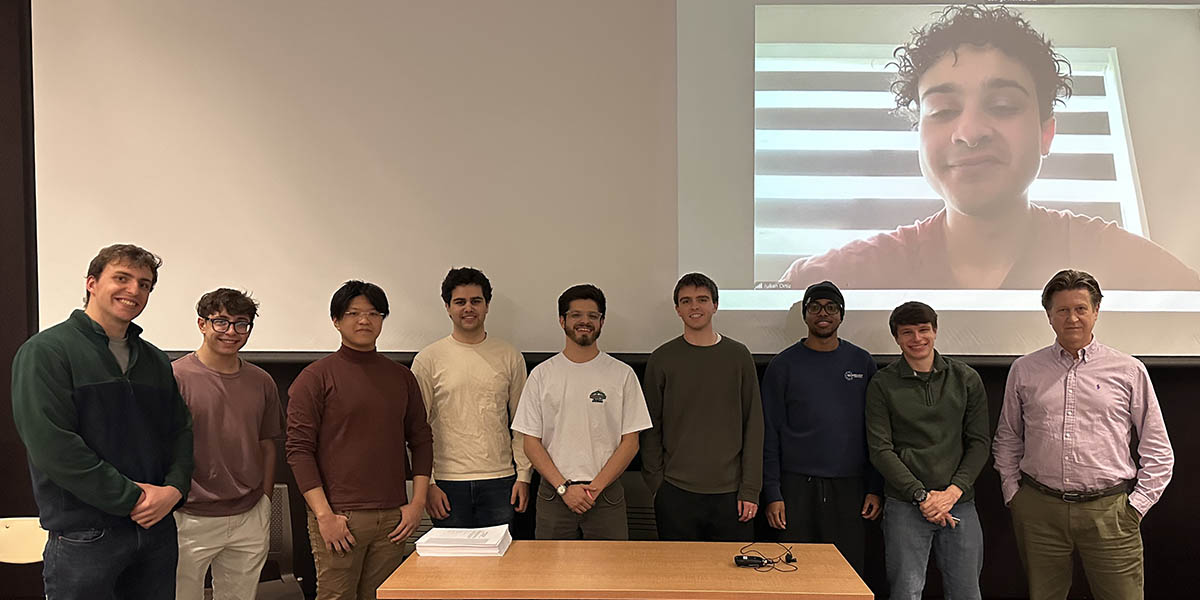
George Weinschenk, a lecturer who serves as the School of Computing’s undergraduate faculty advisor, worked with the students and alumni to launch CS102 - The Tech Recruiting Process this spring. The group includes Battle; Nicholas Reyes ’25; Julian Ortiz ’26; Nikita Safronov ‘25, MS ‘26; Jack Hunter ‘25; Max Mazer ‘26; Jide Obioha ‘26, MS ‘27; Lucas Buonopane '27; and Daniel Zheng '28.
At a time when companies are filling many entry-level programming roles with artificial intelligence, Weinschenk believes the class gives a competitive edge, especially to first-year students and sophomores.
“Students weren't being educated on surviving these interviews until they were juniors,” he said. “You need to have some exposure to the interviewing process before then, because you might want to get an internship as a basis for getting an even better internship later. By the time you try to pick it up as a junior, it might be too late.”
Technical interviews typically focus on live coding challenges, alongside some behavioral questions. Job candidates are often required to describe their thought processes while coding, making technical communication a major component of the interview.
“You're expected to get the question right, but arguably one of the most important parts is the communication,” said Reyes, a firmware engineer at Eaton Corp. “You might think you just need to know how to use this algorithm, but you have to explain the algorithm step by step — and not only explain it, but justify it. Why do you use that algorithm instead of this algorithm? It’s a trial of endurance for your skill and communication abilities.”
In addition to technical interviews, CS102 also includes general career advice and presentations from industry leaders, as well as discussions about career specializations such as quantitative analysis, data science, cybersecurity, machine learning, big tech software engineering, financial technology, research, project management, and startups.
Ortiz — who is interning at tech firm Datadog — hopes the new class expands Binghamton students’ horizons about their job options and the companies they can aim to work for.
“Not everyone wants to work for Google and Netflix — but if you have the ability to, why not try to push yourself?” he said. “You could go where students from MIT and Princeton are ending up. Binghamton deserves to be in those places just as much as the rest of the universities in our country.”
Computer science students currently in the class appreciate the advice about technical interviews and career opportunities. Sophomore Xinlin Wu said CS102 helped her to understand exactly what employers want and expect from applicants.
“I absolutely love this class,” she said. “It's a gift to early undergraduate students who feel lost navigating the job market. You can see the immense care the creators of the course put into the curriculum, from breaking down LeetCode patterns to bringing in industry guest speakers.”
Wu also praised the one-on-one mentorship she’s received this semester.
“When I was panicking over a job interview, I reached out to Clay looking for some help, and was absolutely blown away,” she said. “He spent countless hours breaking down what to expect, including sharing his own personal experiences, and overall just giving me the confidence I needed to pass the interview.”
First-year student Kathryn Schauber admitted she came to Binghamton and the CS field without any knowledge of the job market and recruiting process.
“All I knew was what my parents know, and neither of them are in technical fields, so what I thought I knew was completely wrong,” she said. “This class has forced me to look forward and start preparing as early as possible, and has helped me gain a better understanding of what I'm in for when looking for jobs and internships.
“I'm super-grateful for Clay and everyone involved in the class for preparing myself and my classmates for the competitive job market.”
Battle appreciates how the School of Computing took the feedback and acted on it quickly as the tech world transforms with the rise of generative AI.
“I'm grateful that our school is willing to hear from students and recent alumni who have a well-defined problem and have done a lot of thinking about it,” he said. “School leaders were willing to implement it with such a quick turnaround time. In less than a year, we were able to get this class up and running.”