Harpur Commencement 2026: Challenge, resilience and making the world a better place
William Groner ’77 awarded honorary doctorate, and Shareema Gadson Shaw ’96 receives Distinguished Alumni Award
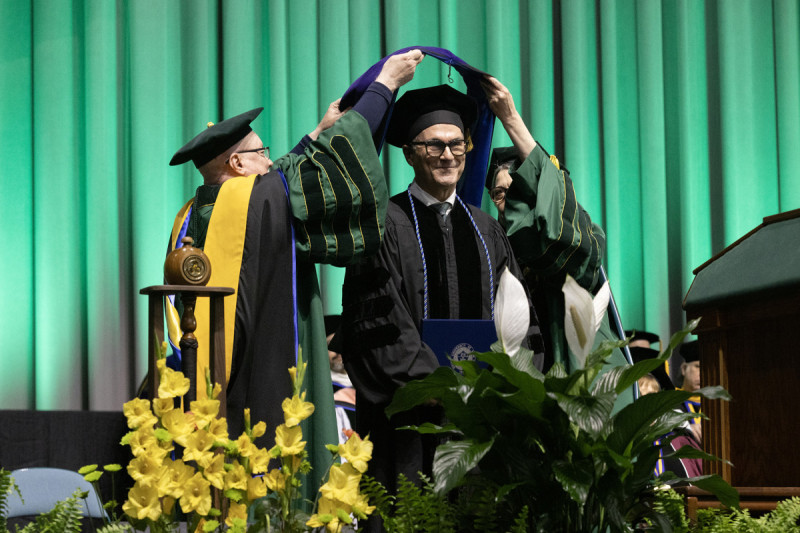
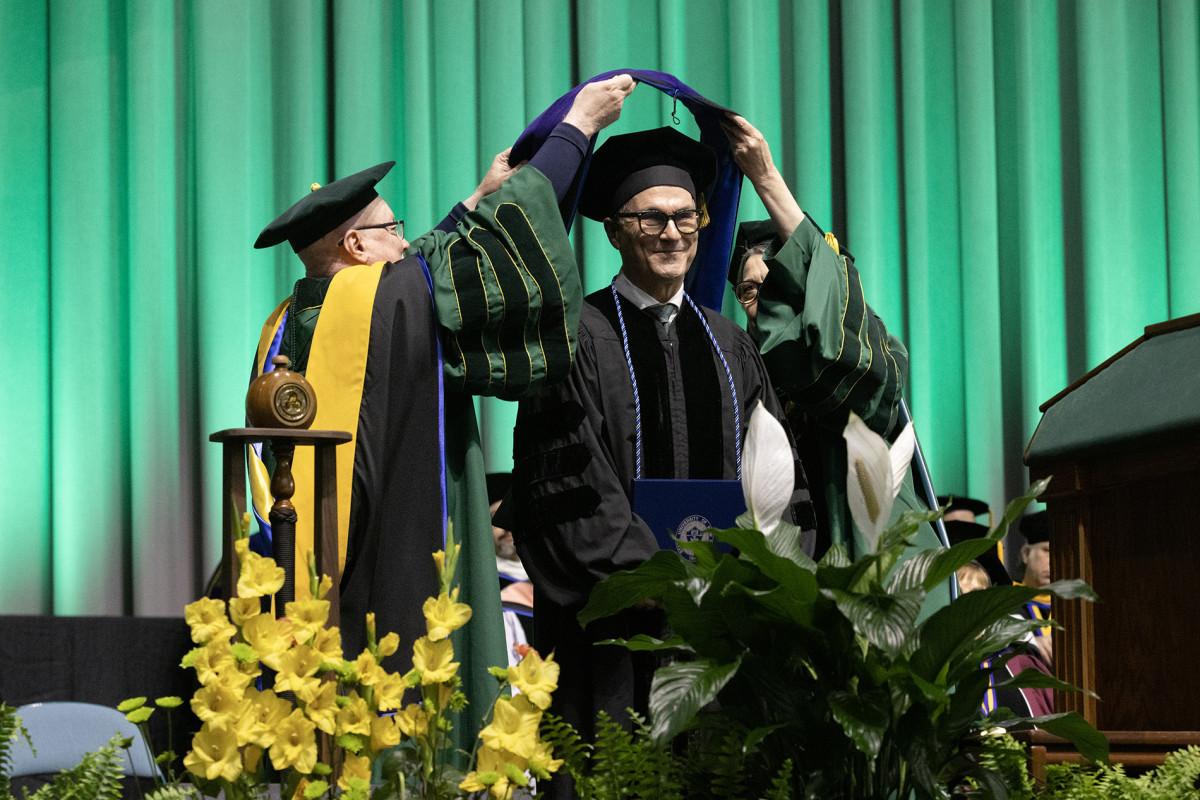
Everyone has a superpower.
Not to leap tall buildings with a single bound or slip into invisibility at whim, but something more basic and more powerful: the ability to enhance another person’s well-being anytime, anywhere, no matter how well or little you know them.
For years, Harpur College alum William H. Groner ’77 would pick up groceries at his local market, never speaking to the clerk or even meeting her eyes. One day, the absurdity of this struck him. He read her name tag, looked up and asked, “Hey Lynn, how are you?” They had a conversation and shared a smile.
In positive psychology, that profound sense of connection, of seeing and being seen, is known as mattering.
“In that brief moment, something even bigger happens: An ordinary interaction becomes a human connection,” said the attorney, educator, and social entrepreneur, who received an honorary doctorate during the first of three Harpur Commencement ceremonies on Saturday, May 16. “And those moments, small as they may seem, are what build stronger relationships, stronger communities, and ultimately a better world.”
It was a timely message for Harpur College graduates, who are entering a world marked by profound social and political challenges, and deepening polarization. But periods of difficulty also give rise to growth and opportunity, noted Groner, who earned his bachelor’s in psychology at Harpur, followed by a law degree from Boston University and a master’s in applied positive psychology from the University of Pennsylvania.
More than 2,200 Harpur students received bachelor’s degrees and 85 received master’s degrees on Saturday; another 62 graduates received doctorates at a separate ceremony on Thursday. As the University’s oldest, largest and most academically diverse school, Harpur is home to a wide range of programs, including the fine and performing arts, social sciences, natural sciences, humanities, mathematics, and interdisciplinary programs.
A co-founder and managing partner of Worby Groner Edelman LLP, Groner spent 35 years as a lawyer focused on personal injury, product liability, medical malpractice, and toxic exposure litigation. He is also founder and CEO of Settle Systems Arbitration and Mediation Alternative Dispute Resolution, co-founder of the Positive Connection Initiative, and host of “The Connection Effect” podcast.
For more than a decade, he managed one of the most complex torts in legal history, representing more than 10,000 first-responders, construction workers, and volunteers exposed to toxins after the Sept. 11, 2001, terrorist attack on the World Trade Center. Proceeds from his book 9/12: The Epic Battle of the Ground Zero Responders supported the creation of a national social studies program that focuses on empathy, respect, communication, and compromise.
A multi-term member of Binghamton’s Alumni Association Board of Directors, Groner also sparked the Talks that Inspire, Educate, and Resonate (TIER Talks) series. In 2023, he co-created the University’s Civil Dialogue Project, which provides workshops to first-year students that promote positive communication, especially with those with whom they disagree.
When our identities become tightly bound to a label or group, we can retreat into echo chambers and lose sight of our shared humanity, Groner warned. But mattering is the superpower that can help us overcome the divide.
Notice people: open a door, look them in the eye, offer help. Listen with your full attention. Ask curious questions not to win an argument, but simply to understand. Be patient and courteous.
“It’s not about being polite; it’s something far deeper,” he said. “It’s a recognition that we are all connected, that we are part of something larger than ourselves, and every person you encounter has a world inside them just as real as yours.”
“Go out into the world, and make people feel like they matter.”
Harpur College Distinguished Alumni Award
During the second ceremony, Shareema Gadson Shaw ’96 received the 2026 Harpur College Distinguished Alumni Award for her commitment to social and economic justice, professional excellence, teaching and mentorship.
After earning a degree in political science, Gadson Shaw received her law degree from Hofstra University. She went on to serve as an assistant district attorney in the Bronx, a senior litigation attorney for the New York City Department of Education, and special counsel in the New York State Governor’s Office combating waste, fraud, and abuse. She is currently the deputy bureau chief for recruitment and retention at the Bronx District Attorney’s Office, and has earned multiple awards for her innovative teaching and commitment to mentorship with the National Institute of Trial Advocacy.
Gadson Shaw has also contributed to Binghamton University in multiple ways, noted Harpur College Dean Celia Klin. A long-time member of the Harpur Law Council, Gadson has mentored students interested in pursuing legal careers, sponsored a summer internship program for pre-law students, served as an admissions volunteer, and contributed to Binghamton’s Educational Opportunity Program and the Thurgood Marshall Pre-Law Society.
The liberal arts education that Gadson Shaw received at Harpur instilled a way of seeing: how to think critically, question boldly, listen deeply, and understand the world through more than one lens.
“I learned that every issue, no matter how complex, is ultimately about people: Every case, every victim, every policy decision. It's all about people,” she said. “That truth has guided me through every courtroom and every challenge where knowledge wasn’t enough: Humanity had to lead.”
A degree isn’t just a credential; it’s a covenant, a promise between you and the society that invested in your success, she told graduates. That investment comes with an expectation: What will you give in return?
For Gadson Shaw, a liberal arts education plants the seed for public service — not just a job, but a way of moving through the world, and leaving conditions better than you found them. It’s a tough road, but one that leads to unmatched fulfillment.
“Carry this mission into every room you enter — when it’s easy, when it’s hard, when it’s celebrated, and even when no one is watching,” she advised. “And when someone asks why you chose this path, let your answer be steady and let your answer be true: Because I was educated — and education without service is a debt unpaid. Because the measure of what I learned is not what I kept, but what I gave.”
Student voices
Harpur College’s trio of student speakers have roots all over the globe: Ela Shriqui comes from France and moved to Manhattan with her family four years ago. Jocelyn Ghanney’s parents are from Ghana, while Mahzuba “Rome” Maliha was born in Bangladesh, immigrating to Queens when she was in middle school.
They share other similarities, too: Ghanney and Maliha are both graduates of the Educational Opportunity Program and had leadership roles in the Juvenile Urban Multicultural Program (JUMP). Shriqui and Ghanney are both headed to medical school. Maliha, on the other hand, has opted to work in the financial sector and has already built an impressive resume, working as a personal relationship management associate at a Johnson City firm, as well as in real estate and at an insurance company.
And the three struggled during their educational journey — a quality that perhaps all college students share, as they seek to discover themselves, their passions and purpose.
College challenges us in many ways, from learning to do laundry for the first time, to weathering heartbreak, burnout and bad grades. Each struggle brought lessons, discernment, and growth, observed Maliha, a financial economics major.
“Just when I thought I had it all figured out, I found out I had cancer my junior year. Don’t worry; I’m okay now,” she told her peers during the second Commencement ceremony. “I had surgery in January, and I stand here in front of you today as someone who persevered because this is not a sob story. This is a story of celebration.”
Shriqui spent countless hours in the Bartle Library and Associate Professor Fake “Frank” Lu’s Biophotonics and Translational Optical Imaging Lab, where she conducted research on cancer cells using stimulated Raman scattering microscopy. But when stress overwhelmed her, the integrative neuroscience major found solace in the kitchen.
“While neuroscience trained my mind, something else quietly shaped my heart and my hands: baking,” she said during the first Harpur Commencement ceremony of the day. “Yes, baking. Sorry, mom and dad.”
During her first semester, she tried to master chouchouka, a Moroccan dish with tomatoes and peppers, and burned it twice. Around that time, Associate Professor of Chemistry John Swierk was discussing lab protocols, and offered some advice that stayed with her: “Failure is good here.”
“That was the first time I realized that science and life taste the same; both require patience and the courage to try again,” she said.
She went on to make perfect chouchouka and hosted a Moroccan Shabbat dinner with 30 friends to share food and fellowship. Shriqui also discovered that our skills matter most when we give them away, a lesson she will carry into medical school and beyond.
A triple major in biology, global public health, and human development, Ghanney drew attention to a little-known fact: genetically, we are virtually identical to each other, with less than half a percentage difference in our DNA.
“And yet, so many of us spent our time here believing we were fundamentally different, that we were behind, that we didn’t have this thing figured out, that we didn't belong,” mused Ghanney, the student speaker during the final ceremony of the day.
The feeling of not-belonging and a quiet pressure to prove herself haunted her first year. She failed her first chemistry exam. As one of the only Black women on her First-year Research Immersion team, she felt a wave of anxiety walking into the room, she said.
A professor noticed her struggle and gave some compassionate advice: If someone bumps into you while you’re holding a cup of coffee, you’ll spill coffee because the coffee was in your cup.
“The main message she wanted me to take away was very simple: whatever is inside the cup is what spills out when life shakes you,” Ghanney said. “And life will shake you: deadlines, losses, rejections, imposter syndrome, the list goes on. The question was never if, when or why, but rather what we were filling ourselves with to begin with.”
Ghanney chose to fill herself with community as a leader of campus groups, a mentor and a residential assistant. Beyond campus, she taught basic medical skills to middle and high school students.
“Remember that you made it through not because you were invincible, but because you didn’t do it alone,” she said. “If less than half a percent of our DNA separates us, imagine what even the smallest thing we pour into each other can do.”