Anthropology department wins awards at the Society for American Archaeology’s annual conference
Recipients include graduate students Bailey Raab and Liv Winnicki, and Professor Carl Lipo
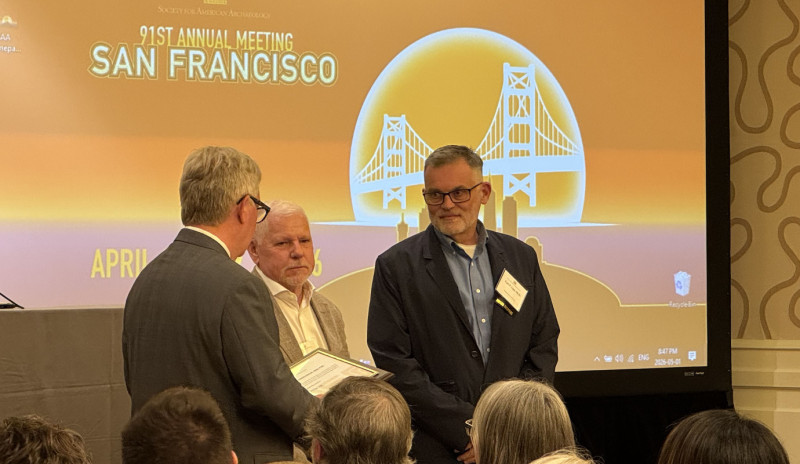
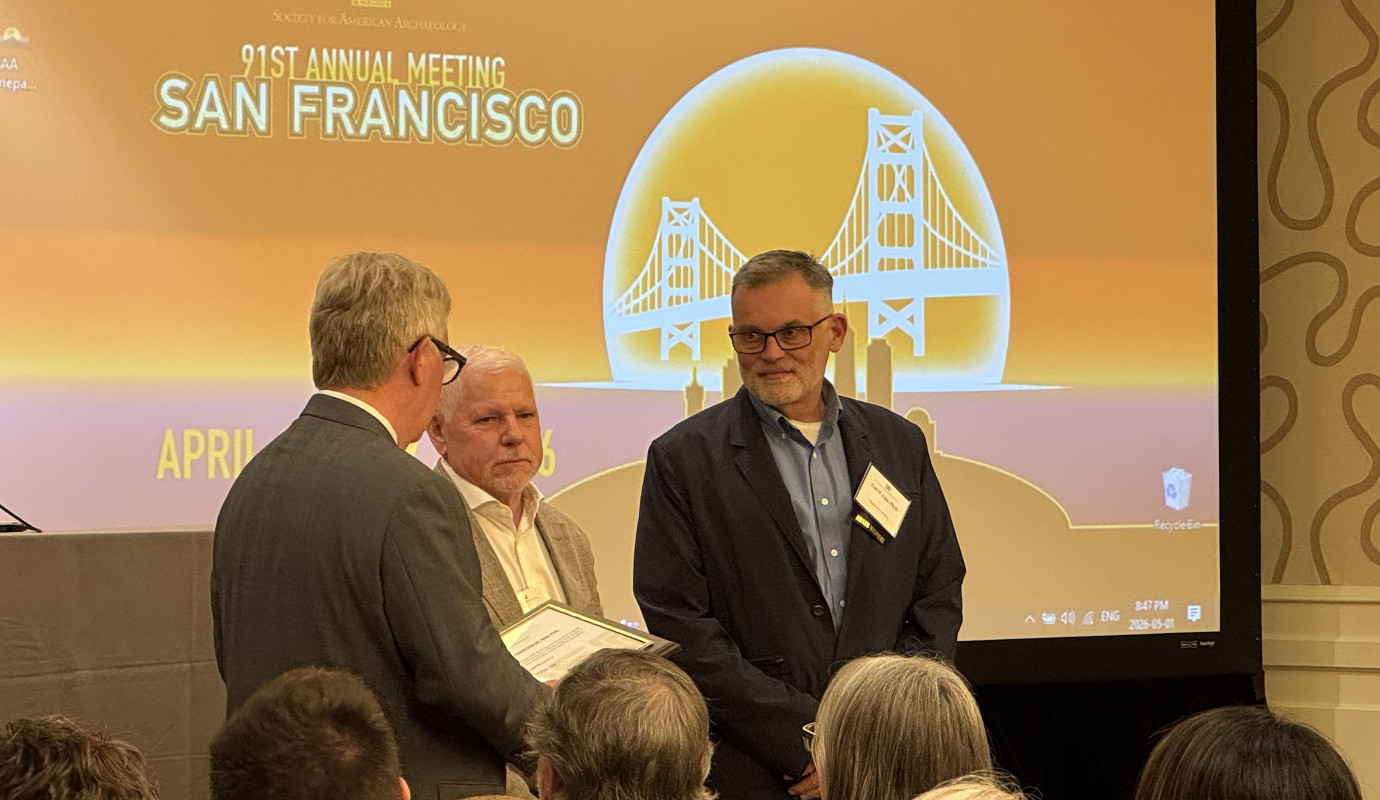
Binghamton University anthropology faculty and doctoral students netted awards this spring at the annual meeting of the Society for American Archaeology (SAA), the largest academic conference for archaeologists.
Bailey Raab won an award for the best student poster, while Liv Winnicki received the Fred Plog Dissertation Fellowship. Additionally, Professor Carl Lipo received the 2026 SAA Award for Excellence in Archaeological Analysis, which he shared with longtime research collaborator Terry Hunt.
Over the past 20 years, Lipo and Hunt have combined cutting-edge technology, quantitative methodology, experimental archaeology, and sophisticated theoretical frameworks to address fundamental questions related to Rapa Nui (Easter Island), ranging from the “walking” moai statues to decentralized quarry workshops, the complex ecological dynamics of deforestation and more. Ultimately, the story they reveal isn’t one of failure, but resilience and adaptation, according to their nomination letter. Their research is widely read and cited even beyond archaeology.
“I was surprised and honored to learn that Terry and I had been selected for the Archaeological Analysis award. The list of previous awardees includes archaeologists I read about as an undergraduate and whose work shaped my own thinking. To join that list is humbling,” Lipo said. “I hope our research continues to inspire students to take on the kinds of questions that drew us to Rapa Nui.”
Distinguished Professor Ruth Van Dyke and four of her graduate student advisees — Winnicki, Julia Coverdale, Daniel Hampson and Emma Valade — presented a poster detailing their recent archaeological fieldwork in Chaco Culture National Historical Park in northwest New Mexico. Entitled “New Eyes on Kin Ya'a: A Chacoan Great House Community,” the presentation illustrated the results of archaeology surveys and lidar investigations into a substantial ancient Chacoan community dating from the 800s through the 1100s CE. The team recorded architecture, roads, and ceramic and lithic artifacts, data that are being analyzed by the students for PhD dissertations and MA theses. The community surrounds a Chacoan great house, or monumental structure, called Kin yaa’áanii by local Diné (Navajo) residents. Kin Yaa'áanii is the traditional home of the Towering House Diné clan.
Winnicki, Coverdale, and master’s student Emma Angell presented papers at the conference, while doctoral students Taylor Hummel and Jessica Weinmeister presented posters, and Associate Professor BrieAnna Langlie organized a session. Associate Professor Kathleen Sterling also attended the conference.
“We met up with numerous alumni at the conference who were likewise presenting their research. It was a mini reunion of sorts,” Langlie said. “It was a great opportunity for our students to network, learn the latest and greatest advances in archaeology, peruse new books, and try out new cutting-edge technology.”
Liv Winnicki
Originally from New Jersey, Winnicki came to Binghamton specifically to work with Van Dyke, one of the leading scholars in Chacoan archaeology. The opportunity to study under someone with active fieldwork opportunities at Chaco Canyon National Historical Park was a major factor in her decision, she said.
Winnicki’s dissertation examines Navajo (Diné) fortress architecture, particularly pueblitos and associated sites in the greater Chaco region. She’s examining how these defensive sites functioned socially and strategically, whether as permanent living spaces, temporary refuges during conflict periods, or broader community centers.
Her research combines archaeological surveys, drone mapping, dendrochronology, GIS line-of-sight studies, and ceramic petrography. She also works closely with the Diné community, including Diné mentors and a Diné academic advisor from Boston University as guides.
“Despite Diné communities having deep historical and cultural ties to this landscape for at least four centuries, they are often marginalized or excluded from dominant archaeological narratives, which tend to prioritize earlier Puebloan occupations,” she said. “I’m passionate about helping expand those narratives to better recognize Diné history, resilience, and presence within these landscapes. This work is important not only archaeologically, but also for addressing larger issues of representation and Indigenous history.”
Thanks to the SAA fellowship, Winnicki will be able to take a ceramic petrography course at the Massachusetts Institute of Technology, where she will analyze whether the pottery found at fortress sites was locally produced. That will help her determine whether people were living full-time at these sites or residing there only on a temporary basis.
At this point, she has finished the primary fieldwork and is focused on analysis and writing, she said. She was also among the last recipients of a National Science Foundation Doctoral Dissertation Improvement Grant; the program has since been discontinued.
Bailey Raab
Originally from Wisconsin, Raab came to Binghamton to study with Langlie, a paleo-ethnobotanist known for her community-engaged work.
Raab’s research focuses on Indigenous archaeological sites in the Ohio River Valley that are around 1,000 years old. At Northern Illinois University, where she completed her master’s degree, she ran into trouble examining botanical samples from these sites.
In paleobotany, soil samples are processed by a flotation machine. The water is agitated by jets, which send lighter objects — typically the size of a poppy seed — to the top of the machine, while heavier materials sink to the bottom. The initial flotation on the Ohio River Valley samples, however, was sloppily done. For her master’s thesis, Raab refloated them, but wondered if material was lost by repeating the process.
She decided to find out. For the experiment documented in her poster, she made five fake float samples using soil from Agway, mixed with poppy and broccoli seeds.
“The poppy seeds emulate light botanicals like Chenopodium: small seeds. The broccoli seeds emulate heavier botanicals like wood or nutshell,” she explained. “I mixed it all up, floated them and then dried them, analyzed and counted all the botanicals.”
To mimic her initial circumstances, she did a poor job on the initial flotation, which made it difficult to recover the seeds from the sample. On a more thorough second run, more seeds were recovered, but some poppy seeds were lost, and the broccoli seeds sustained some damage.
“I wanted to prove that you should do a good floatation the first time because a second float would result in the loss of botanicals,” she said. “But it turns out that a second float is a good idea if your first float was bad. The recovery rates are much better for a second float.”
In her dissertation research, she will continue to analyze paleo-ethnobotanical samples from the Ohio River Valley, examining human-plant relationships beyond food, including textiles, dyes, and medicine. She’s using some of the samples she re-floated back in Illinois.
She enjoyed sharing the results of her research at the SAA and attending panels on subjects of interest, she said.
“The conference is a great way to get new ideas for research and meet people you might be able to collaborate with,” she said.