Students, alumni offer Commencement words of wisdom
11 graduates address classmates in seven ceremonies
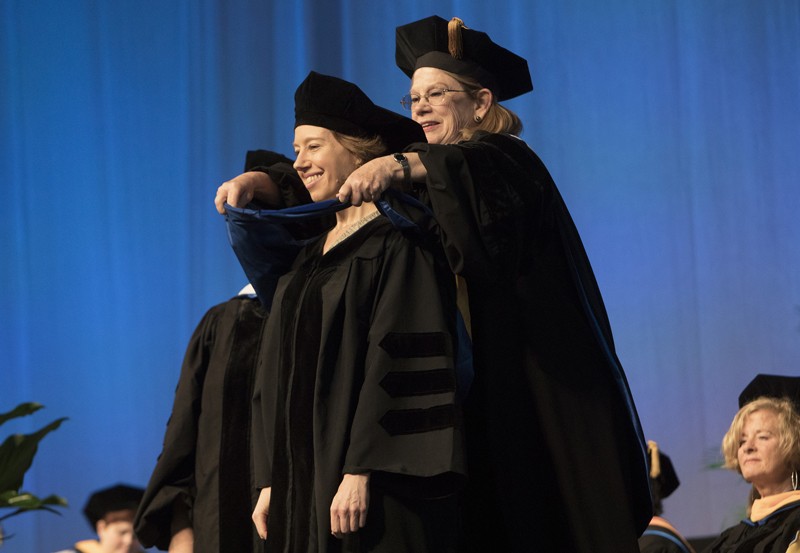

Here are some of the speaker highlights from the school Commencement ceremonies held May 19-21 at the Events Center:
Harpur College of Arts and Sciences
As ambassador to the Pacific island Republic of Palau, Amy Hyatt represents America on a daily basis. But when Hyatt graduated from Binghamton University in 1978, she was set on becoming a lawyer.
“I enjoyed being a trial attorney, but I didn’t love it,” she said. “Then I took the Foreign Service Exam and decided to take a short sabbatical from my ‘real life’ as a lawyer. I took a chance, asked my office to hold my job and expected to return in two years — except that I discovered I loved the Foreign Service.
“Instead of serving one overseas tour and returning to the law, I continued from assignment to assignment, never looking back. It’s been 32 years. … I embarked on a ‘lark’ back in 1985 and discovered my calling.”
Hyatt, who received a Harpur College Alumni Award, urged the Class of 2017 to take advantage of “unexpected opportunities.”
“If you are so sure you know where you’re headed, you may be tempted to disregard something unexpected and wonderful,” she said. “Some of the best things that have happened in my career were unplanned. Sometimes I chose them with reservations, because that wasn’t where I thought I was headed. But the unexpected nature of an opportunity can make it that much more rewarding in the end if you seize it.”
Mitchell Lieberman ’80, another Harpur College Alumni Award recipient, encouraged the graduates to stay connected to Binghamton University. Attending alumni events, joining the Alumni Association and helping to recruit were among his suggestions.
“You should leave here today with the expectation and hope that someday you will be able to give back and help other students achieve a degree from a premier public university,” said Lieberman, who spent 30 years working at Goldman Sachs before retiring in 2010.
Student speaker James Shih, who received a dual bachelor’s degree in economics and philosophy, politics and law, stressed how being part of the crew team helped him answer the question: What does it mean to be strong?
“There was much more to strength than how big one’s biceps were or the firmness of one’s nicely shaped calves,” he said. “There was much more to strength than how much I could accomplish on my own. To become truly strong meant looking beyond myself and giving it my all for others.
“I came to Binghamton with a vision of strength that emphasized independence and self-reliance,” he said. “Yet repeatedly I saw my success was built by those willing to go out of their way to help me. … I was humbled when I came to realize the fragility of my own achievement and its dependence on the hard work of countless people.”
Khadijah Collins, who received her bachelor’s degree in integrative neuroscience, advised her classmates to embrace failure and persevere through life’s obstacles.
“You each have a dream or a goal and you must put your all into it,” she said. “I’m talking blood, sweat and tears. Trust me, there will be plenty of obstacles and failures along the way. But those failures and obstacles only mean that you are one step close to success.”
Dyana Beretz, who received her bachelor’s degree in psychology, stressed that each graduate has the potential to lead by positive example.
“My challenge to everyone in the room is to reflect,” she said. “Look inside and understand who you are. What makes you unique and what makes you feel fulfilled? If you do, you will always find opportunities for growth – and you will find happiness. … Teach what you know, learn what you don’t and remember that the only real answer to ‘what do you want to be?’ is you.”
Thomas J. Watson School of Engineering and Applied Science
Stephanie Tsalwa received her bachelor’s degree in biomedical engineering and discussed the confusion she felt when asked: What do you want to be when you grow up?
“The purpose of this question was to inspire us as children,” she said. “Inspire us to dream about the possibilities that life has to offer. As a young adult, however, it does just the opposite, because when someone asks you what you want to be, you can’t simply reply with 15 different things.”
The question can be answered by following your curiosity and exploring your complexities, Tsalwa said.
“As we continue the next part of our journey, do not compare yourself to others and what they are doing,” she said. “You have to embrace your value, your many talents and your strengths. To be true to ourselves, we must lose the fear of failing.”
Danielle Goldinsky, who received her bachelor’s degree in industrial and systems engineering, asked her own question: Why engineering? She thanked her classmates and professors for sharing friendship and wisdom.
Watson students should take what they have learned over the past four years and “use it to mold our own perspective,” she said.
“We as engineering students are trained to take a problem and solve it using the tools we have in front of us and the wit we have attained,” she said. “Each discipline brings a different area of expertise and introduces a different vantage point from which to look through.”
Decker School of Nursing
Denisa Talovic, who came to the United States from Bosnia in 2001, told nursing graduates that they are marching out of Commencement as “a new force, a new strength and a new vision to our profession.”
“Tonight, Binghamton, N.Y., is stronger because all of us were willing to put our all into our education and with a willingness to stay and change nursing for the better,” said Talovic, who received a post-graduate family psychiatric mental health nurse practitioner certificate. “Be the force – and may the force be with you!”
Kelly Gleason, who received her bachelor’s degree in nursing after transferring from SUNY Oneonta, took her classmates through 300 days of school and predicted that they would change the world.
“They say it takes a special person to become a nurse,” she said. “We are all compassionate people who are prepared in evidence-based practice, research, community health and leadership. We’re all privileged to make a positive impact on our patients during their most vulnerable times.”
College of Community and Public Affairs/Graduate School of Education
Amber Decker received her bachelor’s degree in human development and told the Class of 2017 that the world is waiting for it to create change.
“The world of today does not just await our academic qualifications and professional skills,” she said. “It awaits our vulnerability. It awaits our passion for change, our drive for reform and social justice, and our perseverance for making a difference in the world.”
Jacqueline Mamorsky, who received her master’s degree in public administration, delivered her speech in sign language.
“Let’s not forget that having a voice is not just about speaking,” said Mamorsky, who is deaf. “It’s about having the ability to listen to people. It’s not about having the ability to hear, but the ability to have empathy and sympathy. It matters how you approach people and learn their stories and walk in their shoes before you understand why and how you can fight for them.
“I don’t need to hear to learn their stories: I see their stories in their faces, body language, wrinkles, callouses and scars.”
Peter Gierlach, who teaches eighth-grade social studies in the Windsor Central School District, stressed that students are not “done” learning after college.
“The road to fulfillment starts with the realization that nobody in this room is ‘done,’” said Gierlach, who received his master’s degree in literacy education for grades 5-12. “Everyday we get 86,400 seconds that never get refunded, but that we all get replenished each and every morning. That time in itself is a gift we need to cherish and use to the best of our abilities.”
School of Management
William Rayfield, who received his bachelor’s degree in business administration, emphasized the resources and opportunities that Binghamton University provides to its students.
“We must be willing to place ourselves in uncomfortable situations because that is truly how we learn what we are made of and how far we can push ourselves,” he said. “If we continue to take these chances, who knows what the future might hold for us.”
SOM Alumni Award recipient Thomas Porcelli Jr. ’96 said being a good listener is a key skill for success.
“So many of us just want to sound smart and talk over people,” said Porcelli, managing director and chief U.S. economist at RBC Capital Markets. “I detest this. I am struck when I see someone interrupt another person in mid-sentence and talk over them to make their point. It reminds me of a great twist on an old saying: ‘Don’t just do something. Stand there.’ Not everything requires a response.”
Make a great life for yourself, Porcelli advised the graduates.
“Just make sure that you define what ‘great’ actually is,” he said.