Acres of natural beauty: Exploring Binghamton’s Nature Preserve
'Living classroom' has been source of education and recreation for decades
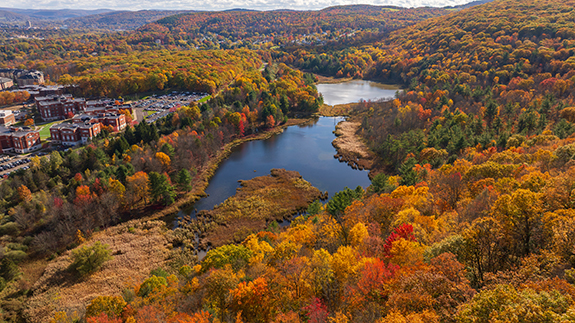
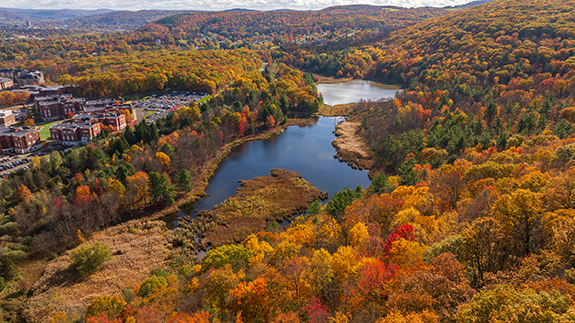
Deep within Binghamton University’s campus is one of the richest biomes in the Southern Tier, home to an evolving and diverse ecosystem of flora and fauna, all condensed within 190 acres.
With new- and old-growth forests, marshy wetlands, and shrubbed meadows, the Nature Preserve (located in the upper south side of the campus) has largely remained untouched since its designation in the late 1960s. From amphibians like salamanders and frogs to mammals like beavers and deer, visitors have the rare opportunity to observe a broad range of species across the animal kingdom. An orchestra of noises — the vibrating buzz of insects to the gentle rush of streams — greets all who set foot on the site.
For Dylan Horvath, MS ’03, the University’s steward of natural areas, the Nature Preserve is much more than a career. Before assuming the first-of-its-kind caretaker position in 2006, Horvath’s research took him to remote landscapes across the country, studying wolverines, bats, and birds in states such as Montana, Idaho, and North and South Carolina.
But there was something special about the Nature Preserve that drew Horvath back to Binghamton, and it has kept him here for over two decades.
“I’d been out West and I thought I would stay there,” says Horvath, who was first exposed to the Nature Preserve as a graduate student studying biology. “I thought I’d fall in love with it. All the animals that I saw were like a safari — you see wolves and bears and moose and all sorts of things out there. But out of all the places I’ve been, the Nature Preserve has been a place where I see the most animals. I see a lot of diversity.”
Students have been the heart of the Nature Preserve since its inception. In 1969, it was the pressure of student activism that encouraged then-University President Bruce Dearing to designate these natural wetlands — originally intended to be bulldozed to create recreational fields — as off-limits to development. To this day, it’s students who volunteer their time and energy to the upkeep of the Nature Preserve for generations to come. Open to anyone with an interest in the outdoors, the Friends of the Nature Preserve program invites students and others to take an active role in management, maintenance, and education — drawing participation from people as far as Pennsylvania.
“I try to involve students in everything I do,” says Horvath, who notes that the Nature Preserve serves as a “core” to a surrounding natural area of nearly an additional 285 acres. “That’s the physical maintenance, all the educational outreach. From what I can do time-wise, that’s mostly limited to tours, nature walks, educational walks, but I try to bring students into all of it.”
Julian Shepherd, a Bartle professor of biological sciences, first arrived at the University in the 1970s. He has witnessed how the space has grown into what it is today.
“You might think, ‘Oh, Nature Preserve: What you do is you let nature take care of itself,’” says Shepherd, who worked to shape and expand the Nature Preserve alongside the late Richard Andrus (who established the University’s environmental studies program). “But it does need help, especially when there's a lot of people visiting it. You want to give tours and you want to make sure the trails are in good shape — and Dylan does a lot of that.”
For educators like Horvath and Shepherd, the Nature Preserve has long served as an accessible, living laboratory, to observe, identify, and collect specimens like birds, bugs, and butterflies. Students are conveniently able to embark on field trips without having to leave campus, going far beyond the four walls of the classroom — an immersive learning experience that occasionally opens them up to careers in wildlife biology and conservation.
“A lot of universities have a natural area somewhere, but it's often five miles or more away,” Shepherd says. “I've given classes within an hour, and we’ve run up to the Nature Preserve to do something and gotten back in time for students’ next courses. It’s great to have it on campus.”
Now, rather than construction, climate change is the greatest challenge to the Nature Preserve. A particularly wet period starting in 2017 led to increased precipitation and accelerated erosion — washing decades of soil away over the course of just five years. Other threats include invasive pathogens and pests that quickly spread across the forests, potentially leading to their decimation if left unaddressed.
“I morbidly joke that once the final tree has its disease, that might be when I quit,” Horvath says. “But I'll keep going, no matter what. Students keep me going. They keep my emotions positive.”
Despite the challenges, the Nature Preserve has remained a valuable resource for Binghamton students, faculty, staff, and the greater community. Even with miles of trails (which include the wooden footbridge in Pond Trail) and most of the athletics cross-country course winding throughout, Horvath emphasizes that the Nature Preserve can offer much more than recreation — with sights and sounds that cannot be experienced anywhere else.
“It’s a big deal that students are going into nature and hopefully appreciating it, possibly seeing animals,” he says. “It helps your mental health to be out there. So many students go out there to get away from things a little bit and have some peace in the preserve. If it was a park, you wouldn't have that.”
***
This story is part of Binghamton University Magazine’s “80 things to love about Binghamton University” in the Spring 2026 issue. The special section highlights the people, places, history, and cornerstones that have made the University special over the past 80 years.