Q&A with Binghamton’s Nobel Laureate professor
M. Stanley Whittingham now leads Binghamton's battery initiative
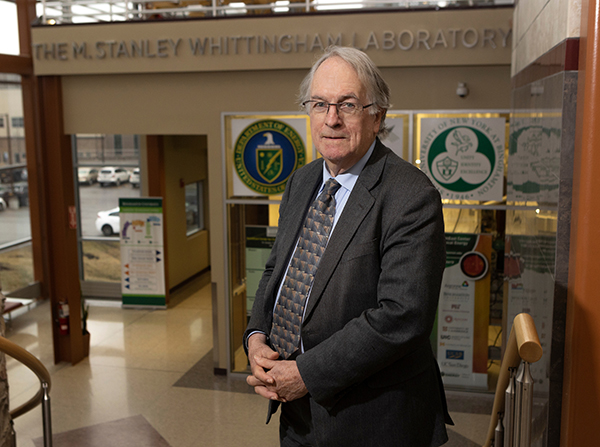
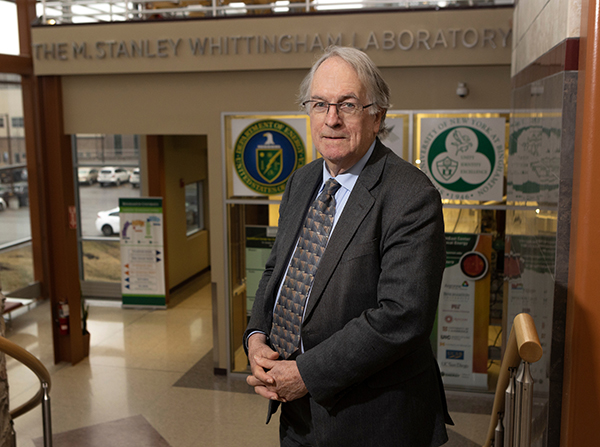
M. Stanley Whittingham, who joined Binghamton’s faculty in 1988, received the Nobel Prize in Chemistry in 2019 for his research leading to the development of the lithium-ion battery. Whittingham, now 84, remains a fixture on campus, leading Binghamton University’s battery initiatives. Binghamton University Magazine spoke with Whittingham, who was dubbed a Knight Bachelor by Princess Anne in 2025.
Question: Where have you been able to speak or visit since receiving the Nobel Prize?
Answer: I traveled a lot last year and the plan is to travel much less this year! At the Lindau Nobel Laureate Meeting in Germany last summer, there were probably 15 to 20 Nobel laureates, about 400 graduate students, and a few undergraduate students. There are some lectures, walks with groups of students, a boat ride. The students are so excited, and we got to meet a lot of other Nobel laureates. That’s fun. You get to see the other sides of some of these people. I went back to England in December to give the first John Goodenough Lecture at St. Catherine’s College in Oxford. Culturally, a lot has changed compared with America. I walked three-plus miles every day. The downtown is basically no traffic except buses.
Q: What’s the most important message or advice you share when you speak to students?
A: Do something that excites you and don’t follow the gang, as it were.
Q: Are there celebrities who have especially impressed you in your travels?
A: I met Princess Anne at Windsor Castle. She talked for about five minutes, holding the whole ceremony up. Arnold Schwarzenegger impressed me. In Los Angeles, he gave a 40-minute talk with no notes, completely literate.
Q: What do you see as your legacy at Binghamton?
A: Besides the Nobel, I started the efforts in materials science. Later on, the center we started was named an Energy Frontier Research Center by the Department of Energy, and that was one of the first big nationally funded efforts on campus. In a sense, that got us on the map for the battery research.
Q: Are there breakthroughs in terms of the battery industry that you’re excited about?
A: The chance of getting rid of the toxic materials, including PFAS. … I also hope to have a manufacturing presence in this country. It looks like it’s getting harder and harder, not easier. What I’m happy about, I started at Exxon. They started the battery business. They’re now back in it again. They’re drilling for lithium; they’re making carbon for the anodes. We need big companies to lead or to invest.
Q: Where do you keep your Nobel medal?
A: There’s a replica in the president’s office. The original is in the bank safe, and I have another copy somewhere, but I can’t find it.
Q: How long do you want to keep teaching and innovating at Binghamton?
A: I recently was in Monterey, California. There was a blue sky,70 degrees, beautiful ocean. I think we’re going to be looking at spending more time somewhere warmer in January and February, but I’m not sure they’ll let me retire.
***
This story is part of Binghamton University Magazine’s “80 things to love about Binghamton University” in the Spring 2026 issue. The special section highlights the people, places, history, and cornerstones that have made the University special over the past 80 years.