Binghamton University at 80: The history
Triple Cities College, Harpur College, WHRW, and more
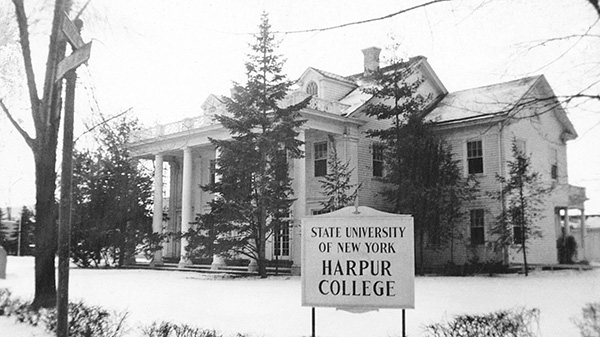
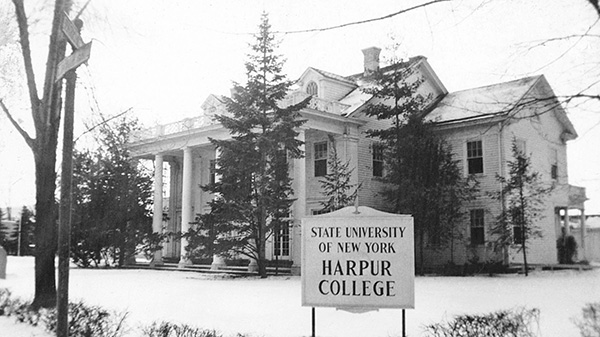
Binghamton University is celebrating its 80th birthday in 2026! In honor of 80 years of excellence, Binghamton University Magazine is presenting “80 Things to Love About Binghamton University,” highlighting the people, places, history, and cornerstones. Here is some of the history that has made the University special.
31. Endicott roots: Triple Cities College and Harpur College
Why Endicott? An educational extension program had been held in Endicott (mostly at Union-Endicott High School) since 1932. Triple Cities College was started on the basis of that program, along with Thomas J. Watson’s donation of the Lincoln Avenue building that became Colonial Hall.
Why Harpur? Triple Cities College was ready for a new identity when it joined the SUNY system in 1950. The new names were narrowed to three choices: Chenango College, Whitney College, and Harpur College. The last, named for an 18th-century educator and early settler of nearby Harpursville in Broome County, was chosen.
32. The move to Vestal
In May 1952, SUNY trustees announced that Harpur College’s permanent home would be located on 387 acres of former farmland in Vestal (seen above in 1954), between downtown Binghamton and downtown Endicott, on what is now the Vestal Parkway. The campus opened in late 1958.
• Thomas J. Watson offered to donate IBM land on Robinson Hill Road in the Town of Union as the site of the new campus. Trustees were reluctant to approve the land’s suitability, and Watson withdrew the offer in April 1952.
• President Glenn G. Bartle cancelled classes on a spring 1952 afternoon so members of the Endicott campus could visit the Vestal site.
• Gov. Thomas E. Dewey attended and spoke at groundbreaking ceremonies on Oct. 6, 1954. It is believed that Dewey decided the gymnasium would be built first, so passing motorists could see it from the road.
33. Harpo the Burro
Here is the only known photograph of Harpur College’s first mascot! In the mid-1950s, the burro was chosen by students over the American Eagle and the Great Dane (you’re welcome, UAlbany), so the senior class bought Harpo and gifted him to the college. But Harpo’s bad temper did not endear him to the campus community and he was removed for safety reasons.
34. The Colonial News/Pipe Dream
Headlines from the inaugural issue of The Colonial News (Nov. 22, 1946):
• Student govt. election Dec. 13
• School library plans opening
• Basketball candidates turn out in force for initial cage practice
• Bartle will attend educators’ conclave in Rome
In 1970, The Colonial News changed its name to Pipe Dream, which can be read online and in print.
35. Eleanor Roosevelt speaks on campus
One of the highest profile visits in the early years of Harpur College, former First Lady Eleanor Roosevelt discussed state politics, President Kennedy, and the United Nations during a January 1962 appearance. The talk drew an audience of nearly 1,000 to what is now the Fine Arts Building. Accompanying Roosevelt are Ronald Bayer ’64, Lesley Krauss ’64, and Robert Poczik ’64.
36. The trimester schedule
Called “The Great Experiment” by The Colonial News, Harpur College unveiled a trimester plan in July 1963 that also incorporated a four-course schedule instead of the usual five. Although the schedule only lasted until 1967, it showed that the college was willing to innovate. In 1971, SUNY Binghamton switched to an “ABC-no credit” grading system. Like the trimester, the new grading system received low marks from students, faculty and administrators, and reverted to the traditional “ABCDF” by 1976.
37. Social awareness
Tackling controversial issues has long defined Binghamton students, particularly in the 1960s and early 1970s. In the early 1960s, students spoke out against nuclear testing and for civil rights. By 1966, the campus community was holding vigils and protests over the Vietnam War. In 1970, President Bruce Dearing led an anti-war march to the Binghamton City Courthouse and classes were suspended after the Kent State shootings. In later years, students brought issues such as racism and women’s rights to the forefront.
38. WHRW
Campus radio station is a long-lasting hit
39. Becoming SUNY Binghamton
In 1965, the state designated the campus as the State University of New York at Binghamton. A commitment to graduate curriculum and expanded research opportunities enabled New York to name Harpur one of its four SUNY university centers. The SUNY Binghamton name would be in place until 1992 when it became Binghamton University. Harpur College still remains as the University’s liberal-arts (and largest) college.
40. The Grateful Dead
The legendary jam band’s May 1970 West Gym concert was a defining cultural moment for the institution. The concert, which was held during Spring Weekend and featured New Riders of the Purple Sage opening, became of the most memorable shows in the Dead’s long career. The next 55 years saw acts such as Crosby, Stills, Nash and Young, James Taylor, Santana, Elvis Costello, REM, Bob Dylan, Green Day, Tony Bennett, Diana Ross, Drake, and Post Malone perform at the West Gym, the Events Center and the Anderson Center for the Performing Arts.
41. Decker, SOM, Watson, CCPA and Pharmacy
Binghamton broadened its range of undergraduate and graduate programs with the establishments of the Decker College of Nursing and Health Sciences (1969); the School of Management (1970); the Thomas J. Watson College of Engineering and Applied Science (1983); the College of Community and Public Affairs (2006); and the School of Pharmacy and Pharmaceutical Sciences (2017). Today, students from these schools and college make up about 44% of Binghamton’s student population.
42. The jump to Division I athletics
Who are the top five Binghamton sports teams from the past 25 years?
43. President Obama visits
Barack Obama became the first sitting president to speak at Binghamton University when he addressed a packed audience in the Mandela Room on Aug. 23, 2013. While his talk was about “Making College More Affordable,” Obama made some Binghamton-specific remarks:
• “I've been told that it’s very important for me to get a spiedie while I'm here. So, we're going to pick one up and try it on the road.”
• “I’m excited because of the great work that SUNY campuses like Binghamton are doing to keep costs down for hardworking students like so many of you.”
44. BingUNews
Binghamton University’s official news site replaced the weekly online Inside in April 2017 with updated daily stories and videos ranging from research to student life. In 2025, BingUNews content drew 1.2 million page views.
45. The Road Map
Launched in 2013, the strategic-planning Road Map to Premier projects provided an outline for the University’s next decade. Led by then-President Harvey Stenger and then-Provost Donald Nieman, the Road Map work stressed collaboration and led to initiatives that will impact the University for years to come.
80 Things to Love about Binghamton University
See the digital edition of the magazine