New endowed professorship to focus on artificial intelligence
Subhachandra, MS ’95, and Nandita Chandra want to encourage AI integration into other disciplines
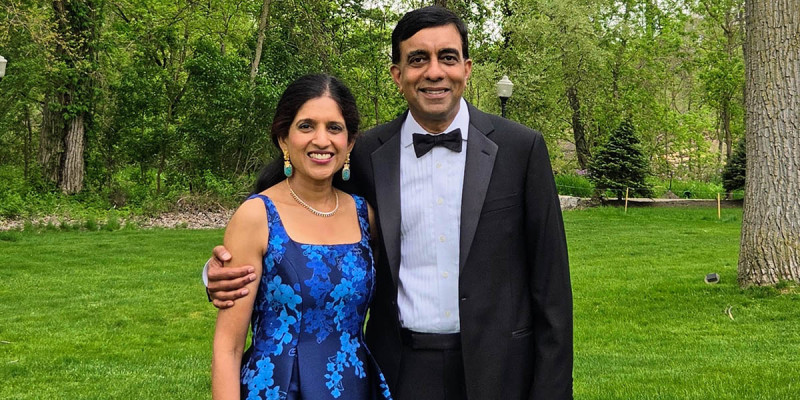
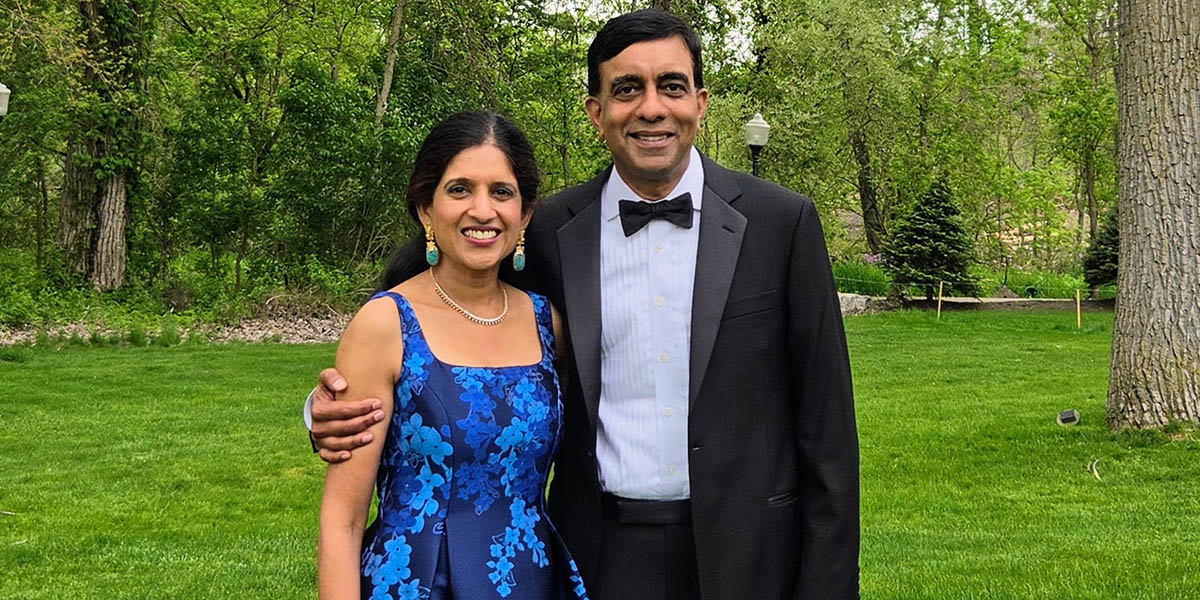
A transformative gift from a Binghamton University alumnus and his wife will establish an endowed professorship focused on artificial intelligence at the Thomas J. Watson College of Engineering and Applied Science.
The Subhachandra and Nandita Chandra Endowed Professorship in Watson College will support an associate professor or professor in any discipline whose research uses AI in innovative ways.
“Challenges always create new opportunities,” said Subhachandra Chandra, MS ’95. “It’s not just using AI within the tech sector, however — it's also about how we apply AI to everything else. How do we best use AI for medicine, environmental sciences, manufacturing, or anything else that you can think of? We can use the power of AI to improve things across the world in many areas.”
The Chandras have generously funded a graduate student scholarship and other programs at Binghamton for more than 20 years, including the Watson College Scholars Program. The endowed professorship is just the latest way for them to give back to Subhachandra’s alma mater.
“Endowed professorships are a powerful way to support and retain faculty who are doing novel and valuable work, and I am incredibly grateful to the Chandras for their gift on behalf of Watson College,” said President Anne D’Alleva.
“In addition to the tangible benefits for our faculty and students, the endowed professorship also pays tribute to the broad successes of alumni like Subhachandra Chandra. Watson College has nurtured the development of many brilliant engineers, and I’m glad that an endowed professorship will inspire others to follow in the footsteps of those who came before them — in science, in leadership, and in philanthropy.”
Watson College Dean Atul Kelkar added: “We are deeply grateful for this professorship, which strengthens Watson College and honors the donor’s vision for innovation,” he said. “It empowers us to support the transformative fields of tomorrow, ensuring that our research remains at the cutting edge of global technological progress for decades to come.
“I cannot emphasize enough how important these gifts are to the future of Watson; they have a profound impact not only on advancing research but also on the academic experience of our students. We are extremely grateful to our alumni and friends who choose to partner with us in our mission of academic excellence.”
“With this professorship, Binghamton’s use of AI will amplify and accelerate the impact our work can have in the world,” Vice President for Advancement David K. Whitmore said. “The Chandra family’s generosity enables us to lead the way in AI advancements and breakthroughs, and we couldn’t be more thankful for their support.”
‘A critical stepping-stone’
Chandra was born in India and came to Binghamton for his master’s degree in computer science as part of Distinguished Professor Kanad Ghose’s research group. He is grateful for the graduate assistantships provided by the University for making it possible.
“Watson and Binghamton did a fantastic job of setting me up for success,” he said. “It gave me an opportunity to come to the United States and to learn about the latest in computing that was not available in India. Looking back, the University was a critical stepping-stone to future success elsewhere.”
After graduating from Binghamton, he earned his doctorate in computer science at the University of Michigan in 2000, and he started his professional career in the San Francisco Bay Area, building software systems and platforms at small startups.
He is currently the co-founder and chief technology officer at Aria Networks, a startup trying to build a better networking infrastructure to meet the demands of rapid AI adoption.
Chandra believes that universities and industry should have a mutually beneficial relationship, so that research from professors and their students supports breakthroughs in the private sector, and companies can partner with faculty members to provide funding and guidance.
“In the corporate sector, we build startups in Silicon Valley, but a lot of it is based on fundamental research that comes out of universities,” he said. “That research drives the rest of our technology ecosystem across the United States, and that’s how we can keep ahead of the rest of the world. Funding research through professorships and other ways feels like a good investment.”
An interdisciplinary future
The Subhachandra and Nandita Chandra Endowed Professorship is an important tool to strengthen Binghamton University’s ability to recruit exceptional faculty and advance innovation in a rapidly evolving digital world. While the initial focus is on advancing AI, the gift has flexibility that allows Watson College to pivot if needed.
Among other purposes, the endowment can help to fund travel, equipment, online resources, publication expenses, stipends for student assistants, and matching funds on grant applications.
This latest gift builds on two previous professorships at Watson: the George J. Klir Professor of Systems Science (established in 2020) and the Geraldine Knoll MacDonald Endowed Professorship in Computer Science (announced earlier this spring).
“Nandita and I are always interested in academia, since both of us are PhD's and our own advisors in our PhD programs had named professorships. So we came into it saying that this is important,” Chandra said. “We also know that when you recruit professors, funding is always a bit of a challenge. It takes some time to get grants and other funding.”
He also likes how Watson encourages interdisciplinary collaborations, which will be critical to optimizing AI safely and ethically: “The college recently organized clusters that group together research into similar topic areas, so they're thinking about things in a way that goes beyond separate departments and schools.”