The best math lesson might be happening at your kitchen table, new study finds
Research outlines how family members impact a child’s math education, regardless of parents’ math knowledge

In the minds of many people, math lives in the classroom – on blackboards, in textbooks, and in tests. New research from Amber Simpson, associate professor in the Department of Teaching, Learning, and Educational Leadership at the College of Community and Public Affairs, shows how math is happening all around us, especially at home, and that families don’t even realize the role they play in how children experience mathematics.
The findings were recently published in Mathematical Thinking and Learning, but the study's origins date back to Simpson’s postdoctoral work in after-school programs. Simpson says she was in awe of the amazing things children were doing to learn STEM concepts. However, this led her to ask an important question: How does the learning continue when they go home?
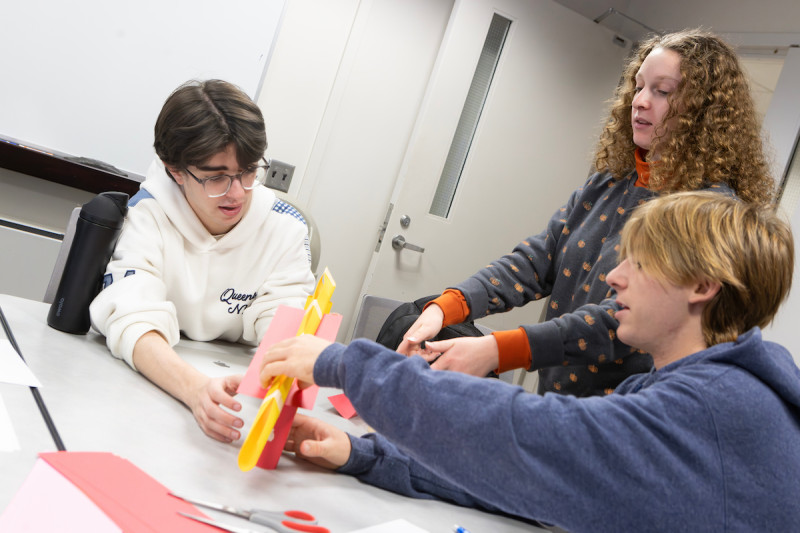
For the study, Simpson and her team created 12 different MAKEngineering kits for children in second through sixth grades that required them to accomplish a task. For example, one challenge asked children to use household materials to build a prototype of a house that would help animals survive an extreme weather event (e.g., tornadoes, earthquakes, extreme heat and cold) where they live.
When creating the kits, the engineering design process was at the forefront. Each kit was designed to get caregivers and children to research, plan, create, test, improve, and reflect on the process and finished product. The challenges were also deliberately open-ended, so that no two families produced the same result.
Experiencing math, not just “doing” math
Seven different families from the Northeast and Midwest United States participated in the study. Each provided researchers with recordings showing the family members working through each problem together.
The recording served as proof of how the kits were designed to get children thinking about engineering concepts, but also engage them in mathematical concepts. From the data, there was clear evidence of kids using geometric reasoning, informal measurement, and proportional reasoning in their builds. For example, one child used his index finger as a rough unit of measurement for measuring his own foot when creating a sneaker. Another pair of siblings decided to add a horizontal ledge for birds to perch on and an angled roof to create shelter from rain while constructing a birdhouse.
The biggest surprise in the findings, though, was about the parents, not the children.
"There's this assumption that parents do not have the knowledge and skills to sometimes do mathematics,” Simpson said. “But I think what we're trying to argue is that parents and caregivers do have the knowledge to support their kids as mathematicians in the ways that it's being grounded in sort of their familiar ways of acting."
Another key finding, for which Simpson has a separate dedicated paper under review, is the role of siblings, particularly how an older sibling's role shapes the engineering experiences of their younger sibling. Siblings who worked on the kits took on both supporting and dominant roles in the task, yet they remained engaged in the design. The study included a set of twins, which Simpson says provided a fascinating look into their interactions.
Out of the classroom, into the home
The paper frames math as “not just something we do, but something we experience, embody, utilize, and interpret in context.” Simpsons herself frames the research as a shift in how we think about mathematics and the role parents play in education. She argues that there is a legitimate place for “non-school math” alongside traditional classroom math, and that the two should be viewed more on equal footing.
“It's almost a shift in how we think about math and the role of parents in their child's education — there is a place for non-school math in relationship to school math,” Simpson said. “So how do we start to think about those equally?"
Now, the big question for Simpson is how to turn the research into practice. She mentions that the concepts featured in the kits and in her research are not currently being implemented in classrooms. Simpson has developed professional development kits for teachers in classrooms and found that having teachers engage in these tasks first, before thinking about how to use them with children, is incredibly important.
While broad classroom implementation is not currently in place, it’s a definite goal.
"Research to practice is really important — trying to get this out to parents and teachers about the value of honoring and seeing the ways that families can engage in math that are not like school math," Simpson said.