Eight CCPA faculty and fellows earn Research Excellence Awards
Six research proposals awarded competitive funds for 2026-27
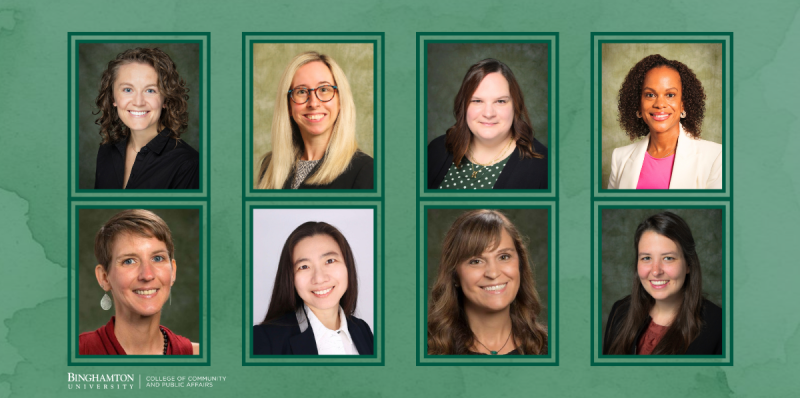
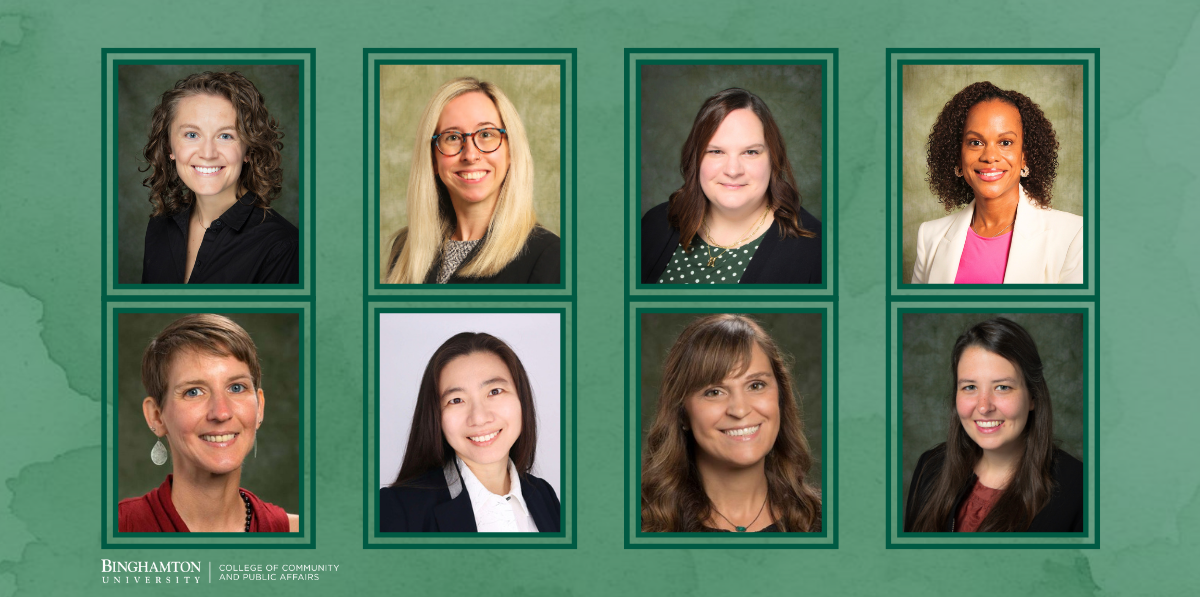
This year, eight CCPA faculty members were awarded the competitive Research Excellence Awards. This seed-grant program, funded by the College of Community and Public Affairs, supports proposed collaborative research projects with strong potential to attract external funding.
Learn more about the research proposals below.
“Development and Validation of a Measure of College Sexual Violence Survivors’ Barriers to Accessing Campus Resources”
Allison Brachmann, PRODiG+ Postdoctoral Fellow, Department of Social Work
About 22% of college students in the U.S. experience sexual violence while in school. However, few survivors reach out to campus resources like campus police, Title IX offices, crisis centers, or health centers. As a result, universities can assist only a small fraction of those who need help. Most campus climate surveys ask survivors why they don’t use these resources, but there is no clear, comprehensive way to measure the barriers they face. Without a good measure, schools can’t understand what survivors need, how their challenges compare to those at other campuses, or how to build better support programs.
This project will create and test the first in-depth tool to measure all the reasons college survivors might not use campus resources. It seeks to identify the main barriers and ensure the final tool is easy for schools to use and provides reliable information. Having this measure will help schools understand the real obstacles, compare their services to others, design better interventions, and make it easier for survivors to get the help they need.
“Institutional Betrayal, Institutional Courage, and Moral Injury Across Higher Education Disciplines Under Political Constraint”
Heather Deal, Assistant Professor, Department of Social Work
Co-investigators: Allison Brachmann, Binghamton University, and Veronica Timbers, University of Utah
This project extends research on institutional betrayal, institutional courage, and moral injury beyond social work to a broader set of higher education disciplines, including education, nursing, and sociology. These fields differ in professionalization and accreditation requirements, but all engage in teaching and scholarship on contested social issues shaped by political scrutiny and institutional risk management. Existing higher education work on institutional betrayal and institutional courage has focused mainly on sexual assault, racism, and related marginalization, with little examination of how these constructs emerge in response to political constraints around teaching and scholarship.
This CCPA-led pilot will field an existing survey across four disciplines to test whether these constructs can be measured meaningfully across distinct academic contexts. It will also generate preliminary comparative data on institutional response and faculty experience. In doing so, it advances CCPA’s public-service mission by examining the institutional conditions that support or constrain values-driven teaching in politically contested environments.
“Project Marigold: Growing and Sustaining Inclusive Practices in Rural Classrooms”
Kathryn Meyer, PRODiG+ Postdoctoral Fellow, Department of Teaching, Learning and Educational Leadership
Although many research universities are located near rural communities, these areas are often excluded from educational research. Small towns in the Southern Tier continue to face the effects of long-term economic divestment and deindustrialization. Rural school districts, which serve as community hubs, must operate with limited resources, leading to unmet needs and untapped strengths among educators and disabled learners. This project seeks to explore how university partnerships based on care-based inclusion can enhance teaching and learning for students with disabilities in elementary schools and teacher education programs.
“Generative AI for Mathematical Enhancement and Self-Regulated Problem-Solving (GAMES)”
Jiyeon Park, Assistant Professor, Department of Teaching, Learning and Educational Leadership
Co-investigators: Candace Mulcahy and Amber Simpson, Binghamton University
Mathematics is essential for STEM careers, but many students find it challenging, resulting in low performance and slow progress. Generative AI can support students by offering step-by-step problem-solving, immediate feedback, understanding checks, and real-time error correction. To maximize these benefits, students need strong self-regulation skills. However, educators are concerned about students’ cognitive and metacognitive engagement when using generative AI. Experimental research on generative AI in math classrooms remains limited, leading to questions about its feasibility and effectiveness in schools.
This project will examine a mathematics intervention that integrates generative AI with evidence-based instructional practices, such as self-regulated strategy development, to enhance high school math instruction. The study will assess the intervention’s impact on about 120 secondary students across six classrooms.
“Evaluating the Role of Public Finance on Green Infrastructure Adoption in New York”
Kristen Swedberg, PRODiG+ Postdoctoral Fellow, Department of Public Administration and Policy
Green infrastructure offers sustainable stormwater management solutions, but many local communities cannot implement these projects without external funding. This study analyzes how public finance supports the adoption of green infrastructure in New York, with a focus on projects funded by the Environmental Facilities Corporation (EFC). Data was compiled from EFC-funded projects and combined with municipal finance and demographic information to assess the current distribution of grant awards.
The survey presents administrators with hypothetical green infrastructure projects to assess how local officials, given varying preferences and budget constraints, evaluate future benefits. These findings will help predict statewide adoption, assess the equity and effectiveness of EFC grant programs, and guide future state investments in green infrastructure.
“Helping Educators Acknowledge Loss in Schools [HEALS]: A Pilot Study with Early Childhood Educators”
Keisha M. Wint, Assistant Professor, Department of Social Work
Co-investigator: Kimberly D. Harry, Binghamton University
Grief and loss are experiences that everyone faces at some point in life. Research shows that when young children (ages 3 to 8) do not get the support they need to cope with grief, it can affect their learning and health. Unfortunately, the grief of young children often goes unnoticed, and many educators do not feel ready or trained to respond to the grief-related needs of children. This can make it harder for teachers to support their students and may impact their own professional engagement.
There has not been much research on what early childhood educators need to help children with grief, or how well they can respond to these situations. To address this, a new study will examine how a special program called Helping Children with Loss can support both educator- and site-specific outcomes. The study will involve educators from 20 schools who will participate in the program and share their experiences. This research builds on earlier work with preschool teachers in urban settings and aims to find better ways to support both educators and young children in addressing grief and loss.