New York lawmakers introduce bill to prevent graduate student loan ‘cliff’ for essential healthcare professions
Federal legislation seeks protections for social work, nursing, public health, and more
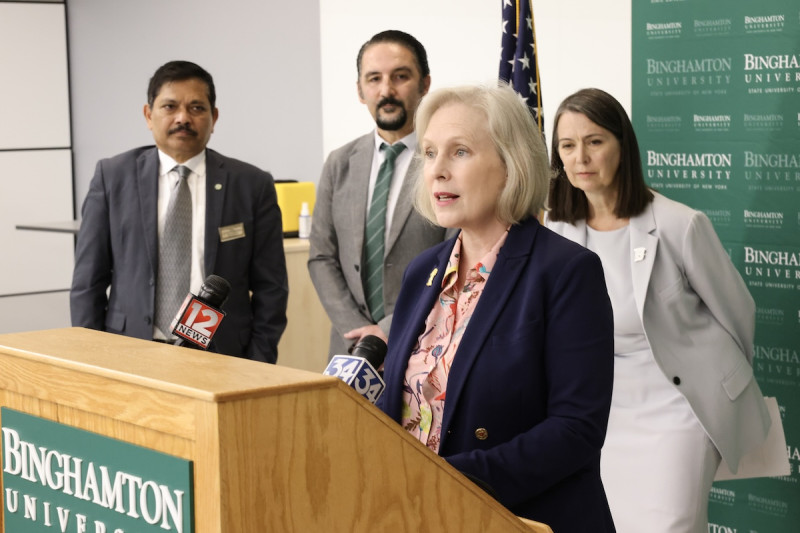
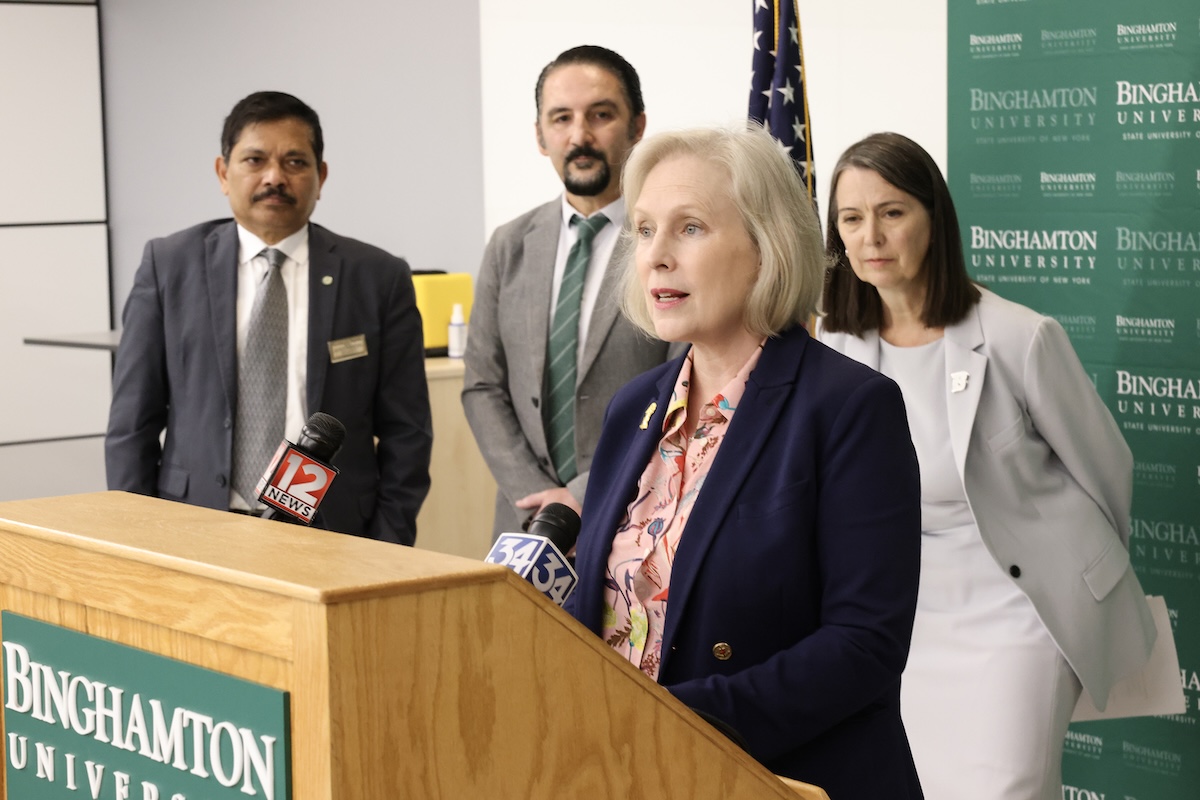
Through a new bill introduced in the U.S. Senate, the Professional Student Degree Act, New York lawmakers and leaders hope to protect several graduate education programs from recent administrative changes and ensure that the current workforce shortage does not continue to grow.
“Binghamton University is training the next generation of essential workers that New York needs — our nurses, our social workers, our public health professionals, and so many more. These are people who hold our communities together,” said Sen. Kirsten Gillibrand, who introduced the bill. “Unfortunately, many of these professions are facing devastating workforce shortages. … The consequences of the shortage are dire, increasing patient wait times, decreasing quality of patient care, and overburdening our healthcare workers.”
On Monday, June 8, at Binghamton University’s Health Sciences Campus, Gillibrand joined Assemblywoman Donna Lupardo, Johnson City Mayor Christina Charuk, Binghamton University Executive Vice President for Academic Affairs and Provost Donald Hall, Decker College of Nursing and Health Sciences Dean Mario Ortiz, and School of Pharmacy and Pharmaceutical Sciences Dean Kanneboyina Nagaraju to announce a new bipartisan plan aimed at protecting the higher borrowing power of several graduate programs that will soon otherwise lose their designated ability at that loan level.
Gillibrand called these limits a crisis for graduate education affordability, saying the Department of Education’s implementation of the federal student loan provisions in H.R.1 creates an immediate "loan cliff" for essential graduate degrees, narrowing the definition of a “professional degree” to include only 11 programs eligible for higher borrowing limits.
The bill will identify 24 program types as "professional degrees" to codify their loan borrowing power. If passed, it will restore and codify professional status for social work, audiology, physician assistants, occupational therapy, physical therapy, nursing, public health, business administration and management, accounting, architecture, education, and special education, while maintaining professional status for pharmacy, dentistry, veterinary medicine, chiropractic, law, medicine, optometry, osteopathic medicine, podiatric medicine, theology, and clinical psychology. If needed, the secretary of education may add any other programs that meet “professional degree” requirements.
Binghamton University President Anne D’Alleva outlined why this is particularly important at Binghamton.
“The School of Pharmacy and Pharmaceutical Sciences and Decker College of Nursing and Health Sciences offer just the kind of degree programs that this act addresses,” D’Alleva said. “We take pride in training the next generation of nurses, pharmacists, healthcare professionals, and academic researchers who are going to continue to move these disciplines forward. The Professional Student Degree Act is a necessary step in restoring student access to these programs, ensuring pathways for qualified and skilled professionals, and respecting the work of people in so many crucial professions.”
Deans Ortiz and Nagaraju added to D’Alleva’s statement.
“At the Decker College of Nursing and Health Sciences, we have nursing and occupational and physical therapies, speech and language pathology, and public health, and all those programs are affected by caps on student loans,” Ortiz said. “We're concerned about enrollment, but in the long term, we're concerned about the workforce.”
"The elimination of Graduate PLUS Loans puts pharmacy students with the greatest financial need, especially from lower-income and first-generation backgrounds, at risk,” Nagaraju said. “Without immediate action, reduced federal financing will directly threaten recruitment, retention, and degree completion, and weaken the pharmacy workforce pipeline by deterring qualified candidates."
Excluding these programs limits students’ ability to take out the federal student loans they need to complete their education and would worsen existing workforce shortages, especially in the healthcare sector. By broadening the definition, Gillibrand’s bill seeks to protect access to education, ensure university stability, and bolster workforce pipelines for in-demand professions.
Despite receiving significant backlash during the public comment period, these rules were finalized on April 30; caps on federal loans will go into effect on July 1. Without a statutory fix, Gillibrand and other lawmakers say students entering these costly but essential degree programs will be priced out of the workforce, further destabilizing already high-need professions.
“When the rule takes effect in just three weeks, graduate students in fields not defined as professional — including our aspiring nursing professionals, social workers, public health researchers, and physician assistants — will have access to only about half of the financial support that they need to qualify in their profession,” Gillibrand said. “That means that individuals looking to fill these critical jobs will no longer be able to take out all the loans they need to pay for it. This makes no sense, hurts our communities, and keeps talented individuals away from essential jobs.”
Many of the affected professions, which are already facing workforce shortages, make following those career paths especially unaffordable. Students in these fields face annual loan caps $30,000 lower and aggregate limits $100,000 lower than those in designated tracks.
By removing decision-making from departmental guidance and relying on federal statute, Gillibrand said this bill also prevents future administrations from unilaterally stripping students of their funding based on political discretion rather than workforce or educational needs.
“I introduced this bipartisan bill to expand the statutory definition of a professional degree to make sure that these students have the same access to federal student loans as their peers in law or medicine,” Gillibrand said. “This legislation will help more students enroll in graduate education programs at Binghamton and continue training the healthcare workforce right here in New York. This legislation is a win for our students, universities, and communities. I'm committed to doing everything I possibly can to get this done.”