Binghamton.edu homepage recognized for accessibility
New report ranks University website in top 1% of a million homepages
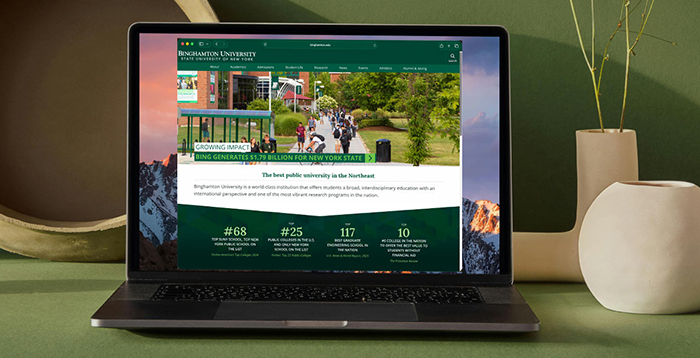
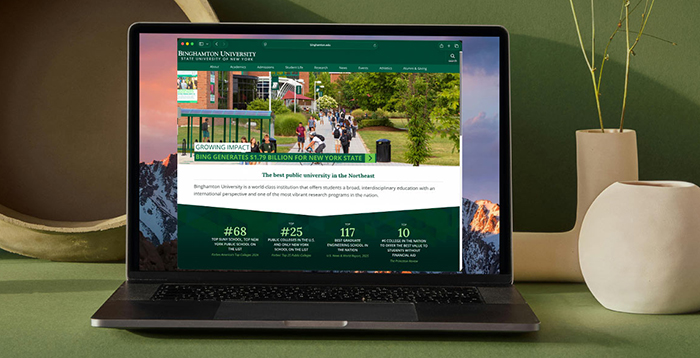
Binghamton University’s commitment to digital accessibility was validated this spring when it placed in the top 1% of worldwide homepages examined by the nonprofit organization WebAIM.
In February, WebAIM conducted the accessibility analysis of the home pages for the 1,000,000 most-visited web sites. It was the eighth consecutive year that the Utah-based organization released its WebAIM Million report, which evaluates sites ranging in fields from education, government, and business, to gaming, travel, and health.
Binghamton ranked 4,351st out of the sites in the WAVE Accessibility Rank. The rank is based on detectable errors, error density, potential errors, and general popularity. By comparison, Binghamton finished a still-impressive 6,741st in the 2025 report.
The 2026 report found zero errors on the Binghamton.edu homepage, which also ranked 12,872nd in overall popularity.
“Placing in the top 1% of homepages worldwide is a remarkable achievement, especially when measured against a million of the most-visited sites on the internet,” said Gerald Hovancik Jr., senior director of creative services in the Division of Communications and Marketing, whose team oversees the homepage. “It reflects a commitment to accessibility that our web team has taken seriously for many years, long before it became a requirement.”
Hovancik credited Patrick Collette, assistant director of web services, and Justin Stewart, associate web developer, with leading the charge to ensure that the University’s online presence is accessible to everyone.
“Accessibility is an ongoing process; we're continually monitoring and updating the site,” said Collette, who is a member of the University’s Technology Access Advisory Group (TAAG) and has developed and built templates and components for online content. “We have good institutional support from TAAG, and campus users have been receptive to the idea that this accessibility is important.”
Stewart, who conducts online accessibility training and reviews, said accessibility was a priority for the University before the 2024 court decision requiring website content to meet Web Content Accessibility Guidelines (WCAG) standards by April 2026 (that date is now pushed back a year).
“A lot of instruction and support is required to make sure that everyone is creating content that is accessible,” Stewart said. “The homepage can only be edited by people on the web team, so it is easier to maintain access standards.”
The training is necessary because the University’s website has about 20,000 pages, Stewart said, with about 365 campus users updating content on their department website. The University’s homepage, meanwhile, can only be edited by members of the Communications and Marketing web team.
“It helps that the (University) administration backs the idea that Communications and Marketing should be the keepers of the site,” Collette said. “We're able to keep better control on what users are able to do, so we're able to prevent inaccessible content from being published.”
According to WebAIM, about 96% of all WAVE Accessibility errors fall into six categories: low-contrast text; missing alternative text for images; missing form input labels; empty links; empty buttons; and missing document language. Education-based homepages averaged 48.9 errors in the 2026 report, while homepages with the .edu domain averaged 23 errors, WebAIM said.
Common errors that Collette and Stewart often see include out-of-order heading tags; using HTML tables for layouts; placing text directly in images; listing complete URLs; and incorporating a simple “click here” link.
Preventing and fixing those errors not only placed Binghamton University in the worldwide top 1%, but also earned Binghamton the No. 1 position among SUNY schools. Only Albany, Old Westbury, and Oneonta ranked in the top 5%, while Fredonia and Plattsburgh finished in the top 10%.
“We are always committed to accessibility,” Stewart said. “Everyone on the team has had accessibility training.”