Biology alumni receive honor for undergraduate paleontology research
Julia Zottola ’26 and Sofia Corsico-Sánchez ’26 earn recognition from the Association for Women Geoscientists and the Paleontological Society
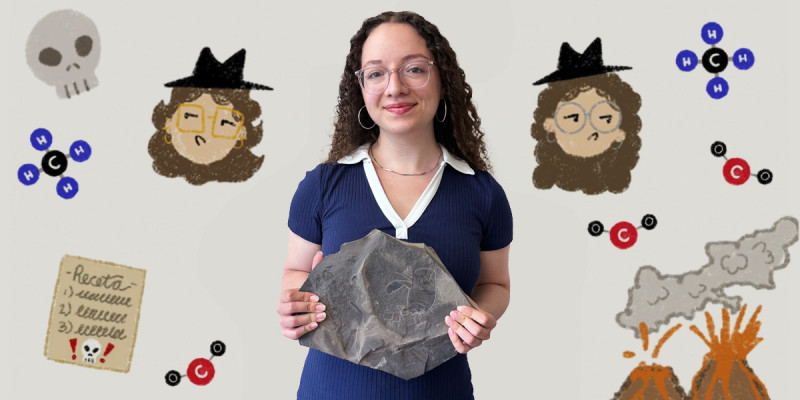
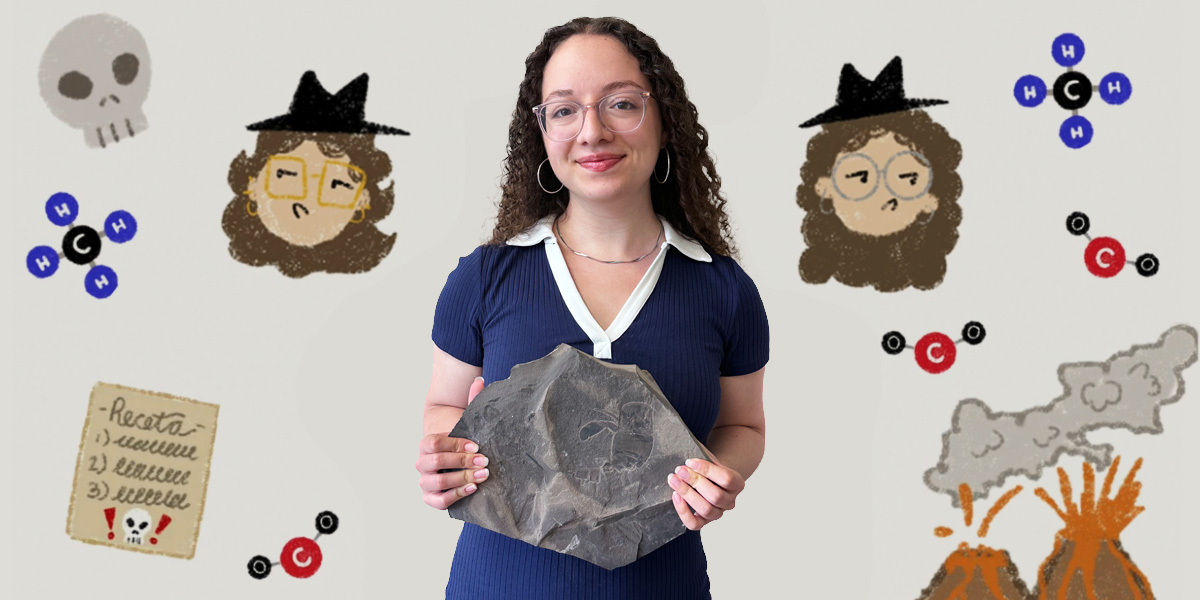
Locked in ancient stone, the traces of life we know as fossils have a great deal to teach about the living world.
“Scientists can learn about the biomechanics of an extinct species, reconstruct the ecology of a specific place and time, and can even collect data that can help with conservation,” said Binghamton University alumna Julia Zottola ’26, who majored in biological science, with minors in Spanish and geochemistry.
This spring, Zottola received the Association for Women Geoscientists (AWG) and the Paleontological Society’s Undergraduate Excellence Award in Paleontology. Sofia Corsico-Sánchez ’26, who majored in biology and environmental science with a minor in geology, received an honorable mention.
The award consists of a $1,000 cash prize and membership in the Paleontological Society and AWG during the awardee’s schooling.
“This is a highly competitive award open to any undergraduate studying paleontology internationally,” explained Assistant Professor of Earth Sciences Sarah Sheffield.
A native of Pine Island, N.Y., Zottola is now headed to the University of Missouri to conduct palaeobiological research and earn an MS in geology. After that, she plans to pursue a doctorate in the field, with the goal of continuing her research at a museum or in academia.
At Binghamton, Zottola was able to hone her skills by conducting research both in class and independently, a key element to her success. She was also involved with the Society of Hispanic Engineers, which provided a supportive community of peers and an opportunity to give back, she said. During her two years on the executive board, she helped organize events, such as a panel discussion of Female Leadership and Mentorship in Engineering and Science (FLAMES).
Zottola found a ready mentor in Sheffield; she joined the paleontologist’s lab during her junior year.
“She’s gone above and beyond to provide me with support and guidance with independent research and graduate school applications,” Zottola said. “Dr. Sheffield has encouraged me to pursue paleontology, and without her, I wouldn’t be where I am today!”
Her labmates have also proved a ready source of inspiration. She presented a poster with research partner Michael Holowiak at the Geological Society of America’s Connects meeting last fall and received valuable insights from graduate student Elizabeth Altier, she said.
Corsico-Sánchez, it turns out, is one of Zottola’s best friends. This past year, the two wrote and filmed two YouTube videos for Spanish-speaking audiences on the Permian Period: Bienvenidos al Pérmico and El Pérmico - La Gran Mortandad.
“I’m incredibly fortunate to have a friend in the same field and at the same point in her career as me,” Zottola said.
Part of Assistant Professor of Earth Sciences Adriane Lam’s lab, Corsico-Sánchez participated in the University's Summer Scholars and Artists Program in Summer 2024; the following year, she attended OCEAN CORE Academy in College Station, Texas. Lam also introduced her to Sheffield, and Corsico-Sánchez worked in her lab as well.
Through Lam, the New York City native also met affiliated faculty member Nicholas Hogancamp; under his guidance, she conducted research on conodonts, a now-extinct group of marine invertebrates. Last October, she presented her research at the Geological Society of America’s Connections Conference; she also worked as a museum collections intern at the Museum of the Earth in Ithaca.
Corsico-Sánchez is interested in conservation paleobiology, which applies paleontological data to modern-day conservation practices, and plans on pursuing a master’s and then a doctorate in the field. Her ultimate goal: to leave the planet better than she found it.
“To be recognized alongside my colleague Julia is a great honor in and of itself. Julia and I met during a paleobiology class in our junior year, and since then, we have been very supportive of each other in our paleontological careers,” she said. “Speaking more broadly, to be included in such a hardworking group of honorees makes me doubly proud: It speaks to an acknowledgment of our work as future contributors to the field we love so much!”