Breast cancer group awards grant to Binghamton University biomedical researcher
Funding supports collaboration between Watson College and School of Pharmacy to test treatments for triple-negative breast cancer
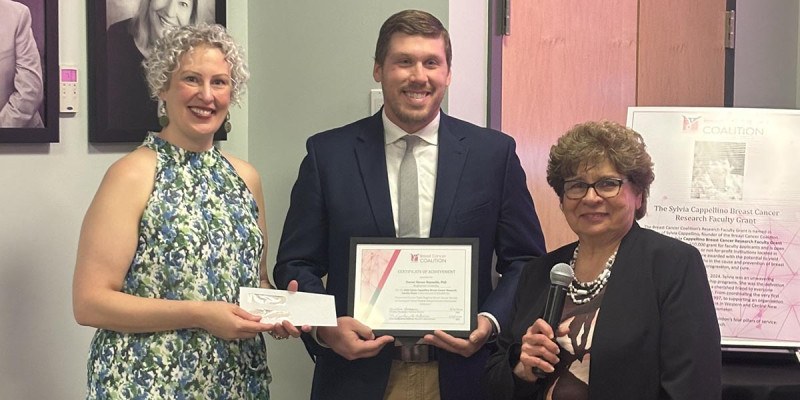
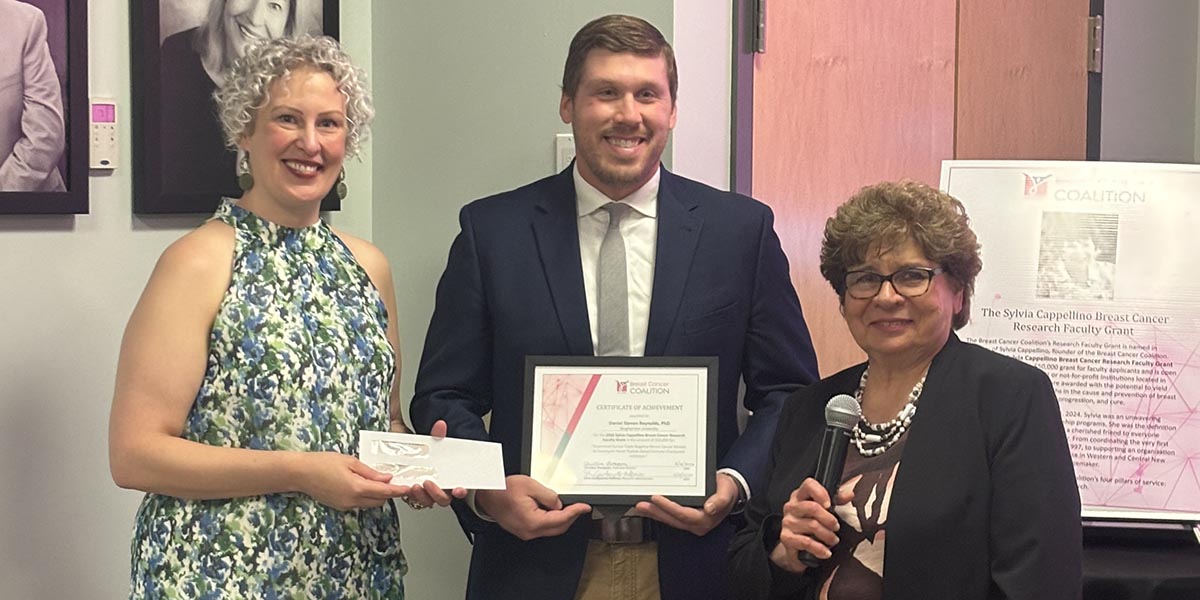
An upstate New York nonprofit supporting breast cancer survivors has awarded a $50,000 seed grant to a Binghamton University faculty member to further his research into a cure.
Assistant Professor Daniel S. Reynolds is the first Binghamton researcher to receive the Breast Cancer Coalition’s Sylvia Cappellino Breast Cancer Research Faculty Grant, named in memory of the group’s founder.
Reynolds is developing a 3D-bioprinted model that uses triple-negative breast cancer cells, which are to blame for aggressive tumors that do not respond to common hormone therapies.
“We are starting to truly appreciate that the structure of tumors affects how they respond, so we need tools that better mimic that complex environment,” said Reynolds, part of the Thomas J. Watson College of Engineering and Applied Science’s Department of Biomedical Engineering.
He will work with Assistant Professor John Fetse from Binghamton University’s School of Pharmacy and Pharmaceutical Sciences to investigate a new peptide-based checkpoint inhibitor to improve immunotherapy.
“In the preclinical pipeline, 90% of drugs and therapies that look promising in the lab fail and don't gain regulatory approval, because there's a gap in our modeling,” Reynolds said. “Conventional 2D assay testing is too simplistic, and with animal studies like mice, there are gaps in the biology between mice and humans. What we need are models with human cells that can recreate that tumor environment, and so that's what we're building with 3D printing.”
Reynolds will use the µPOROS bioprinting platform to engineer 3D tumor models from living human cancer cells that mimic the tumor environment in the body, and Fetse will test them with peptidomimetic analogs that mimic the three-dimensional structure and function of natural peptides. The medications overcome the limitations of human-produced peptides, which include rapid degradation by bodily enzymes and poor cell membrane permeability.
"Our laboratory screens large libraries of peptide-based molecules to discover the next generation of cancer therapeutics, but one of the greatest challenges is reliably identifying the candidates most likely to succeed in patients,” Fetse said. “Dr. Reynolds' 3D bioprinted tumor models faithfully recreate the complexity of the human tumor microenvironment, providing a far more predictive platform for evaluating our therapies. Testing our peptide candidates in models that closely resemble human tumors allows us to make more informed decisions about which therapies have the greatest potential to advance to the clinic."
The Rochester-based Breast Cancer Coalition gave a second award, the $25,000 Pamela Delp Polashenski M.D. Breast Cancer Research Trainee Grant, to PhD candidate Yu-Wei Chang at Cornell University.
“I am continually inspired by the power of collaboration between researchers and survivor advocates,” said Christina Thompson, the executive director of the Breast Cancer Coalition and a breast cancer survivor. “These grant awards represent more than an investment in science — they represent hope for the future. By supporting innovative research and ensuring that the patient perspective remains at the forefront, we are helping drive discoveries that have the potential to improve and save lives.”
Since 2003, the Breast Cancer Coalition has annually awarded grants to fund innovative projects with the potential to yield medical breakthroughs in the cause and prevention of breast cancer, prevention of metastasis, and cure. With these latest awards, the group has provided $1.3 million in funding to researchers in New York. Grant recipients are selected through a competitive application and review process involving regional scientists, clinicians, and survivor advocates.
Beyond this research, Reynolds sees larger applications for his 3D-bioprinting method, which he developed during his postdoctoral work at Harvard University before coming to Binghamton.
“We're focusing on breast cancer for this grant, but the technology can be used for other cancer types and other diseases as well,” he said. “As a seed grant, it could grow into a lot of different directions.”