Biomedical engineering alumna is making medical devices safer
Consultant Melissa Mendoza-Seale, PhD ’22, balances clients’ needs with life in the lab
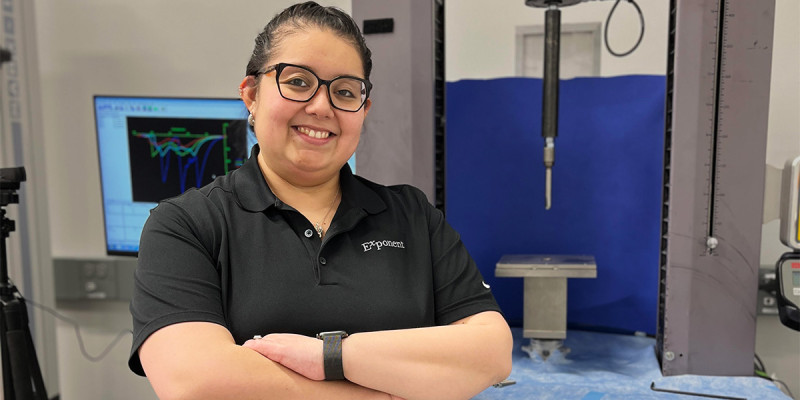
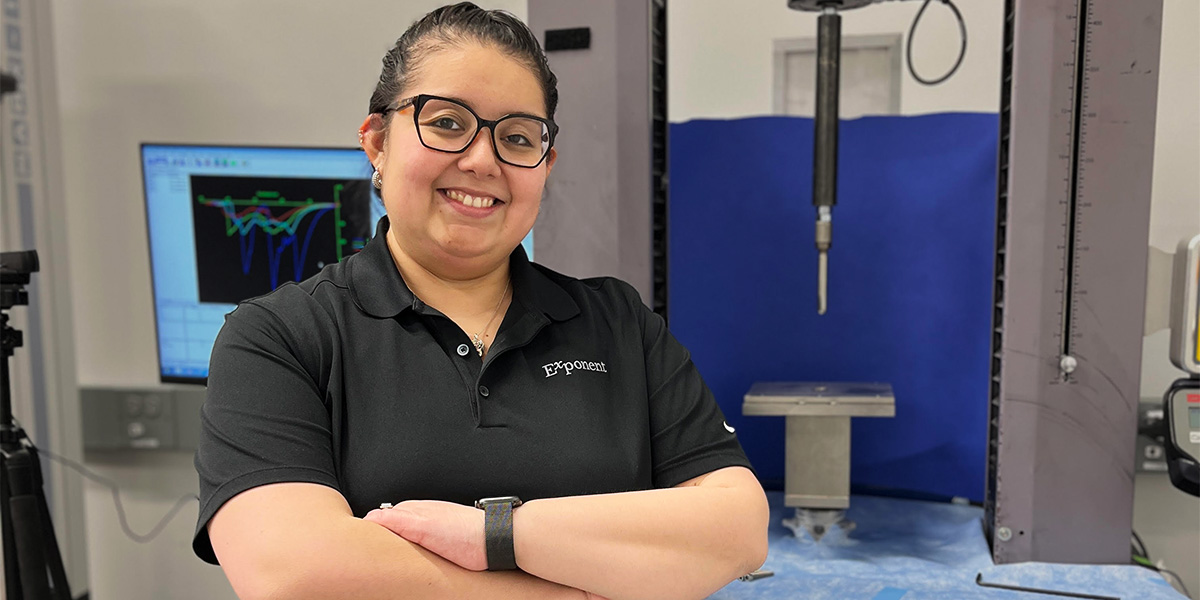
Melissa Mendoza-Seale, PhD ’22, loves the hands-on work she can do in a biomedical engineering lab. So when she graduated from Watson College, she applied primarily to jobs in research.
Her career path took her on a different route, though. Today, as a technical consultant, she blends scientific research with expert client support — and she still gets some lab time, too.
After receiving her degree from Watson College, Mendoza-Seale worked her way up to senior associate at Exponent, a technical consulting firm that specializes in engineering and science. In her role, she supports medical device and pharmaceutical manufacturers as they navigate Food and Drug Administration (FDA) regulations, performs failure analysis of products, and conducts testing according to ASTM standards and International Organization for Standardization guidelines.
To put it simply, she’s making sure medical devices are up to par.
While this wasn’t always her plan, she learned that a consulting path would give her the opportunity to branch out from her specific field. In contrast to her graduate school experience where she focused on independent research, Exponent gave her the chance to contribute to scientific and engineering topics outside of her niche without having to completely give up lab work.
“We not only provide consulting services and review the landscape of the field for our clients, but we also conduct a lot of the testing and investigations ourselves,” Mendoza-Seale says. “That’s what really intrigued me about Exponent. When I started applying for full-time positions and going through the long interview process, that was something that made me happy, that I didn’t have to stop doing hands-on work.”
Mendoza-Seale started her academic journey at the Rochester Institute of Technology with a bachelor’s degree in biomedical engineering. During her undergraduate and graduate studies, she gained practical experience through co-ops and internships at Johnson & Johnson, Renal Research Institute, and the FDA.
Looking back, she considers her time at Binghamton as “fruitful, but difficult.” Her research focused on developing a calcific aortic valve disease model under Professor Gretchen Mahler, interim chair for the Department of Biomedical Engineering, to understand how the condition develops over time. Mendoza-Seale carried out her work through the University’s Clifford D. Clark Fellowship and a pre-doctoral fellowship with the American Heart Association.
However, the transition from academia to technical consulting required a shift in thinking. In grad school, she could set her own research schedule. As a consultant, the key is being efficient while providing great service to clients.
“It was a little bit of a challenge at first to switch the mindset from defining your own timeline and goals to being on the client’s deadlines and understanding the business model of it all,” Mendoza-Seale says.
She also highlights the importance of soft skills. Her job isn’t just about knowing the most about something — it’s being able to communicate ideas clearly and concisely. At Exponent, she uses her technical background alongside the communication skills picked up from her time at Watson.
“I was fortunate enough to attend many, many conferences while I was there,” Mendoza-Seale says. “And what I loved is that I not only attended academic-driven conferences but also science communication and minority conferences where the focus wasn’t just biomedical engineering — it was many other disciplines. It encouraged me to explain my research in a way that was easy for other audiences to understand.”
As a word of advice to students, she emphasizes communication as a vital part of pursuing a STEM career.
“It was immensely helpful for me as a person and as an engineer in my field to be able to explain my work to different audiences,” she says. “Unfortunately, financial hurdles are a hindrance, but I always encourage students to try and attend as many conferences in their field, or even outside their field, to expand their network and to be able to communicate their work effectively.”