History in action: Alumnus used research to bring Nazis to justice
Robert Waite, MA ’73, PhD ’80, spent 20 years at the DOJ, and today is a research historian at the German Resistance Memorial Center in Berlin
On shore in Hamburg, an American seaman was detained by Nazi secret police. In his bag, he carried thousands of anti-Nazi stickers that read “Fascism must die if the worker is to live,” according to an account in The New York Times.
After his 1935 arrest, Lawrence Simpson spent 18 months in prison; he was released after he promised to return home without causing any more trouble. Once back in the U.S., he immediately embarked on a lecture tour, speaking out against the fascist regime; he also published a booklet called Eighteen Months in Nazi Hell. An admitted communist, he was later pursued by the FBI and blacklisted.
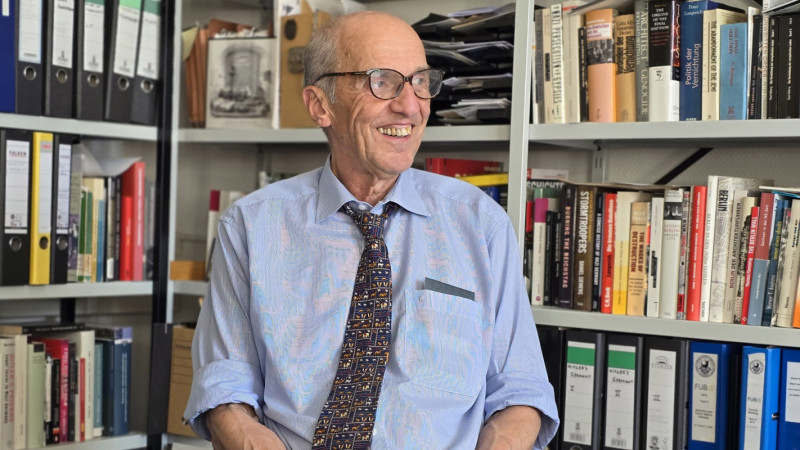
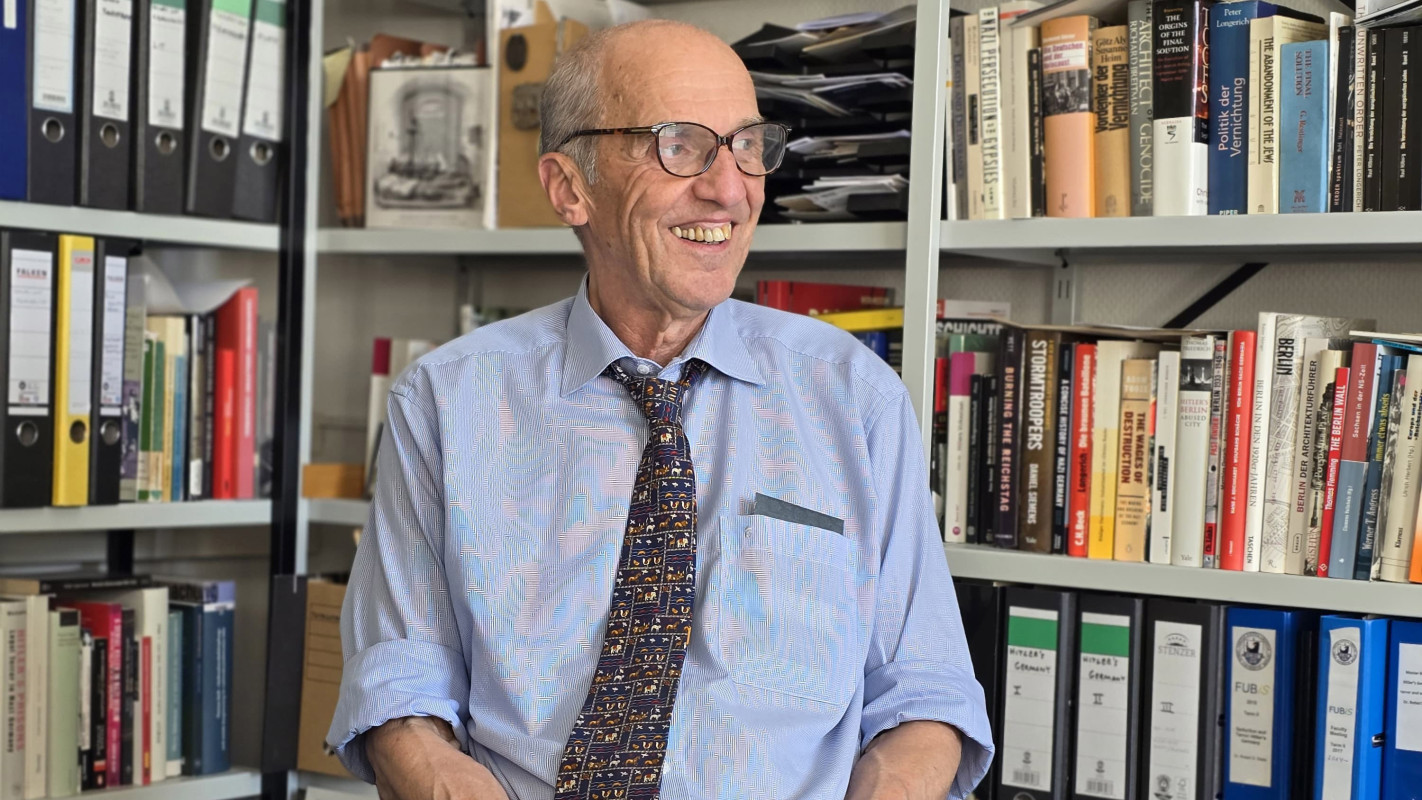
Robert C. Waite, MA ’73, PhD ’80, a research historian at the German Resistance Memorial Center in Berlin, is working on a book about the case, after completing a two-volume history of Berlin’s infamous Plötzensee Prison, where more than 2,500 people were executed by the Nazis.
Not only is Waite a researcher, author and teacher, he has also worked to bring actual Nazis to justice. From 1988 to 2008, he served as the senior historian for the U.S. Department of Justice Office of Special Investigations, where he investigated alleged Nazi offenders.
“One of my colleagues described it as forensic history,” he said. “We were going through records, identifying locations where crimes against civilians were committed — war crimes, things along that line.”
Once they identified a specific location, date and event, the researchers sought to identify the perpetrators and whether they were living in the United States.
“If they were, we worked hard to develop a case with clear, convincing, unequivocal evidence that this individual was at a specific place at a specific time, where crimes against individuals were committed because of race, religion, national origin, or political beliefs,” he said.
From Binghamton to Berlin
A native of Troy, N.Y., Waite has taught modern European, Russian, and German history at the University of Maryland, Idaho State University, Boise State University, and the Free University of Berlin. This summer, he also taught a six-week seminar on Hitler’s Germany at the latter.
He credits his academic and scholarly success to his time at Binghamton University. After finishing his bachelor’s degree at SUNY Oneonta, he spent several years at German universities through an exchange program before heading to Binghamton for the opportunity to study modern German history with Distinguished Professor George Stein. He also worked as a teaching assistant for medievalist Norman Cantor, the department chair at the time.
“He worked us very, very hard. But through him and George Stein, who I worked under, I recognized the value of research — not only the rewards that you get individually, but also its importance for the discipline,” he remembered. “I always remember Norman Cantor saying, ‘Good researchers make good teachers.’ I’m very indebted to Binghamton for the training that I got there as a historian, a scholar, and a teacher.”
When Waite first joined the Department of Justice, he was told that the job would last three to six years. The collapse of the Soviet Union, however, meant that archives in Eastern Europe finally became available. Waite began building contacts there, working closely with a German office that did similar work.
One of the expert witnesses used in DOJ cases was Johannes Tuchel, director of the German Resistance Memorial Center. After Waite retired from the DOJ, he and his wife, German historian and author Katrin Reichelt, joined the center as guest historians, working on separate projects. Today, they split their time between Upstate New York, Berlin, and Riga, Latvia.
Waite’s advice for future Binghamton historians?
“Keep at it,” he advised. “The skills I gained at Binghamton, I was able to use in my professional work.”
And you needn’t stay locked into a specific time period. For all his expertise in Nazi-era Germany, Waite also did a stint as director of the Institute of the American West in Sun Valley, Idaho, he said.
“When you’re in the midst of it, you’re working hard and trying to figure out where this is all going to go,” he reflected. “But you keep at it, and you gain from it as an individual, as a scholar and as a professional.”