With three majors, Harpur student charts a unique path to his future
Sharif Zaky combines his interests in history, the modern Middle East, language study, and research
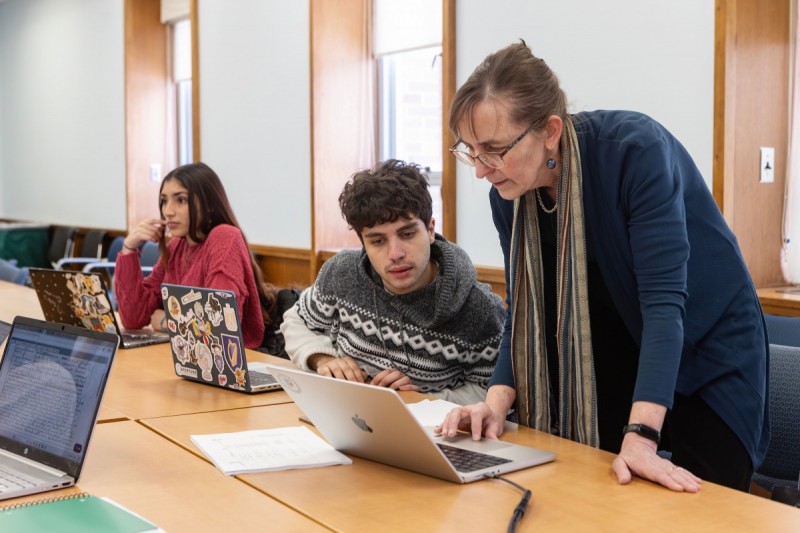
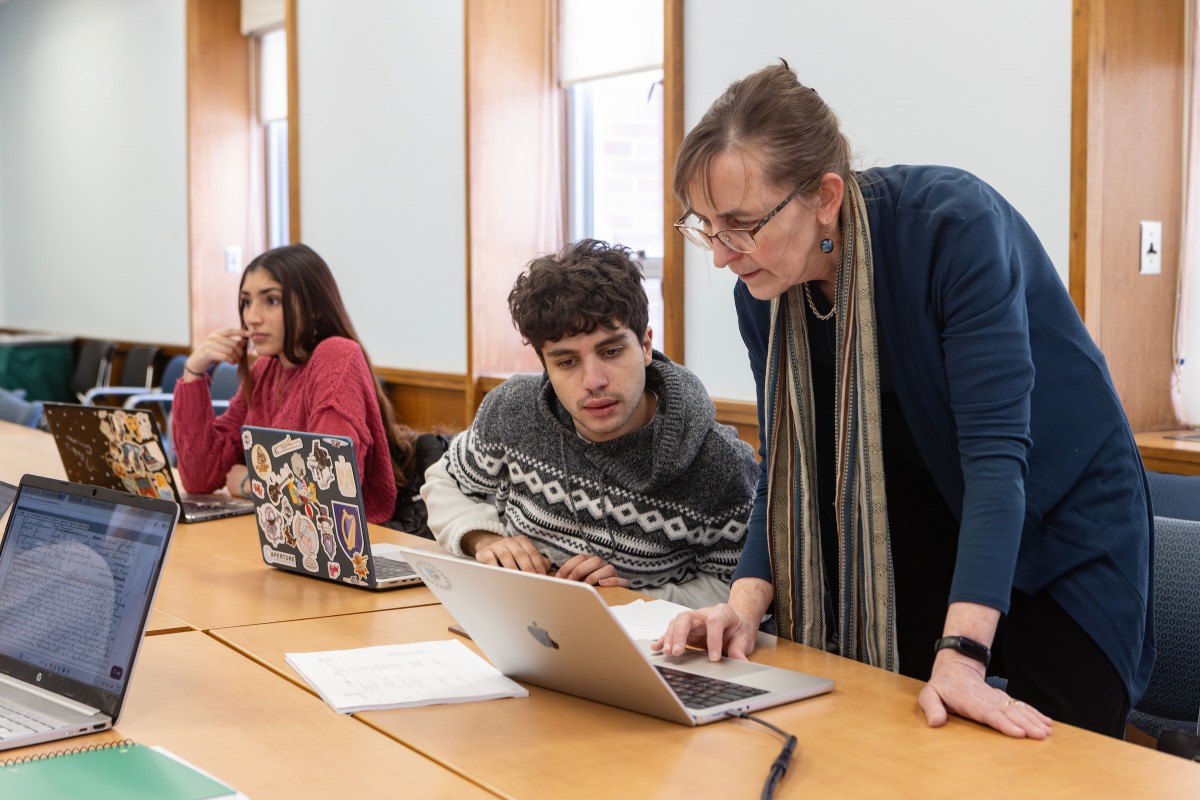
Sharif Zaky was drawn to Binghamton University for two reasons: the chance to pursue meaningful research in the social sciences and to learn Arabic.
Today, the rising junior is successfully combining his interests with three majors: history; philosophy, politics, and law (PPL); and Middle East Studies, with a concentration in Arabic Studies. Through the Source Project’s Mapping American Prejudice Stream, he also participated in a research project on the country’s history of prejudice and racial segregation, through the lens of Binghamton, N.Y.
“We were all essentially freshmen who came from other places to attend Binghamton, and we had this class on the history of Binghamton when we first got here,” the Long Island native reflected.
The Source Project offers first-year students the opportunity to engage in authentic research in the humanities, arts, and social sciences; the Mapping American Prejudice stream is taught by Associate Professor of History Wendy Wall. Research projects in the class focused on racial covenants, or clauses inserted into deeds to prevent targeted groups from buying, leasing, or occupying land.
In the 1920s, Binghamton was the New York state headquarters of the Ku Klux Klan. The practice of racial covenants predates this; the earliest restricted deed dates to 1900, and restrictions became common over the next three years.
For his project, Zaky investigated Water B. Perkins & Co., a Massachusetts-based housing developer that may have first brought the practice to Broome County.
Abolished by the 1968 Fair Housing Act, racial covenants typically targeted people of color or anyone not of Caucasian ancestry. The Perkins deeds stand out because they also mention Italians, but not other common immigrant groups of the period, such as Poles, he said. Other Broome County developers, such as Cora Keyes and the Endicott Land Company, quickly followed suit with their own deed restrictions, obviously modeled on Perkins.
Zaky’s project expanded to other areas of the country where the developer was operating. Perkins published advertisements as far afield as Akron, Ohio; Birmingham, Alabama; parts of Missouri; and Holyoke, Massachusetts. Zaky couldn’t find online deeds for every city, but the ones he did find were telling.
“There were almost no exceptions to Walter B. Perkins using racial covenants — in every single deed I found across four different cities,” he said.
What surprised Zaky the most was the open support that Perkins received; during the early 20th century, newspapers published praises of the developer’s policies, although they didn’t directly refer to the racial restrictions. One of those letters of approval came from Binghamton Mayor Jerome DeWitt.
“They’re essentially praising him for being the individual who came into Binghamton, first used racial covenants, and spread the idea to the rest of Binghamton,” Zaky said. “It’s not surprising to think that people supported this idea at the time, but I wasn’t expecting to see full letters praising Perkins to that extent.”
A shift in focus
While Zaky enjoys American history, he plans to focus more on Middle Eastern history.
In part, that aligns with his language study and his cultural background; he’s of Egyptian descent. Recent history courses also inspired the shift, including a course in Palestinian history with Associate Professor Kent Schull.
His classes also sparked a long-term goal: a career in public interest law, focused on immigration.
“Becoming fluent in the language and understanding the history of that part of the world, which is deeply connected to the politics and law of the modern day, may be helpful in a legal career,” Zaky said.
He’ll have the opportunity to take his understanding of the Middle East to a new level next spring, through a SUNY study abroad program in Egypt. But while the study of history can be intellectually challenging and professionally useful, sometimes it’s just interesting and fun — such as the class he took in premodern Japanese history.
“A lot of my friends weren’t history majors, but we all looked forward to that class every Tuesday and Thursday morning,” he said.
He still has a way to go before Commencement, but he offered some advice to fellow students considering a history major. First: consider learning the language of the region you’re studying. Knowing some Arabic proved beneficial in Zaky’s Palestinian history course and in another class, where he completed a project on Mandeanism, an ancient religious sect in Iraq.
“Minoring in a language is a great thing to do, especially if that language connects to what you want to study or do in the future,” he said.
And don’t forget to chat with your professors. That’s how you forge connections and find out about opportunities.
Zaky would visit Wall during her office hours; ultimately, their conversations led him to join her research team outside the classroom. And you don’t even need to be taking a class with that professor; while working on his racial covenant project, Zaky went to Professor Donald Nieman’s office hours for help, for example.
“Talking to your professors outside of the required number of hours you’re in the classroom is a really great way to learn more or make connections,” he said.