Microelectronics camp introduces students to key industry
Lab tours, hands-on activities highlight weeklong program
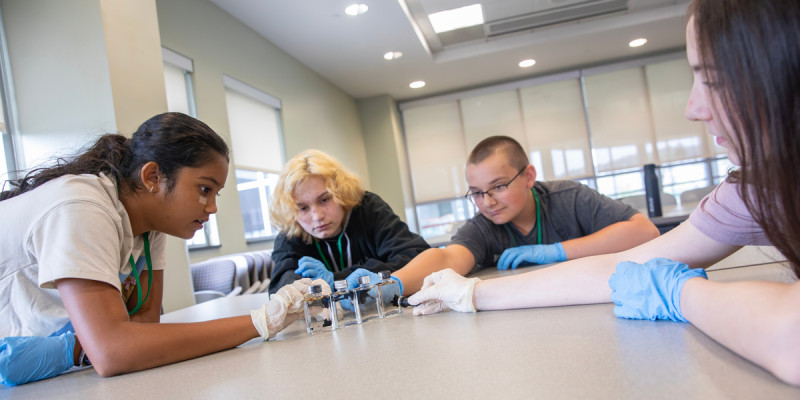
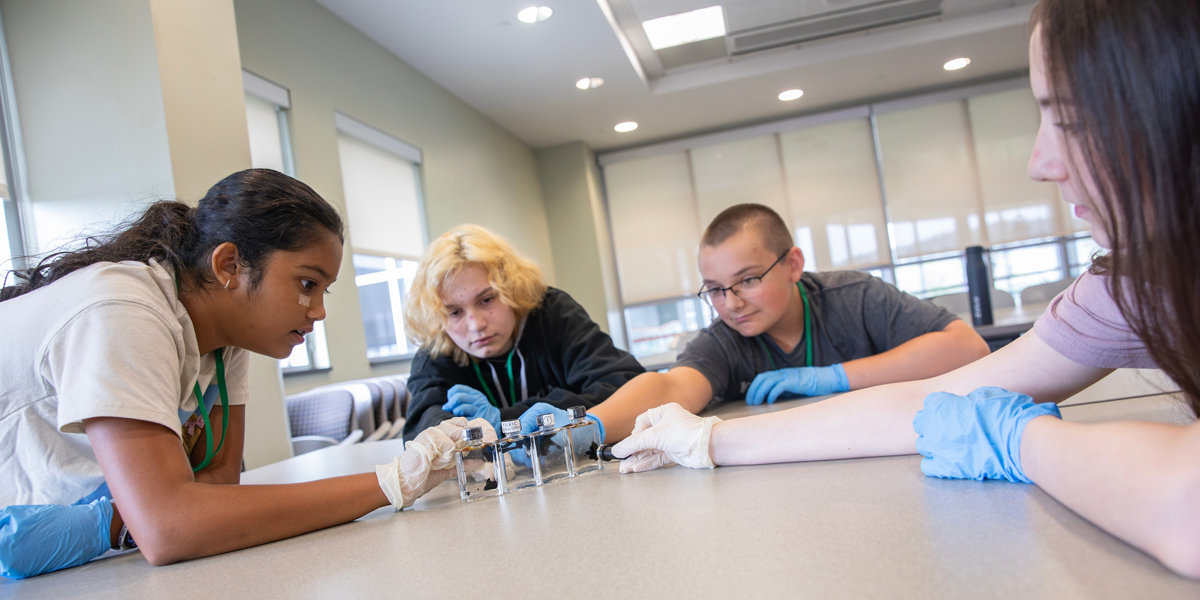
More than 40 middle and high school students crowded around tables at Binghamton University’s Innovative Technologies Complex with nametags and bingo sheets. “Do you have a sibling in college?” they called out across the room in the quest to fill their squares. “Have you built a circuit before?”
This collaborative spirit characterized Binghamton’s first summer microelectronics camp, as the students filled in icebreaker sheets as one might sign the backs of school yearbooks.
Semiconductors and microelectronics power most of the devices we use in our daily lives, from phones to medical tools. Nurturing the future engineers and researchers who will continue sustaining and innovating that technology has become critical. Binghamton’s camp, held July 13-17, was created with that goal in mind, introducing rising eighth- through 10th-graders to foundational skills required for success in the industry, including coding, circuit building, and robot construction.
“Microelectronics are everywhere. Chips are in everything we use. It’s really important that we train the workforce now,” said Andrea Palmeri, research development specialist at the Office of Strategic Research Initiatives and managing director of the Center for Energy-Smart Electronic Systems. “There are tens of thousands of jobs predicted that are going to be needed over the next several years, so we decided we would try to do that. This age group of rising eighth- through 10th-graders is the prime group to get interested in this field, so we felt it was answering a call that’s come out of the government.”
Campers hailed from school districts including Union-Endicott, Vestal, Binghamton, Harpursville, Owego-Apalachin, Chenango Forks, and Chenango Valley. They juggled rope courses on the main campus alongside sessions ranging from programming in Arduino to creating their own mirror actuators in the University’s Fab Lab.
“There’s not a lot in this area for this older group of kids. Learning directly from our engineers and researchers here at the University is important,” Research Development Associate Francesca Bove said. “They are getting these lessons from the experts, which is a very exciting opportunity.”
Seven faculty members from the Thomas J. Watson College of Engineering and Applied Science, alongside staff from the S3IP Center of Excellence, organized demonstrations for campers throughout the week.
The hands-on demonstrations kicked off with a crash course in manipulating black suspensions of ferrofluid with magnets, organized by Associate Professor of Mechanical Engineering Kaiyan Yu’s lab group. By the end of the week, they culminated in a three-hour session to construct moving quadruped robots that students could take home. Under S3IP Associate Director Benson Chan’s guidance, students built and wired together these colorful bots with screwdrivers, coded them with Arduino, and added their own personal touches to the miniature machines.
Additional support for the camp came from Professor Seiichi Takamatsu from the School of Systems Science and Industrial Engineering; Assistant Professor Wenfeng Zhao and Associate Professor David Klotzkin from the Department of Electrical and Computer Engineering; Professor Shahrzad “Sherry” Towfighian and Assistant Professor Jingzhou Zhao from the Department of Mechanical Engineering; Assistant Professor Jayson Boubin from the School of Computing; and Caroline Pasquale, project staff associate at S3IP.
“We have research expertise and amazing lab facilities, and we can offer hands-on experience with researchers that are doing microelectronics in the field and show students the cutting-edge lab spaces that they use for their research,” Research Development Specialist Abagail Breidenstein said.
Microelectronics in Binghamton’s backyard
Middle and high school is a time when students begin thinking about their future plans: whether to take specific classes, chase certain passions, or even pursue higher education in the first place. As Palmeri, Breidenstein, and Bove planned the camp, they also saw it as the perfect time to begin stoking interest in potential career paths, particularly in the field of microelectronics.
“It’s at this age that they start to take the classes they need. They look at what they’re going to do in high school. They’re deciding: Do I like science or don’t I like science?” Palmeri said.
Built into the camp schedule was also a dry run of sorts for future university life, Breidenstein added — and that included the commute between buildings. Campers had an opportunity to hear from Binghamton’s undergraduate and graduate students about the perks and challenges of attending college, as well as what kinds of experiences best prepared them for majors and careers in STEM.
“They’re bouncing around campus, they’re getting the college feel,” Breidenstein said. “I think, being in the labs, that’s really important for younger people to decide if they want to be college bound or not.”
The project to launch this camp is a few years old by now, though there are a number of other local STEM or STEAM camps from which Palmeri, Breidenstein, and Bove took inspiration. That included Binghamton’s own Go Green Institute, under the Chemistry Outreach Program, as well as the Public Archaeology Facility’s community archaeology programs.
The team also spoke to other schools around the county that ran science-oriented summer camps on top of a few out-of-state universities and even the semiconductor company Micron.
“We wanted to carve out our own space and niche, and offer that on campus,” Breidenstein said. “It was really important to do it on campus, to utilize our research labs, researchers, and resources.”
The summer camp was sponsored by Amphenol, the IEEE Electronics Packaging Society, and the IEEE Binghamton Section, Bove said. The costs to attend the camp helped fund stipends for the graduate students in charge of the classes.
While this was the first iteration of a microelectronics-focused camp at the University, Breidenstein sees it as something to keep building on in the future, sparking curiosity for not only the field of engineering but also the prospect of attending Binghamton a few more years down the road.
“We have such great opportunities here on campus. We thought about taking our camp somewhere else, but it was really important for us to bring students to campus,” she said. “We often hear that they have not come to campus before — and we’re literally in their backyard.”