Harpur College welcomes Simons Empire Faculty Fellows in mathematics and physics
The four assistant professors’ research is at the intersection of quantum materials and artificial intelligence
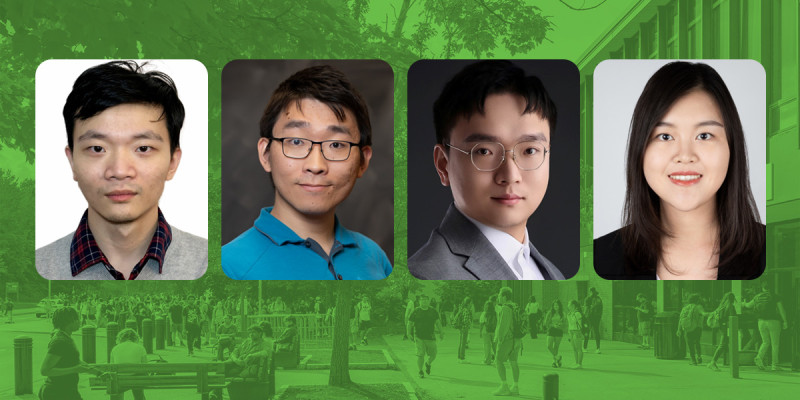
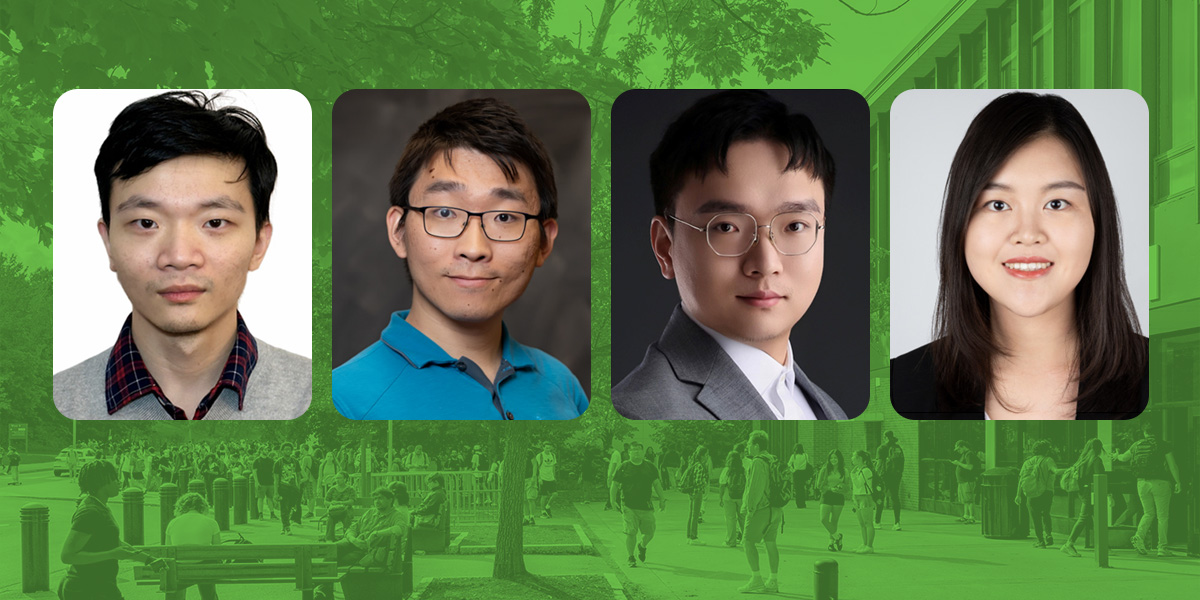
This semester, Harpur College of Arts and Sciences welcomes a quartet of mathematicians and physicists, who will help establish Binghamton University as a major research center at the intersection of quantum science and artificial intelligence.
The assistant professors are among the first class of Simons Empire Faculty Fellows in the SUNY system.
Mathematicians Yahong Yang and Sammy Luo bring expertise in deep learning theory for partial differential equations and discrete mathematics, with applications for machine learning and optimization. Meanwhile, physicists Lebing Chen and Kunyan Zhang bring cutting-edge experimental capabilities in quantum materials discovery and ultrafast spectroscopy of light-matter interactions. Altogether, their publication record includes prestigious journals such as Science Advances, Nature Communications, and Physical Review X, as well as premier machine-learning venues.
The Simons Foundation and Simons Foundation International established the fellowship program to stimulate faculty hiring in mathematics and the sciences across New York state. Four tenure-track faculty members were hired at each of SUNY’s University Centers, which include Binghamton, the State University of New York at Albany, Buffalo, and Stony Brook. Simons Foundation International provides funding to participating institutions, while the Simons Foundation administers the program.
“I thank the Simons Foundation and Simons Foundation International for investing in SUNY’s early-career faculty whose research shows promise in vital and emerging fields,” said Binghamton University President Anne D’Alleva. “At Binghamton, our faculty are international leaders in topics including AI, quantum materials and sensing, and mathematics. The Simons Empire Faculty Fellows program provides essential support for their work as they make pathbreaking discoveries that shape our world.”
Earlier this year, Governor Kathy Hochul announced that the New York Center for AI Responsibility and Research, the first-ever independent artificial intelligence (AI) research center at any public university in the United States, will be established at Binghamton. The center will be used to develop technical tools that make AI safe to use in daily life and build upon the research of Binghamton faculty, who are using machine learning and data science to solve real-world challenges, from delivering better healthcare to improving information security.
Previously a visiting assistant professor at the Georgia Institute of Technology, Yang investigates the mathematical foundations of AI, focusing on neural network approximation, generalization analysis, and symmetry-informed learning models.
“I am very excited to join Binghamton University and honored to be a Simons Faculty Fellow. I was especially inspired by the University’s vision for AI and interdisciplinary collaboration,” Yang said. “My research focuses on using mathematics to better understand AI and to help develop AI methods for applications in other fields, so I am excited to connect with researchers across campus and develop new collaborations through this fellowship.”
Zhang comes to Binghamton from the Chemistry Department at the University of California, Berkeley. Her research focuses on exploring the fundamental physics of nanoscale quantum systems using ultrafast and multidimensional spectroscopy. By integrating advanced spectroscopic technologies, quantum materials, and machine learning, she aims to develop energy-efficient technologies and next-generation sensing platforms.
“I am excited to develop my research in the vibrant community at Binghamton University, and I look forward to opportunities to connect and collaborate with other Simons Empire Faculty Fellows at the frontiers of AI and quantum science,” Zhang said.
Chen comes to Binghamton from a postdoctoral appointment at the University of California, Berkeley, and the Lawrence Berkeley National Laboratory. He is an experimental condensed matter physicist whose research centers on the design, synthesis, and spectroscopic study of quantum materials, which exhibit properties typically not observed in simple materials or at room temperature, such as superconductivity.
“Quantum materials offer an enormous but complex space for discovering new physical phenomena. I’m excited to build an experimental program at Binghamton that combines materials discovery with advanced spectroscopy, while collaborating with colleagues in AI and mathematics to develop new ways of understanding these systems and their potential for addressing challenges in energy, information technology, and sensing," Chen said.
Prior to Binghamton, Luo was a National Science Foundation Postdoctoral Fellow at the Massachusetts Institute of Technology. He works in combinatorics and graph theory on the discrete structures that underlie modern learning systems, including frameworks relevant to quantum circuits and error correction.
All four are part of a quantum-AI research cluster. Chen anchors the materials side of the experimental program, to which Zhang provides the optical, ultrafast, and photonics components. Yang anchors the AI program in theory, while Luo provides the discrete mathematical layer that connects the experimental and theoretical sides.
“We are grateful to the Simons Foundation for making it possible for us to recruit four fantastic scholars. The ability to hire a cluster of faculty who address overlapping questions through very different approaches and perspectives has enabled Harpur College to build research strength with both depth and breadth,” said Harpur College Dean Celia Klin. “These scholars are exciting additions to the departments of Physics and Mathematics and will enhance the education of the students who take their courses and work with them on their research.”