Fellowship gives undergrads the opportunity to pursue research abroad
The Provost’s International Internship Fellowship is intended to foster global perspectives
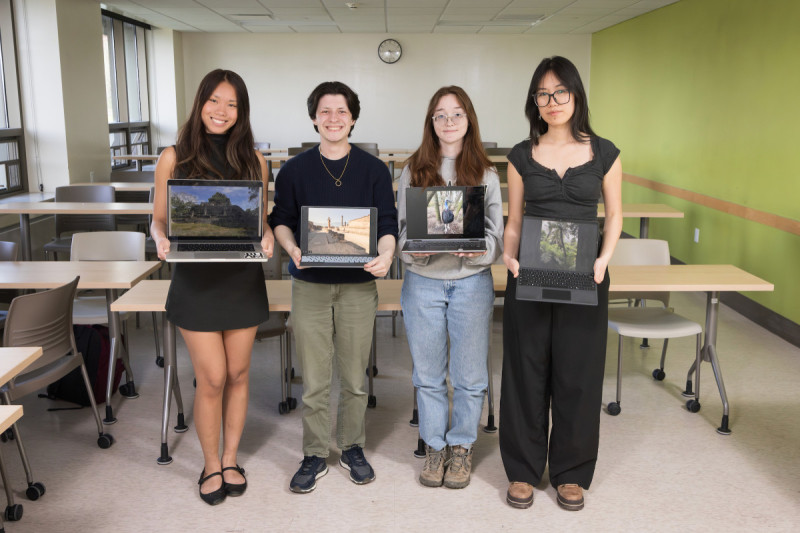
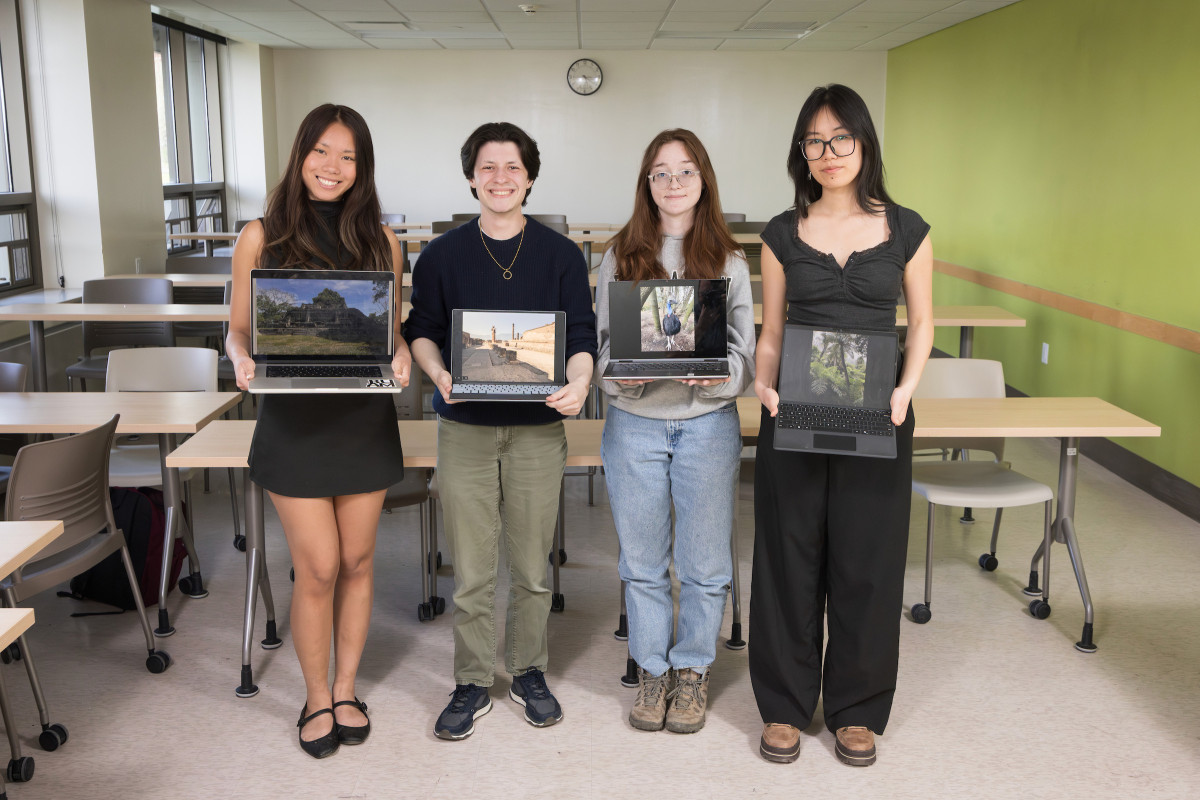
Whether it’s the sprawling pastures of Australia or the terraced mountain- side villages of Peru, Binghamton University undergraduates have traveled across continents and engaged in transformative research experiences thanks to the Provost’s International Internship Fellowship.
Since 2023, the fellowship has funded 26 students to research and study abroad in 12 countries under the mentorship of faculty members — covering all transportation and room-and-board expenses. Each cohort walks away with a stronger understanding of the “whole world outside of Binghamton” and their place in it.
“I’d never been out of North America,” says Sara Boudreaux, a junior studying biomedical anthropology through the 4+1 master’s program. “I had never been on a plane, so it was definitely a life-changing experience. It was amazing.”
For aspiring archaeologists such as Boudreaux, the fellowship allows first-timers to gain hands-on experience at sites containing more than 1,000 years of history. Under the guidance of Associate Professor of Anthropology BrieAnna Langlie, Boudreaux excavated artifacts in Achoma, Peru, to better understand Incan-Andean social relations, developing both practical field skills and proficiency in Spanish in the process.
It was also in Peru where she learned about environment-specific preservation methods, discovering sun-bleached bones that would crumble at the touch due to the dry, exposed atmosphere of the highlands.
“There are different methods that you have to use in different places,” Boudreaux says. “In the Peruvian highlands, it was super-high altitude; it’s very dry there. And so your excavations are going to look a lot different than they would look in New York.”
After connecting with Assistant Professor of Environmental Studies David Mixter as a sophomore, Rachel Aung, a junior majoring in anthropology, profiled underground Mayan temples and documented parts of ancient Meso-American civilization once lost to time. While it took time to adjust to 90-degree temperatures while trekking through the jungles of Actuncan, Belize, Aung says, “It was one of the best experiences” of her life.
Leaving their comfort zone and living in new countries gives students an opportunity to learn unexpected things. Rui Zheng, a senior double-majoring in environmental studies and geography, and Jenna Allen, a senior double- majoring in environmental studies and biology, initially joined Assistant Professor of Ecosystem Science Amber Churchill’s lab as undergraduates.
Over the summer, the pair conducted fieldwork in New South Wales — collecting environmental data and assessing the health of native grass species, with the goal of improving grassland resilience to extreme climatic events.
“The seasons were swapped, and the grass behaves differently,” Allen says. “Kangaroo grass turns red over the winter, and we’re measuring how green it is, and all of a sudden, it’s red. That’s something that I would not have known, or maybe even believed, if I didn’t see it.”
Zheng was struck by how the Australians plan their space usage and the value they place on ecology and environment. She also realized she would be open to having a career abroad.
Zachary Powell, a senior majoring in chemistry, traveled to Italy in the summer of 2025. Working alongside archaeologists, art historians, and conservators, including Associate Professor of Middle Eastern and Ancient Mediterranean Studies Hilary Becker, Powell analyzed elements used to color recovered glass and plaster pieces using an X-ray fluorescence machine.
“I took Latin all through middle and high school and was a Greek/Roman mythology kid growing up, so being able to see and work in Pompeii was a dream come true,” he says. “The samples were very site-specific, because they were preserved uniquely well. As such, it also felt surreal being surrounded by so much history.”
For Powell, traveling abroad through the fellowship and exploring the ruins that once captivated his childhood imagination was an unparalleled experience. But, regardless of which part of the world their research takes them, one thing remains constant: the possibilities presented by new cultures and broadened perspectives, bolstered by the support the fellowship provides.
“If you’re in the humanities, you probably already know this, but for myself and others in STEM: The world is so much bigger and more interconnected than a lab can ever offer,” Powell says. “Learning chemistry at Binghamton has been undeniably a beneficial experience, but being able to apply it to the real world and something as fundamental to humanity as art has had such a profound impact and been all the more encouragement to pursue a career in caring for cultural heritage.
“Outside of the research, any chance to travel is an amazing opportunity to learn about other cultures and expand your worldview, so it’s something I hope to be able to continue to do as I explore my future career.”